
This collaboratively reported story is part of the partnership between Silicon Prairie News and Technical.ly. Find more at technical.ly/omaha. This story is co-authored by Kaela Roeder, lead DC and Virginia reporter at Technical.ly.
Just a few years ago, the Omaha Public Power District, which serves the most populous metro area in Nebraska, expected its annual electricity demand to grow by just 4 megawatts.
That annual growth now is anticipated at over 100 megawatts “for the foreseeable future,” it said in 2024. “That’s the equivalent of adding 65 new metro-area high schools or midsize hospitals in just one year.”
One culprit drives this unprecedented power demand: Data centers. These constructs of computer processing are used for everything from artificial intelligence to making Google Maps work to mining for cryptocurrency.
In Nebraska, like elsewhere in the country, data centers, now part of an artificial intelligence gold rush, are pushing energy infrastructure to its limits. As a result, business and elected leaders worry that lack of new available power could stunt economic growth. Less capacity may mean fewer company relocations, new data centers and high-tech manufacturing facilities.
Meanwhile, in Northern Virginia, Loudoun County is considered the data center capital of the world, often referred to as “Data Center Alley.” It has about a third of the state’s 666 data centers, with many more in development. Nebraska, meanwhile, has just 39, according to Datacentermap.com, with most concentrated in the Omaha metro.
Loudoun’s power issues are exponentially larger, with a near-impossible scramble to provide for its data centers. But these needs will not slow down, said Del. David Reid, who represents a portion of Loudoun County in the Virginia House of Delegates.
“We cannot ask people to stop using the internet,” Reid said. “We cannot stop economic development.”
Perhaps Virginia can provide lessons to Nebraska on the utility and perils of data centers and their effect on energy capacity. As Nebraska struggles with a brain drain, wage and job growth crisis, the stakes of power availability are high.
“We’ve had clients who have gone and built facilities in other states that they wanted to build in Nebraska, because whatever utility … could not promise to get them power for six or eight years,” said David Levy, a Nebraska lawyer who works with developers. “You’re going to go invest your hundreds of millions of dollars somewhere where you can have certainty and get moving sooner.”
The bill comes due for economic development
In Northern Virginia and Nebraska alike, data centers have been a key economic development tool. For some Virginia locales, tax revenue from data centers can make up about 30% of total revenue, according to a report from the state’s Joint Legislative Audit and Review Commission.
But that development now leaves Virginia’s infrastructure on the hook to sustain its many data centers. Even today, some are only operating with 20% of the power they require, said Reid.
Between 2021 and 2025, energy use in Loudoun County spiked from 2 gigawatts to 5.3 — a 166% increase, according to a report by county official Mike Turner, who did not respond to requests for comment. A gigawatt is 1 billion watts of power, compared to a megawatt, which is 1 million watts. One gigawatt is enough to power almost 300,000 homes, or 100 million LED light bulbs.
Reports estimate that by the end of the decade, Loudoun may need 14 gigawatts to serve its power needs as AI use continues to rise. Right now it has only about 9 gigawatts in capacity. Local power company Dominion Energy has plans to bring more energy to meet demand, but not all of the power will funnel to Data Center Alley, according to Turner’s report.
Building new generation and power capacity takes years in the best of times. But as many other power utilities try to keep up with their own data center demand — including in Nebraska — inflation and supply chain issues are leading to longer delays and rising costs.
That means Virginia is running out of time to meet its energy needs. New solar power would have to be added at twice the rate it was in 2024, and additional offshore wind sites will need to be built, the JLARC report said. But that will be “very difficult to achieve.”
“With just the explosion of demand, I don’t know if there’s enough green power out there to offset how much power is going into data centers,” said data center investment expert Jeffrey Foster. “I think they’re gonna have to reassess how they achieve this.”
But there is also some speculation about how much energy will actually be needed in Northern Virginia. Andrei Afanasev, who researches nuclear power and energy demands, noted these projections are connected to business growth and expansions tied to artificial intelligence. There was a surplus of investment during the dot-com bubble, he said. AI may have a similar burst.
“Don’t take all the projections for their face value,” Afanasev said.
Addressing costs and consumer anxiety
As Virginia and Nebraska figure out how to manage their energy infrastructure, both are contending with rising costs and consumer anxiety due to data centers. U.S. metro electricity prices have increased by roughly 40% since 2020, according to Consumer Price Index data. Governor-elect Abigail Spanberger made bringing down energy bills a central point of her campaign.
While Nebraska electricity costs are among the lowest in the country, both OPPD and Lincoln Electric System, in the state’s second-most-populous metro, have pursued rate increases. So has Dominion Energy in Virginia.
No one foresees energy costs or demand going back down.
Policymakers in both states are also scrambling to address the power crunch. Earlier this year, Reid successfully advocated for a bill, signed into law, to incentivize data centers to build and use battery storage. Meanwhile, a Nebraska bill to increase taxes on data centers doing cryptocurrency mining was shelved.
Nebraska may look to Virginia to see what policy solutions stick amid a flurry of bills to regulate data centers.
But Nebraska also has a leg up on Virginia. With a much smaller data center footprint, Nebraska is less on the hook for energy needs. And while future capacity is a concern, Nebraska utilities say they are set to provide reliable power for current needs into the next decade while still keeping rates relatively low.
In this, Virginia may have something to learn from Nebraska. Municipalities and local power utilities have stayed out of the rush to build data centers and instead taken a more considered approach.
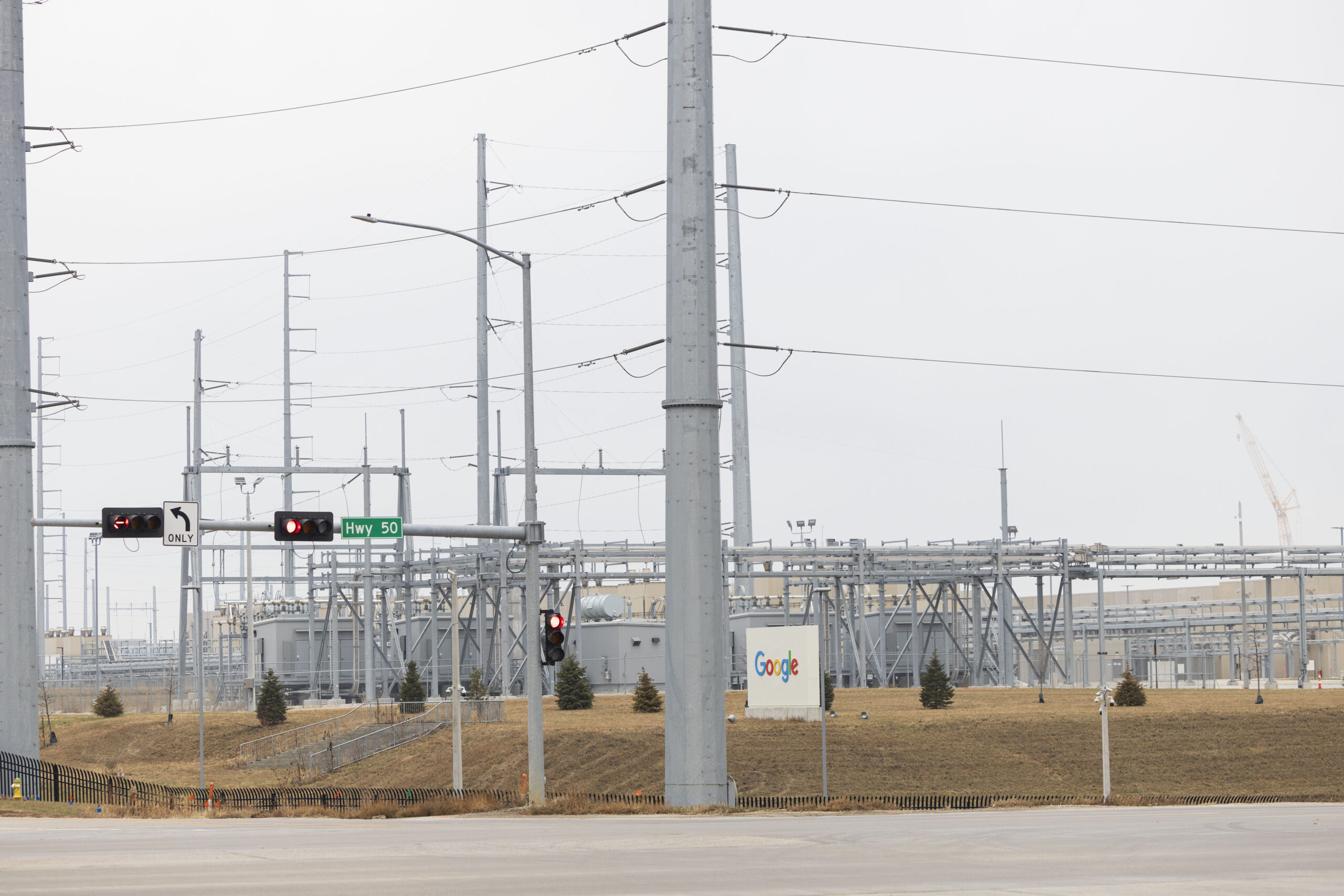
For example, OPPD and LES require large industrial customers to pay for their own substations and other infrastructure, as Google agreed to do for its new Lincoln data center.
“Right off the bat, you make sure that there’s going to be no risk … that’s put on the backs of our existing customers,” said Scott Benson, manager of resource and transmission planning at LES. “It all comes down to how you structure your agreements and arrangements with these large customers.”
Dominion Energy in Virginia is starting to take a similar approach. A new proposal would lock data centers into a 14-year contract to pay for energy infrastructure, even if they use less energy than projected or don’t build at all.
That’s also a safeguard against long-term uncertainty. Observers widely see the rush for AI in data centers as a bubble, with little clarity about how projections will play out. “Who knows if our load is going to grow exactly the way we forecast?” Benson said. “Who knows if all of our existing generation assets are still going to be in play at that time?”
Lev Gringauz is a Report for America corps member who writes about corporate innovation and workforce development for Silicon Prairie News.




Leave a Reply