Nebraska families are under pressure with a lack of affordable and accessible child care, leading parents to avoid promotions, take part-time instead of full-time work, miss more work days and sometimes exit the workforce entirely, according to a new report from the Nebraska Chamber Foundation.
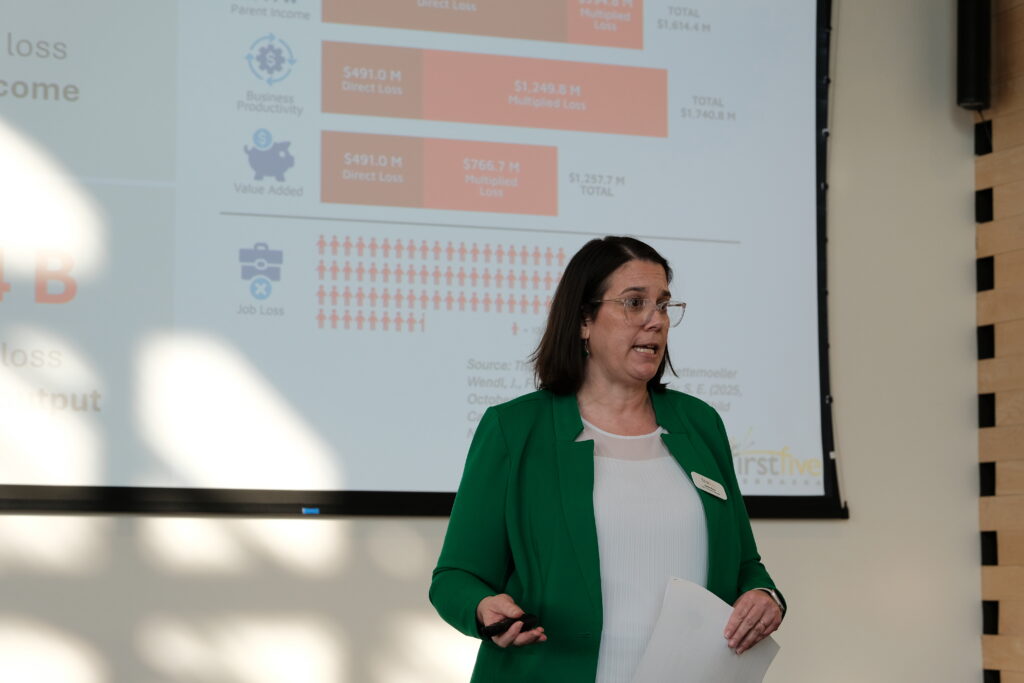
The need — and its effect on the state — has gotten much worse over the past few years. Child care struggles now cost the state $1.74 billion annually in business output, with roughly the same in lost income for parents, the report said.
That’s double the economic impact measured in a 2020 report on child care in Nebraska. It translates to an almost $64 million annual loss in income tax revenue and 6,843 fewer jobs in the state. Parents with lower incomes especially feel the squeeze.
“Families who make less than $100,000 per year are not utilizing licensed child care (at the same rate as wealthier families), but they’re also twice as likely to say child care is a reason why they had to quit a job or change a job,” said Katie Bass, policy research manager at First Five Nebraska.
Bass spoke Nov. 12 at a Greater Omaha Chamber housing and child care event that focused in part on the new NCF report. Researchers from First Five Nebraska and the Bureau of Business Research at the University of Nebraska-Lincoln wrote the report.
For business, community and elected leaders, this updated data makes child care an essential part of solving Nebraska’s brain drain, wage and job growth crisis.
“We are working on creating great jobs for people,” said Josie Schafer, the director of the Center for Public Affairs Research at the University of Nebraska at Omaha. “But it’s not going to be enough. We’re going to have to look at these broader systems … it’s not just about the jobs — it’s this overall quality-of-life picture.”
Greater Omaha Chamber panelists talk creative solutions
The NCF report covers efforts to address the lack of child care across Nebraska. Some communities are addressing the need with a public-private partnership.
In Norfolk, for example, local leaders created the Norfolk Area Childcare Collaborative. Half of the child care slots are reserved for employees of businesses sponsoring the initiative.
But sometimes, businesses feel they have to take matters entirely into their own hands. TMCO, a manufacturing company in Lincoln, used to work with a nonprofit child care provider. About a year ago, that provider suddenly closed.
For CEO Diane Temme Stinton, it was a wake-up call about the fragility of the child care industry — and the need to have a facility in-house. Doing so is even more important for her given that 40% of her 230 employees are immigrants or refugees from about 19 countries.
“We’re dealing with a population of children that are going to start at a deficit,” Stinton said on a Greater Omaha Chamber panel. “They’re not going to be kindergarten ready unless we provide the tools for the family and the children.”

Sports-tech giant Hudl also decided to tackle child care for its employees, contracting with Primrose Schools to open an on-site facility in 2023.
“What started as, ‘Hey, this is a really nice-to-have for a handful of employees’ has now turned into, ‘This is vitally important for me as a mother or as a father if I want to continue working at Hudl,’” said Mark Ketcham, Hudl’s vice president of operations.
Some housing developers are also trying to find ways to help with child care infrastructure — though they have faced their own setbacks. A decade ago, Hoppe Development in Lincoln integrated a Head Start center into a build-out of affordable housing in Grand Island.
But Head Start pulled out of the project, leaving the center empty, said Jake Hoppe, managing principal at the firm. More recently, in Fremont, Hoppe Development received a $350,000 grant to build a child care center, but there wasn’t enough other funding for the $1.4 million project.
“We’re kind of stuck thinking, ‘Okay, well, this center-based model is challenging as a developer to catalyze,’” Hoppe said. Now, the firm is changing tack. Instead of trying to build expensive centers, it’s focusing on enabling cheaper home-based child care.
“We could easily pick any unit in a development that we do and say, ‘OK, that unit is going to be pre-outfitted for home-based care,’” Hoppe said. Hoppe Development is working with child care experts on the best layout to build in a home setting.
The firm could also flex its influence on zoning and homeowners associations for its developments to allow child care, Hoppe said. Across the country, HOAs have become a significant barrier to accessible and affordable child care.
Senators want to help, but budget and attitudes hamper efforts
Several bills have been introduced at the Nebraska Legislature in recent years to help with child care needs in the state. But policy wins aren’t straightforward.
Take an expansion of eligibility for the federal child care subsidy, introduced by State Sen. Wendy DeBoer and passed into law in 2021. In the first two years of the expansion, it helped over 2,500 families access the subsidy, with a roughly $5-9 million positive economic impact.
But in 2026, the increased eligibility will sunset from serving families at 185% of the federal poverty level to 130%. That would leave Nebraska behind almost all other states for child care subsidy access.
To avoid this, DeBoer is pushing LB 304, a bill to permanently keep the expanded eligibility. “The governor, everybody’s talking about not just brain drain, but attracting people to the state,” DeBoer said at the Greater Omaha Chamber event.

“If your choice is between a job in Des Moines and a job in Omaha, and the difference is, in Des Moines, you’re going to get child care subsidy, and you’re not in Omaha — which are you going to choose? It’s not even going to be a question.”
But as Nebraska’s budget deficit has ballooned to almost half a billion dollars, finding the money to keep the expanded eligibility will only become more difficult. Another barrier is elected officials who say the government shouldn’t be involved in child care.
“There’s a lot of talk out there, especially from the executive branch, about how government is a business,” said State Sen. John Fredrickson. “Government is not business … (it) exists to ensure that the citizenry is safe, that basic infrastructure is available, education is available. And I think when you consider the well-being of communities and the constituents that government serves, certainly housing and child care are included in that.”
Some Nebraskans are fed up with the constant finger-pointing between lawmakers and business leaders. What’s needed is coordinated statewide action, TMCO’s Temme Stinton told the Greater Omaha Chamber audience.
“We can point to anybody in this room, like, ‘Why don’t you do something about it?’” she said. “It’s not enough for us individually. The question is, do you care about the future? Do we care about our community? And if we do, then where’s the investment? Where’s the leadership?”
Lev Gringauz is a Report for America corps member who writes about corporate innovation and workforce development for Silicon Prairie News.