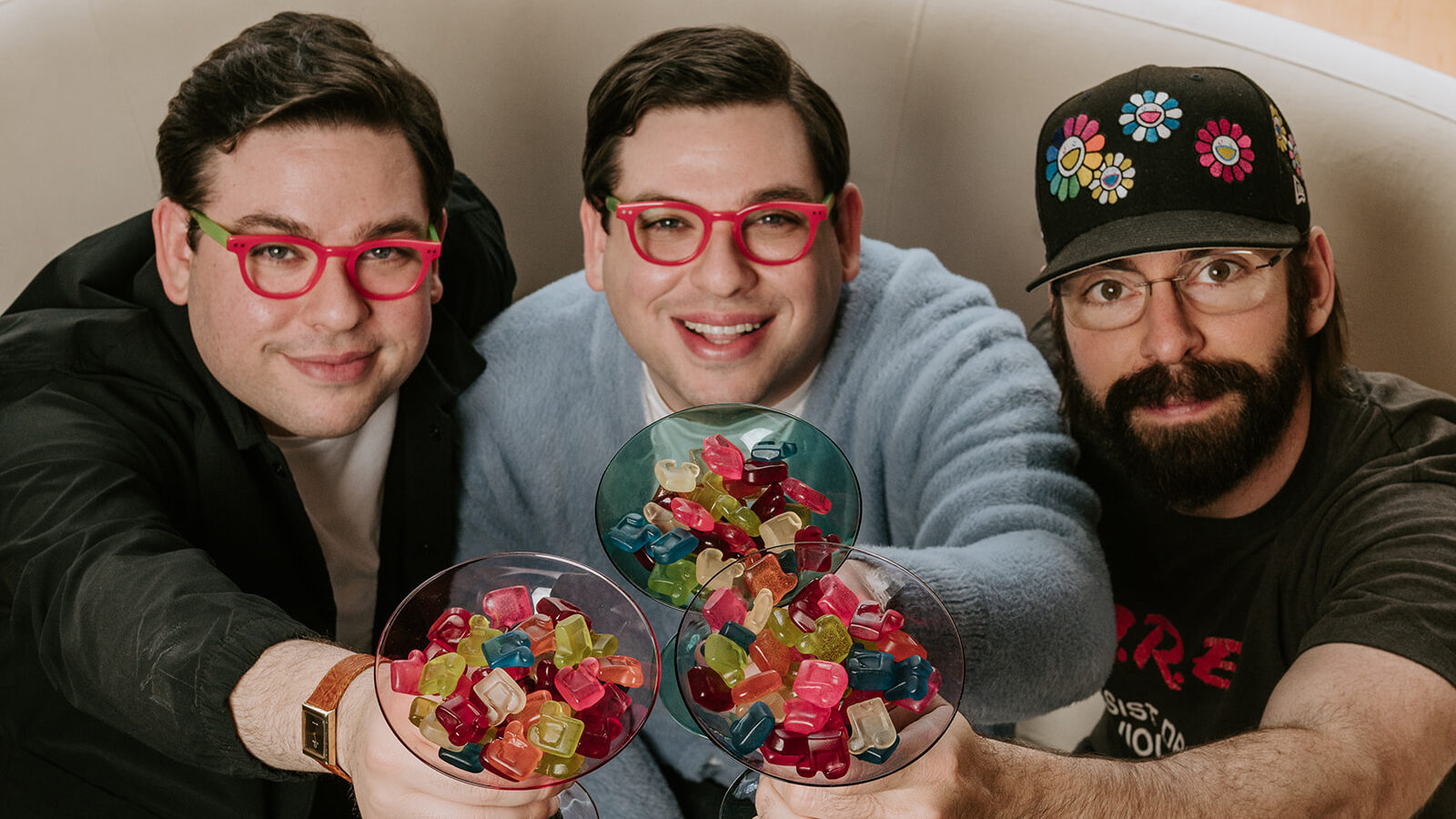
When Ezra and Adeev Potash were growing up in Omaha, they learned that candy wasn’t a finished product but a platform for artistic taste. The twins would bring a sweet haul back from the store and get to perfecting it.
Gummies that passed the flavor test but were too soft and marshmallow-y were left in an open bag to dry age, or tossed in the fridge or freezer to firm up for the right chew.
“We would season other snacks with lime or add salt or add other ingredients to it,” Ezra said. “We knew exactly what we wanted.”
As the brothers rose to fame as jazz and pop musicians — Adeev plays the trumpet, Ezra the trombone — and became food television hosts, they kept experimenting.
Today, the twins have a vehicle for their perfect gummy in Sweet Stash, a candy startup they co-founded with actor and comedian Martin Starr. The Omaha-based company released “Jams,” its first product, in 2025, and announced sour and crunchy variations at the Las Vegas Sweets & Snacks Expo in May.
Sweet Stash was also recently named “Startup of the Year — Consumer Product Industries” by The American Business Awards.
But the success of Sweet Stash isn’t just a venture of love for candy. The startup is a showcase for both an effort to change the candy industry and a journey in innovation made possible by Sprinkk, a candy development startup in Omaha.
For the Potash twins, who also happen to be Nebraska’s first composer laureates, Omaha has been a cornerstone of their careers. The same can be said for Sweet Stash, which benefited from a series of uniquely Omaha- and Midwest-related happy accidents.
It’s a story the twins want everyone to know. “Our fight has always been (that Omaha) is one of the most amazing places in the world,” Adeev said.
“We want to keep it a secret, but a secret can also be a bad thing,” he said. “Because no one will come here if it isn’t for Warren Buffett’s shareholders meeting or for the College World Series.”
Back to basics
In 2022, the Potash brothers met Martin Starr at a Kansas City charity event. The night included a friendly debate over who loved candy more.
But after visiting Starr’s home in Los Angeles and seeing cupboards stuffed with candy from around the world, the brothers accepted that they had met their equal. The friends also bonded over their dislike of synthetic food additives and coloring in candy.
The trio’s concern over food additives is shared by a majority of Americans, according to polling from KFF, the health policy nonprofit. Those worries also helped spark the “Make America Healthy Again” movement.
But before the MAHA movement gained widespread traction, Starr and the Potash twins were already cooking up their dream gummy to avoid those issues.
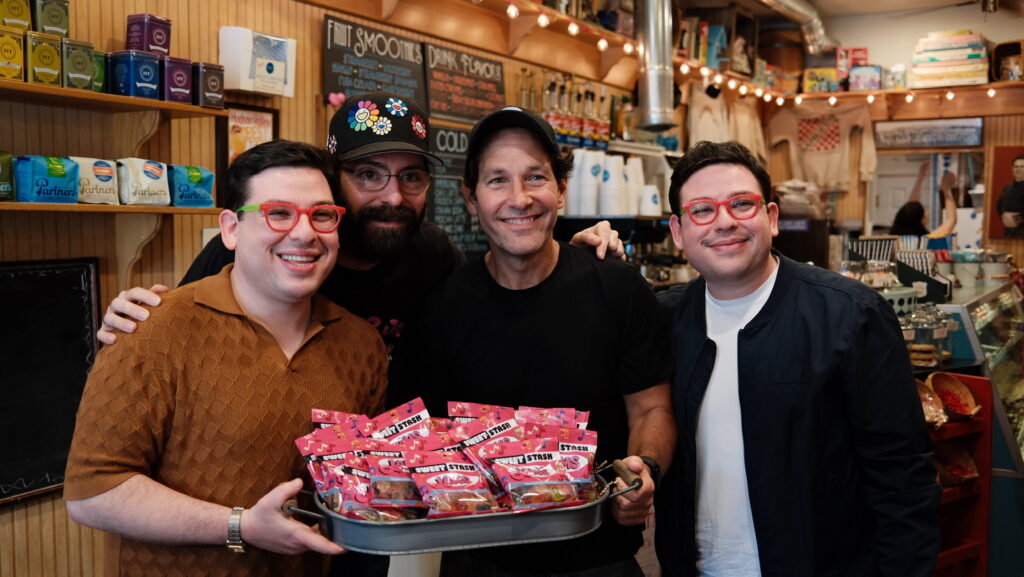
The gummy had to have a complex flavor and be made with simple ingredients and no corn syrup or synthetic food dyes. Doing so was a way to rethink health in the candy world.
Instead of a sugar-free alternative to sweets, Sweet Stash would be a proud and straightforward treat. “We are humbly aware that what we’re making is not an energy bar (or) a salad,” Starr said.
“We’re just trying to make something that we love as good as we possibly can,” he said. “So if you are going to eat candy, we can offer you an option that is at the peak of value and flavor and quality.”
From dream to tastebuds
Tessa Porter has seen up close how the candy industry struggles to innovate. As a food scientist, she saw many new ideas get squashed by the economics of manufacturing.
For candy companies to make a profit, they have to produce at least tens of thousands of pounds of product on large manufacturing lines. Adjusting for each test batch is costly, and every risky new idea — if it doesn’t find an audience — can result in an expensive pile of waste.
“That creates this incredible gap in innovation of, we can do something in the lab — and now we’re going to scale it to a 100,000-pound run?” Porter said. “What happens if it goes wrong? Which — it’s the first time running it — there’s a great probability that something will go wrong.”
This risk also makes it difficult for new candy companies, such as Sweet Stash, to find a manufacturing partner.
But that’s why Porter moved back to Nebraska and created Sprinkk, her candy development startup. With a research lab in Omaha and a small manufacturing facility in Albion, Sprinkk was designed to make candy innovation and small batch production accessible.
And one day in 2024, Yonatan Dotan came calling. Dotan, a childhood friend of the Potash twins who also grew up in Omaha, is the CEO of Sweet Stash.
After reading a story about Sprinkk (which may well have been from Silicon Prairie News), Dotan decided to pitch Porter on Sweet Stash. The local connection made the startup feel “like the right thing to do,” she said.
So Porter took a bet on a group of fellow Nebraskans, despite their inexperience with candy-making, and joined Sweet Stash as a co-owner.
The startup was now ready to create its gummy, test the market and prove itself to larger manufacturers. Without Porter, “I don’t know what else we would have done,” Dotan said. “I don’t know how somebody would have taken us seriously.”
Music meets candy
Ezra and Adeev Potash brought their passion for music into Sweet Stash. “I want to consume music by people who are obsessed with making it, and I want to eat gummies from people who are obsessed with making gummies,” Adeev said.
The team put together detailed briefs about every flavor they wanted for their “Jams” gummies, aiming to create an orchestral journey of taste. That made it fun for Tessa Porter as she translated ideas to real flavors.
“As musicians, they talk a lot about the orchestra, of all of the parts, and we brought that into the candy as well,” she said. “Instead of eating the whole bag at once, if you taste them slowly, there is an intentional beginning, middle and end to the flavors.”
In the fall of 2024, the team kicked off a development process by trying as many as seven versions of proposed flavors. “We’d already tasted this candy in our heads,” Ezra said. “We had to now download that onto somebody that could make it exactly to the specs that we created.”
Some were immediate winners, like “prickly pear.” Some took more time to perfect, like “orange,” and others created havoc in the group. “I just remember trying to split the atom on … peach,” Ezra said.
“We were like, ‘This one has a better fuzz at the end, and this one has a better concentrated peach flavor at the beginning,’” he said. “That was a whole several-week debate on trying to pick one peach versus another peach after having tried 30 other peaches.”
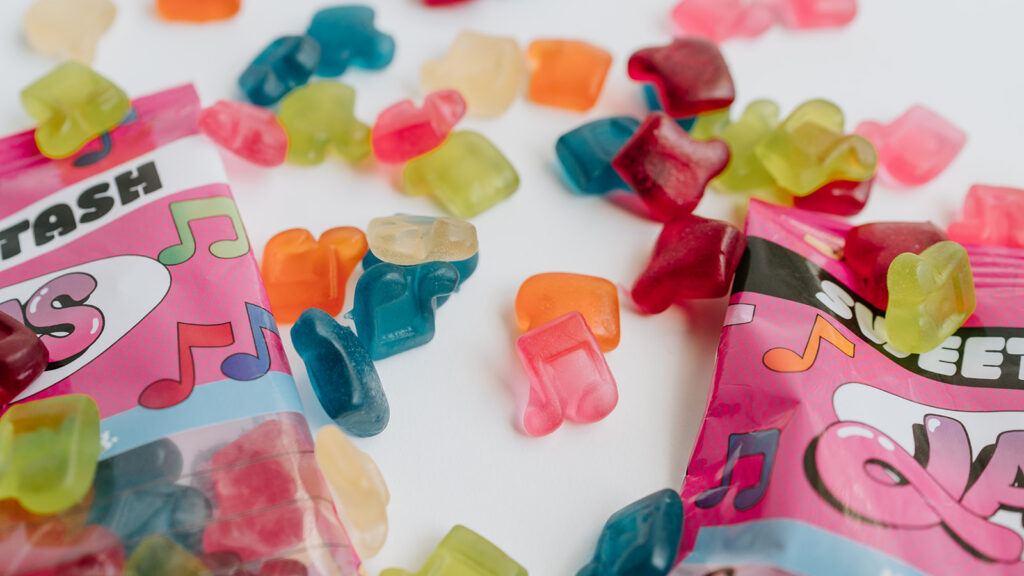
By early 2025, they had settled on six flavors for a music note-shaped gummy on the chewier side. “We’re extremists in the texture department,” Adeev said. Now it was time for the public to taste the group’s vision.
Giving back to Nebraska
Sweet Stash’s initial run would be for roughly 6,000-7,500 pounds of gummies. But getting to that capacity was a trial by fire for Sprinkk’s Albion facility.
At the time, a manual system meant Sprinkk could produce only about 50 pounds of candy every week. From February to May of 2025, Sprinkk installed an automated system that could produce about 1,000 pounds of candy a week, creating a chain reaction of problems to solve.
“We were still figuring out how that equipment even worked; (it) came with no manual,” Porter said. “The machining of the (gummy) nozzles themselves. Do we have the right springs in them for the right tension? … Now we have to batch 1,000 pounds a week. What does that process look like?”
At the same time, Dotan was figuring out Sweet Stash’s retail presence. That’s where the Omaha business community came to the rescue. He connected with Maverick Distribution, which helped Sweet Stash get into over 300 locations in the Midwest, including Mega Saver gas stations.
The Potash twins also made it a point to build a relationship with Omaha Performing Arts (OPA), the organization that operates venues like the Holland Performing Arts Center. Part of the proceeds from each sale of Sweet Stash at its venues goes to supporting OPA.
OPA “gave us a start very early on, and one of the reasons we love Omaha is because they take care of their own,” Adeev said. “We didn’t see a future in Sweet Stash’s success where that wasn’t also giving back.”
Now generating revenue, Sweet Stash has outgrown Sprinkk’s Albion facility and is increasing production with a manufacturing plant in Chicago.
The move is a bit of a dilemma — on one hand, necessary for growth, and on the other hand, part of a cycle of Nebraska-raised startups needing support from outside of the state to grow.
That’s par for the course with the state of candy manufacturing. “There was no one to talk to in Nebraska,” Dotan said. “If there had been, we would have been all over that.”
Porter and the Sweet Stash team would love to, one day, have a larger facility in Nebraska to make all of the startup’s candy. But with industrial candy machinery costing upward of $30 million, it will be a while yet before that becomes a reality.
And while Sweet Stash may one day take venture capital, for the moment, the team is staying lean.
There’s little interest in worrying about equity or exits. “We built this company to change the face of the candy industry,” Ezra said.
“We thought (the candy industry) was steering in the wrong direction, and we got in to help push it back into the right direction,” he said. “For us this isn’t just, ‘Oh, let’s then hand that machine over to a company that’s going to pull it back into the wrong direction’ … If there’s a day that we sell, it would be to somebody that understands exactly why we did it.”