
Over the past few years, as the artificial intelligence revolution enamored the business world and AI chatbots became ubiquitous for personal use, the College of Saint Mary tried to figure out what to do about the technology.
Could AI help staff, faculty and students in an educational context? If yes, then how? And what was the best way to implement it?
“We were inundated by all the same (marketing) all of you are: ‘Buy this. This product can do this for you. Special offer, rush in,’” said Jeff Keyte, chief AI officer and assistant dean of graduate studies at the College of Saint Mary, when presenting at the OMAxAI conference in late June. “What we figured out is that, before we really do anything, we need to have a cohesive framework.”
At OMAxAI, the University of Nebraska at Omaha’s premiere AI event, Saint Mary staff walked through what other local businesses and institutions can learn from their AI journey and showed an inside view of how the educational world is grappling with the technology.
A spring student survey emphasized the anxieties that come with AI. Most students said they are comfortable with AI tools and use it to study.
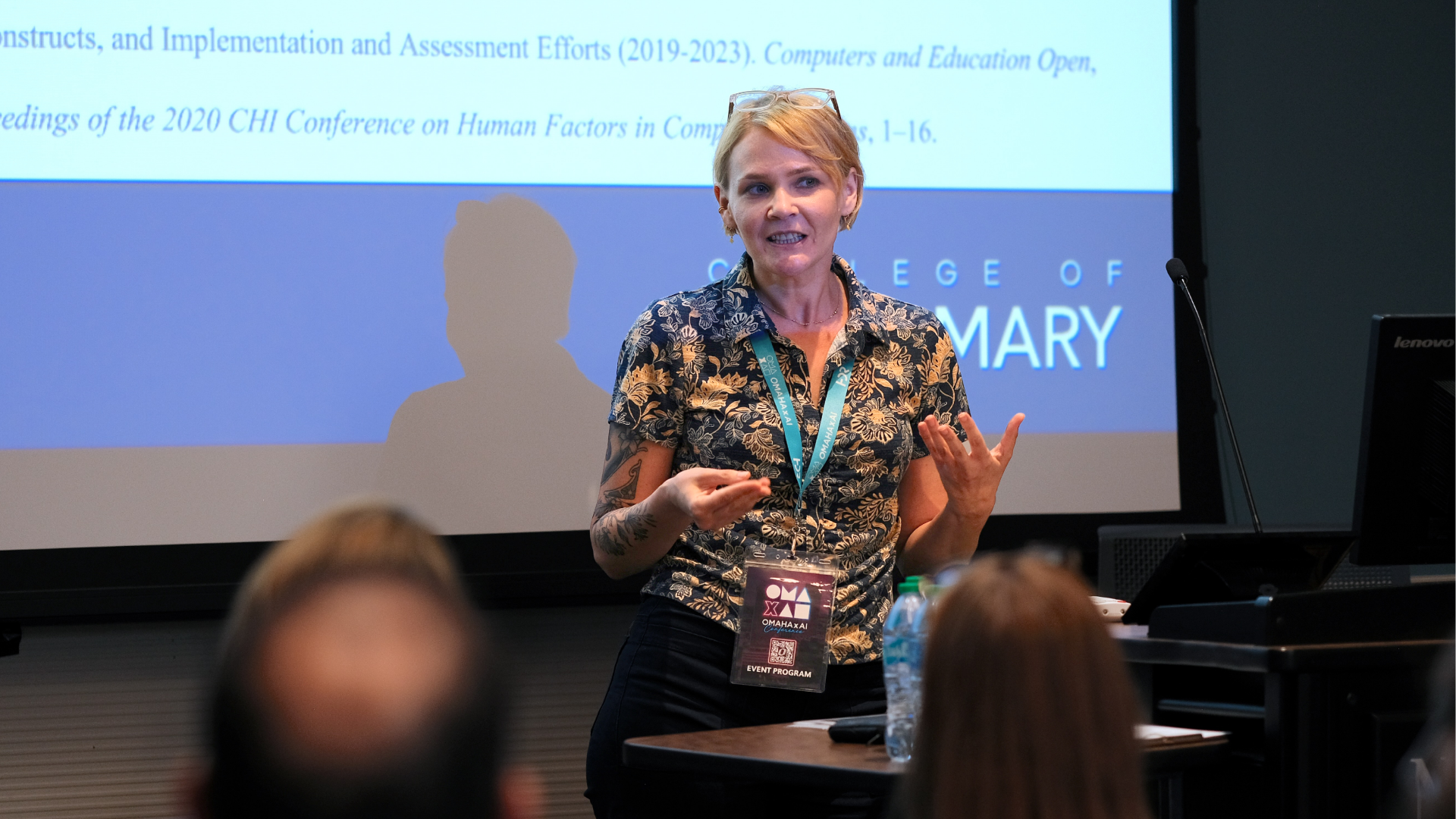
One student wrote that “they used AI to further their understanding of a topic, so that they can complete the work, and not to produce the final product for them,” said Hannah Winchester, the education and research services librarian at the University of Nebraska Medical Center-McGoogan Health Sciences Library.
Winchester previously worked at the College of Saint Mary and was part of the institution’s AI adoption strategy.
But students are uncomfortable with AI use by their professors, especially if it is not disclosed. Survey respondents said they were against AI-generated lecture materials and graphics and worried they might include wrong information hallucinated by AI.
Students were also “uneasy about AI grading practices, and they felt like they wanted to make sure there was the human on the other side, especially because it affected their academic record,” Winchester said.
Winchester’s takeaway is a kind of “asymmetry” with AI use that is likely common outside the classroom, too. She did not mention other examples, but businesses are implementing AI across HR and job application processes that feed a similar frustration with workers.
Navigating the CLEAR framework
To guide its AI implementation, the Catholic women’s college settled on the acronym CLEAR, which stands for critical, literate, equipped, active and responsible.
The acronym guide isn’t necessarily about doing each facet in order. Keyte, the chief AI officer, started with E — getting equipped — with a $4,000 exploration grant.
“I went to eBay, I bought a server that could hold a bunch of (graphics cards to run AI models). I then bought a bunch of GPUs, stuck them all together,” he said. “What that did is it gave us … a foundation.”
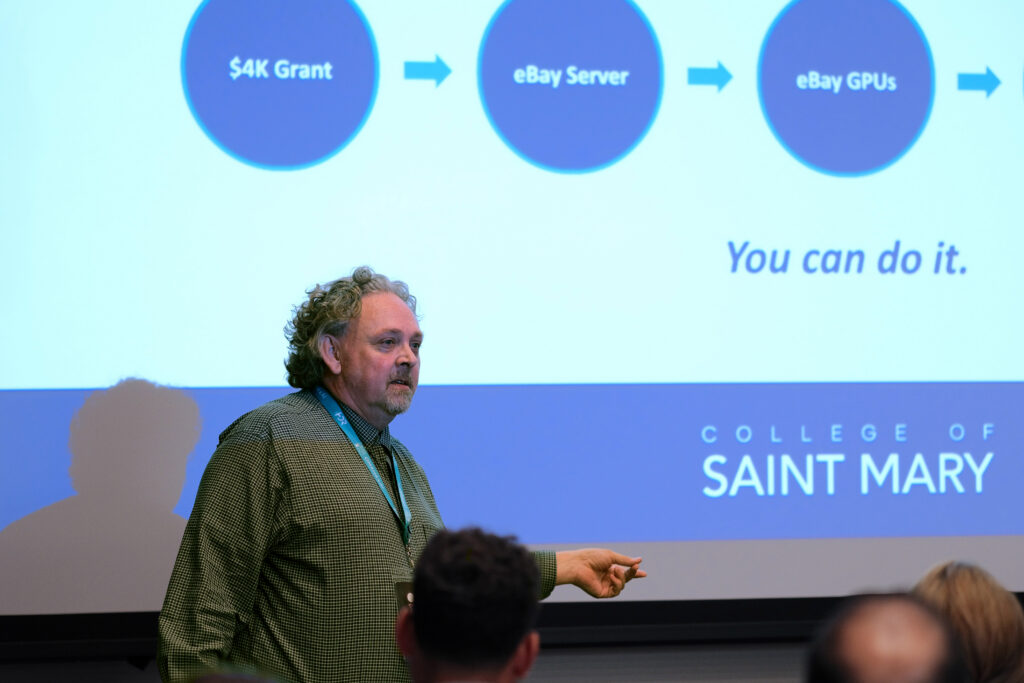
But quickly, Keyte realized his makeshift AI server was a bust. It was too weak to use. So the college pivoted to using the AI services offered through Microsoft Azure, the cloud data hosting service.
Two aspects of Azure were essential to the college. First, Azure offers secure servers that are compliant with FERPA, the federal student data privacy regulations. And second, the college could pay based on its AI usage. That helped speed up an AI rollout in April 2025.
“We’re a small college, grand total about 1,100 (students) in a really good year,” Keyte said. “So we need pay-as-you-go, we can’t afford a lot, and this gave us that opportunity.”
Winchester took the lead on figuring out the critical and literate parts of CLEAR to guide students and staff. That involves understanding, even if at a basic level, that AI chatbots are designed to sound accurate, encouraging and appealing to users.
That means a chatbot might present a wrong answer or a hallucinated response with full confidence. People need to be able to evaluate AI outputs and check if they are real.
“I’ve searched for an article, and everything looks great. The author exists, the article is in their actual area of expertise. The journal exists. It all passes every single plausibility check — except for (the academic article itself) actually existing,” Winchester said.
One experiment Winchester did to better understand AI was to create Alice, a kind of librarian chatbot. Where Winchester had to go home and sleep, Alice could be the first stop for students doing research on a Monday night. Winchester’s experience is applicable to more than just the college setting, she said.
“I think three questions really travel: Where does your community want a human and not a model?” she said. “How can you customize your tools to better help your community? And are you teaching people to use these tools, or just letting them loose on them?”
For the last parts of CLEAR, being active and responsible, Keyte brought up the AI tensions between students and faculty again.
“We’re already starting to hear pushback (against) people when they say, ‘Oh, sorry, AI wrote that, I’m sorry it wasn’t accurate,’” he said. “Students will eat you alive for that … The student doesn’t care whether you did the work or the AI did the work, they’re going to hold you responsible for the outcome.”
Taking responsibility for AI use also extends to concerns about its environmental impact with water and energy usage. In Keyte’s view, that’s something users need to mitigate by being smarter with their AI use.
Many tasks don’t need AI or need to be run on an expensive and power-hungry AI model. Responsibility also extends to bias in AI and making sure any generated images or materials don’t perpetuate bigotry, Keyte said.
Learning how best to use AI, though, is about actively using it. Keyte described himself and the attendees of OMAxAI as “early adopters” of the technology, often working side by side with people skeptical or outright afraid of AI.
Not using AI will lead to more distrust and fear, he said. The early adopters need to make experimentation easy and safe if they want better AI use in their workplaces.
Another aspect of being active in AI is navigating the thorny moral implications of the technology. AI models have been trained on copyrighted material, often in ways alleged to be illegal.
And there are widespread concerns about the use of AI for surveillance, deepfakes that erode trust and how the technology can drive vulnerable people to suicide.
But “use does not imply agreement,” Keyte said. “Just because you don’t want it to exist, that doesn’t mean you can ignore it. In fact, I would say if you hate it, become an AI expert — kind of how I started. Because the more you know, the more you can affect how this new technology is going to change the world around us.”

Leave a Reply