
Buildertrend has a problem. The construction project management company helps contractors manage their work with a centralized software, coordinating across billing, scheduling and communication needs.
But sometimes, contractors hit a roadblock. There is some issue in Buildertrend’s platform that confuses them or stops them from getting work done.
“Construction runs on thin margins … so, when something goes wrong, it’s expensive and it’s visible,” said Madeline Anderson, director of technical program management at Buildertrend. “As a unified platform, we have busy hands-on customers in a high-pressure industry where time and clarity are everything.”
Problem solving can mean looking through Buildertrend’s help articles or watching a video on the company’s learning platform. If that doesn’t work, then customer service gets a call.
Buildertrend’s average support call time is 10 minutes, plus five minutes of being on hold. By the end of the journey, a contractor has spent about 45 minutes to solve one issue.
“Forty-five minutes for one person doesn’t seem like a lot if it’s once, but he has questions all day long,” Anderson said. “And it’s not just him, it multiplies across every customer.”
So in February, Buildertrend deployed Bailey, a new artificial intelligence chatbot to help clients. While still in its infancy, the chatbot has already reduced the usual customer help journey to around 20 minutes.
Now, almost a third of all customer issues are resolved without escalating to a human representative, letting Buildertrend’s customer support team spend more time on harder problems, Anderson said.

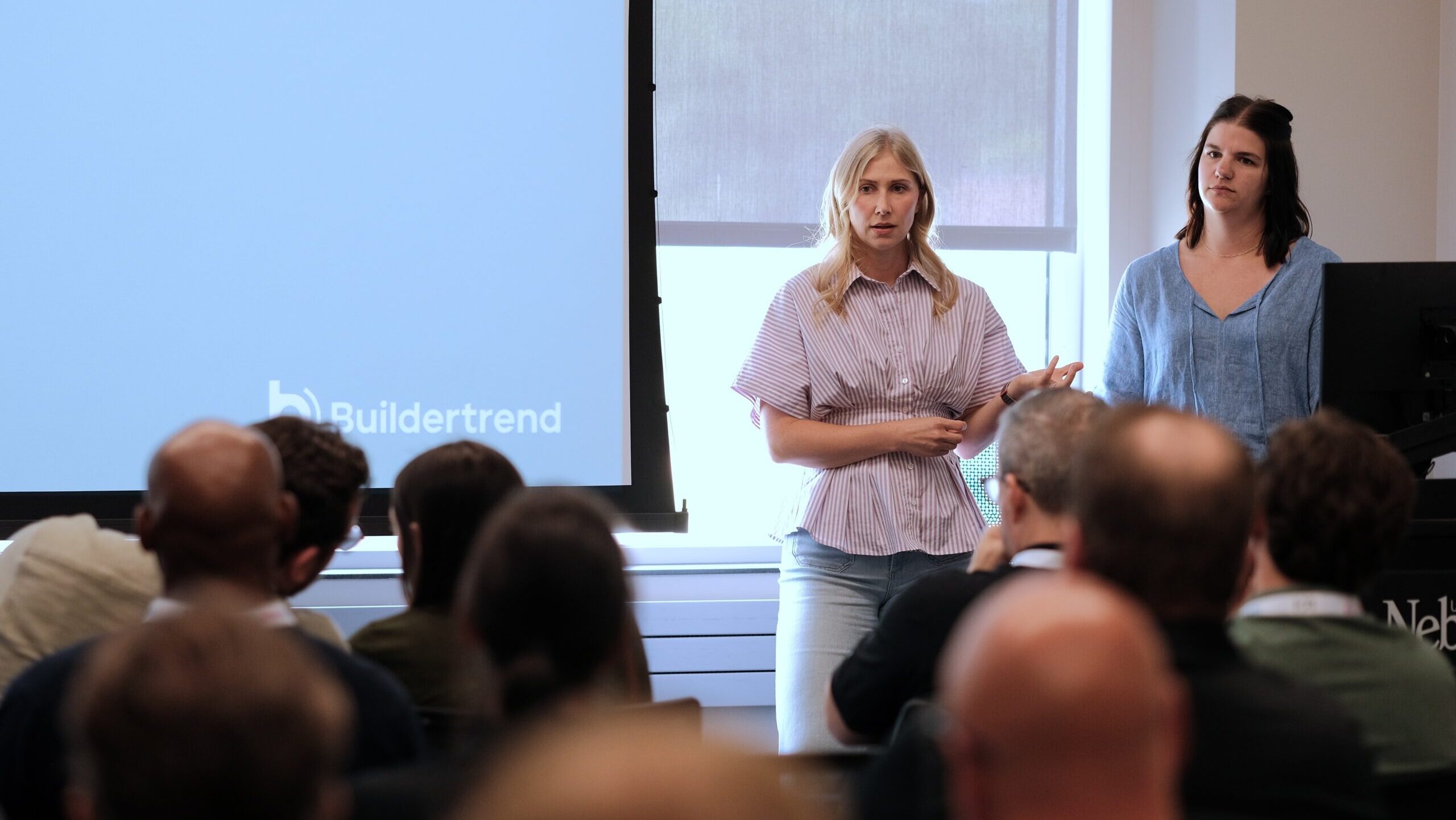
On June 30, at the OMAxAI conference at the University of Nebraska at Omaha, Buildertrend gave attendees a behind-the-scenes view on how the company approaches AI, how they built the Bailey chatbot and how the team navigates the pitfalls of the technology.
Principles and application
Buildertrend settled on three core AI pillars. The first is to focus on solving real customer problems with AI. The second is to have AI be a core part of Buildertrend’s platform. And the third is to deploy regular, smaller updates integrating AI into the company’s software.
“We’re shipping iteratively, we’re not waiting for one big launch,” Anderson said. “Customers see value sooner and then we learn faster … this also signals to the customers that AI and Buildertrend keeps getting better over time.”
This approach is solidified by a culture shift at Buildertrend. All teams, from software to sales, are expected to use AI to bolster their work.
Internally, Buildertrend had talked about an AI customer support chatbot over the last year and a half. In October, they decided to actually build it, spending the next five months developing Bailey through Salesforce, which Buildertrend uses as its customer relationship management platform.
Tylene Lucas, a staff solutions architect at Buildertrend, is in charge of the Bailey chatbot. Much of her work is to give Bailey the right guardrails so it is respectful and helpful with customers — and so Bailey doesn’t hallucinate wrong answers and pretend they’re right.
“We tell the model exactly who it is, right from the start: that they’re a customer support assistant at Buildertrend,” Lucas said. “This anchors everything in the response that it gives, the tone, the persona, so that everything comes sounding from Buildertrend, not a generic chatbot.”
Bailey’s instructions also include “very explicit, numerous” reminders for the chatbot to only use Buildertrend’s internal help documents — and not information the AI model was trained on — to answer questions. That cuts down on the likelihood for hallucination.
Bailey is also trained for “graceful failure and follow-up,” Lucas said. If Bailey can’t answer a question, it simply apologizes and escalates to a real customer support representative.
Early days
Continuing to develop Bailey is its own challenge. As a chatbot, it can answer questions in different ways, each of which might be right. But those answers need to be evaluated for clarity.
As a result, Lucas has a mountain of transcripts to sort through from Bailey’s conversations with customers. She uses a different AI tool to figure out what went wrong in unsuccessful interactions. Did Bailey misunderstand a question because a customer misspelled words? Did the customer get upset because Bailey didn’t give a very good answer?
“I made changes to the prompts and how the model answered it, and then I’m comparing what it said before to what it is now, and I’m like, ‘Oh, that’s a lot better than what it was,’” Lucas said “So there’s a little bit of both human and high ingestion (with AI).”
During a Q&A session at the end of the presentation, attendees seemed interested in the Bailey chatbot but also cautious about its longevity and impact.
One questioner brought up that, anecdotally, people quickly get chatbot fatigue and go back to wanting a human customer service representative. So how is Buildertrend planning for that?
“We’re trying to determine now, how do we get this information and the updates we’re making to Bailey to our customers? What is impactful to them and what is not?” Lucas said. “We have not figured that cycle out yet, but we’re hoping to try to figure out a way to say that, ‘Hey, there are updates, stop just saying ‘Ask for a human’ or something like that’ — but in an appropriate way.”
Asked how Bailey affects Buildertrend’s customer representative team, Anderson said the chatbot’s use has been positive. Buildertrend isn’t trying to replace human employees and isn’t laying them off.
Though just a few months in, Bailey signals a way to help clients, save time and reduce costs for Buildertrend. “Fewer escalations and more deflections is really what drives that cost per resolution down,” Anderson said. “We can’t yet claim really that this has amazing adoption, (but) the early signs are positive.”



Leave a Reply