
Today’s artificial intelligence tools promise many benefits, from boosting productivity to making coding more accessible. But AI also can be used for creative cyberattacks on businesses, governments and such critical infrastructure as water treatment plants and hospitals.
“It’s just a really challenging ecosystem,” said Matt Hale, an associate professor of cybersecurity at the University of Nebraska at Omaha. “It becomes this cat-and-mouse game, where, as those adversaries increase their capacity with these new tools, we need detection strategies and mitigation strategies (and) compartmentalization at an enterprise level that prevents and limits damage.”
For Hale, defending against those attacks in a fast-changing environment requires good workforce development. Cybersecurity professionals need to be able to think strategically and deploy security measures across a range of different tools.
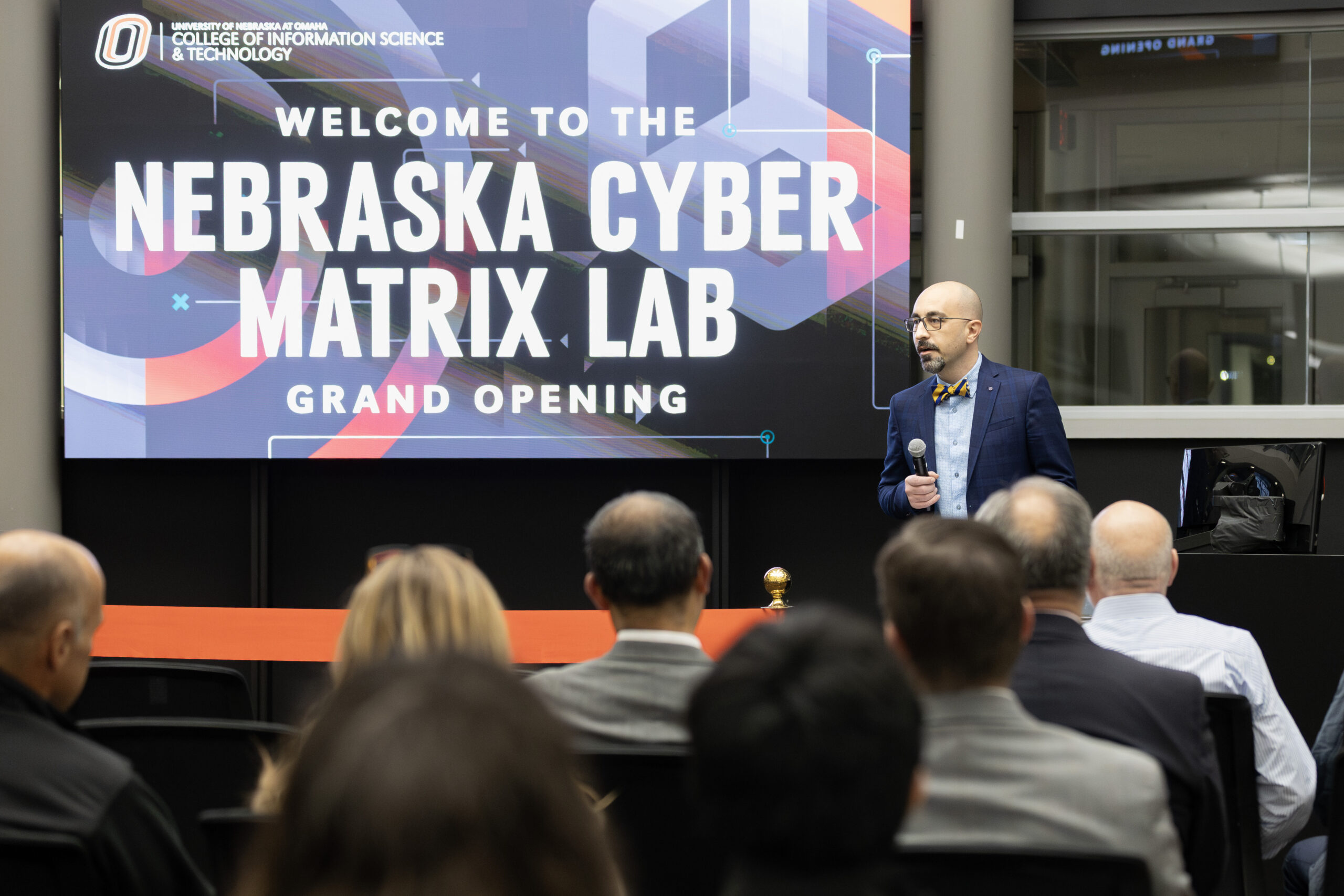
Now, students and working professionals can look to a new initiative at UNO’s College of Information, Science & Technology for some of the best up-to-date training: The Nebraska Cyber MATRIX, an acronym for the Machine Learning, Artificial Intelligence, and Threat Response Initiative for Cybersecurity Excellence.

Officially unveiled on Nov. 12, the MATRIX is a new classroom and lecture space modeled off of how internal cybersecurity teams operate at Nebraska companies. The initiative fits into the University of Nebraska System’s increased focus on industry relations in a time of state and federal funding constraints.
It’s also a hallmark of the public-private partnerships that sustain Omaha. MATRIX is supported by part of a $14 million grant to UNO from philanthropists Barbara and Wally Weitz.
“The objective is to make sure that the students are getting the best education, not from a textbook perspective, but from actual applied work,” said Martha Garcia-Murillo, dean of IS&T. “We are grateful and, of course, proud of the fact that companies are our partners, and we are not an isolated entity that works separate from what industry or our city is doing.”
A cyber range with AI teaching tools
Much like how security experts practice their gun handling by going to a gun range, cybersecurity professionals hone their skills at a cyber range. For the MATRIX, that means a secure digital sandbox where students can learn how computers and malware work.
Hosted on Microsoft’s Azure cloud environment, each student has access to a virtual computer running Kali Linux, an operating system built for cybersecurity and industry tools. But each virtual computer, and the cyber range as a whole, is walled off so that learning about and experimenting with malicious software doesn’t actually damage UNO’s systems.
“We could take company systems and create sort of digital twins of those systems in (the MATRIX cyber range), and then replay the attacks that may have occurred in the past,” said Hale, who is also the program director for MATRIX. “Then have real-time wargaming exercises to say, ‘Well, what if we did this at this time? Would it have made a difference?’”
Modules, designed by UNO’s faculty, range from the basics of teaching students how directories and permissions work to analyzing data sets of Russian tweets and how state actors operate.
As students work through those modules, they also will have help. VECTR, an AI chatbot built on ChatGPT and trained on UNO’s cybersecurity and faculty material, is a 24/7 assistant.

Across academia, “some instructors … are afraid of these (AI) engines being used for cheating,” said Garcia-Murillo. “So the fact that, in our case, we are actually improving the learning experience by using the tools purposely — we are, from our perspective, advancing education, as opposed to trying to prevent the use of these very powerful technologies.”
MATRIX’s educational approach is shaped by national standards like the NICE Framework for Cybersecurity, which has specific categories for different cybersecurity roles and the knowledge workers need for each role. UNO’s curriculum is also certified in cyber defense and operations as a National Center of Academic Excellence in Cybersecurity by the National Security Agency.
A new approach to internships and upskilling
The MATRIX already has seven interns and two student workers in its inaugural class. The experience they’re getting is as close as possible to real-life cybersecurity work, in part thanks to the new physical space, housed at the Peter Kiewit Institute.
“We need people to have a communal space of work where they can collaborate with peers,” Hale said. “These investigations that happen when there’s an attack or something, we want to forensically analyze what happened and respond to it.
“So I might pull a thread and you might pull a thread, and they’re both leading to the same piece of fabric, but they’re coming from different angles, and we need to be able to talk to one another to understand the whole piece of fabric.”
While MATRIX was kick-started by grant funding, the program is aiming for self-sustainability. That can come by licensing programming, like the chatbot VECTR, to other schools and institutions, working with companies to upskill their workers and being creative with other resources for industry.
Hale aims to have a collaborative internship program where, instead of a business hiring one intern and devoting resources to train them, a cohort of interns from different companies can be trained together in the MATRIX program. Businesses can then focus on training interns for their specific needs, with the foundational education addressed by UNO faculty.
In a time of increasing skepticism about the value of a college education, Hale hopes that MATRIX can prove its worth, especially to students most in need of opportunity.
Like much of UNO’s work, the initiative is motivated by “the person who maybe is coming from a blue-collar family, like I was, where their family worked themselves into the dirt — sometimes literally,” Hale said. “It’s to give them a shot.”
Hale also compared MATRIX’s mission to that of the science fiction TV show “Doctor Who,” about a time-traveling alien out to see the universe. “The sense of wonder, the sense of exploration, the confidence that comes along with putting yourself out there in unfamiliar circumstances,” he said. “It’s really similar to what we do in education.”
Lev Gringauz is a Report for America corps member who writes about corporate innovation and workforce development for Silicon Prairie News.



Leave a Reply