Artificial intelligence is now everywhere in the tech and startup ecosystem, enabling new tools, services and innovation. But it can also prove to be a risk for an important startup tool: Getting a patent.
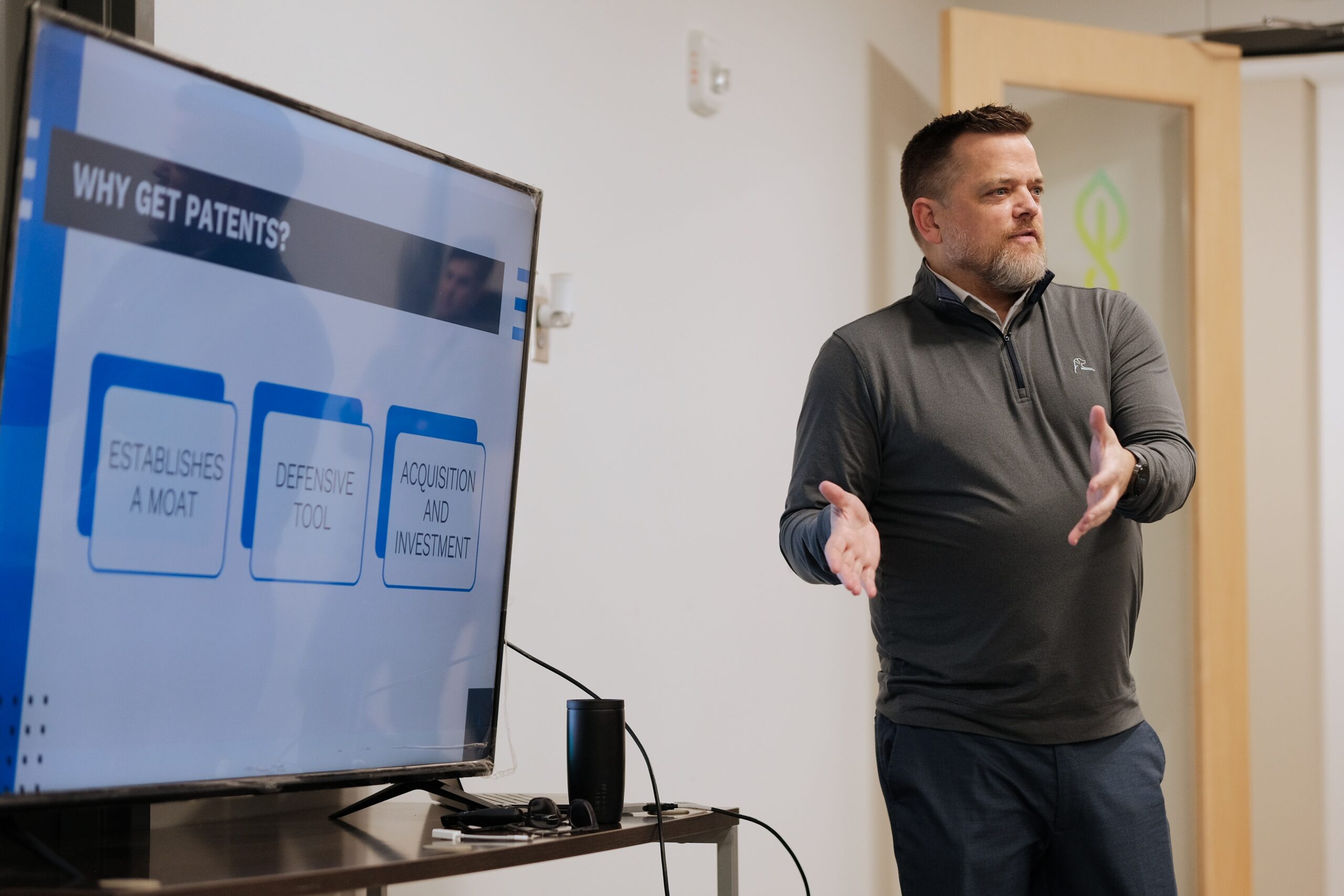
A patent “gives you a right to exclude others from making, using, offering for sale, selling and importing” an invention, said Matt Poulsen, a patent attorney at Suiter Swantz. “We obviously get patents because they establish some sort of moat. We’re getting some sort of barrier to entry (against) competitors.”
In a Feb. 19 “Protecting Innovation in the Age of AI” presentation at The Combine, the Nebraska agtech startup incubator and accelerator in Lincoln, Poulsen laid out why patents are important, and why startup teams need to be wary of the ways they use AI in their innovation process.
Having documented intellectual property, in the form of one or more patents, adds real value to startups. It shows investors and larger companies that a startup is worth taking seriously, potentially easing the path to investment or an exit.
“It signals to the outside world that you’re ready for the next level in your company’s evolution,” Poulsen said.
Now more than ever, obtaining a patent requires good and consistent documentation, Poulsen said. As startups develop ideas, they should file invention disclosure forms. They should also file for provisional patents of inventions before unveiling them publicly at pitch competitions or on websites, which could disqualify those ideas from being patentable. The provisional patent grants one year to sort out documentation for a full patent application, which may take two years or more to be approved.
But with AI, whether and how an idea is patentable can get complicated.
On one hand, “an inventor has to be a natural person,” Poulsen said. “AI is not a natural person, (so it) cannot be an inventor on a patent.”
On the other hand, patents are a collection of claims defining an invention, and as long as just one of those claims is from a real person, AI could contribute the rest, Poulsen said. That makes proving real human involvement a potential liability.
“I’m going to guess there’s a lot of cheating going on right now, because (with) AI, well, you plug something in, it will give you some ideas you did not think about,” Poulsen said. “I know those ideas are getting filed in patents. Which means there are probably going to be a lot of invalidated patents down the road.”
That’s why documentation is so important. If a company tries to enforce a patent, an attorney could argue to invalidate the patent because AI was used. The only way to avoid that would be to have key records — like AI prompt and chat histories — to show in court.
“If you didn’t use AI, then you say, ‘I didn’t use AI,’” Poulsen said. “But be prepared for that to come out (in a) trial if you would ever actually litigate something.”
Poulson cautioned that using AI for patent research could even make an idea un-patentable. Some publicly available large language models, like the free version of ChatGPT, train their models on the information that people put in when asking ChatGPT for help. From a legal standpoint, that can count as public disclosure of an innovation.
“If you’re using AI to research patents at any level, I would strongly urge you to use the enterprise level of whatever tool you’re using,” Poulsen said. Otherwise, document everything.
“Who are the inventors? Was AI involved? Make sure you’re tracking that,” he said. “In 2026, AI probably was involved at some level.”
Lev Gringauz is a Report for America corps member who writes about corporate innovation and workforce development for Silicon Prairie News.