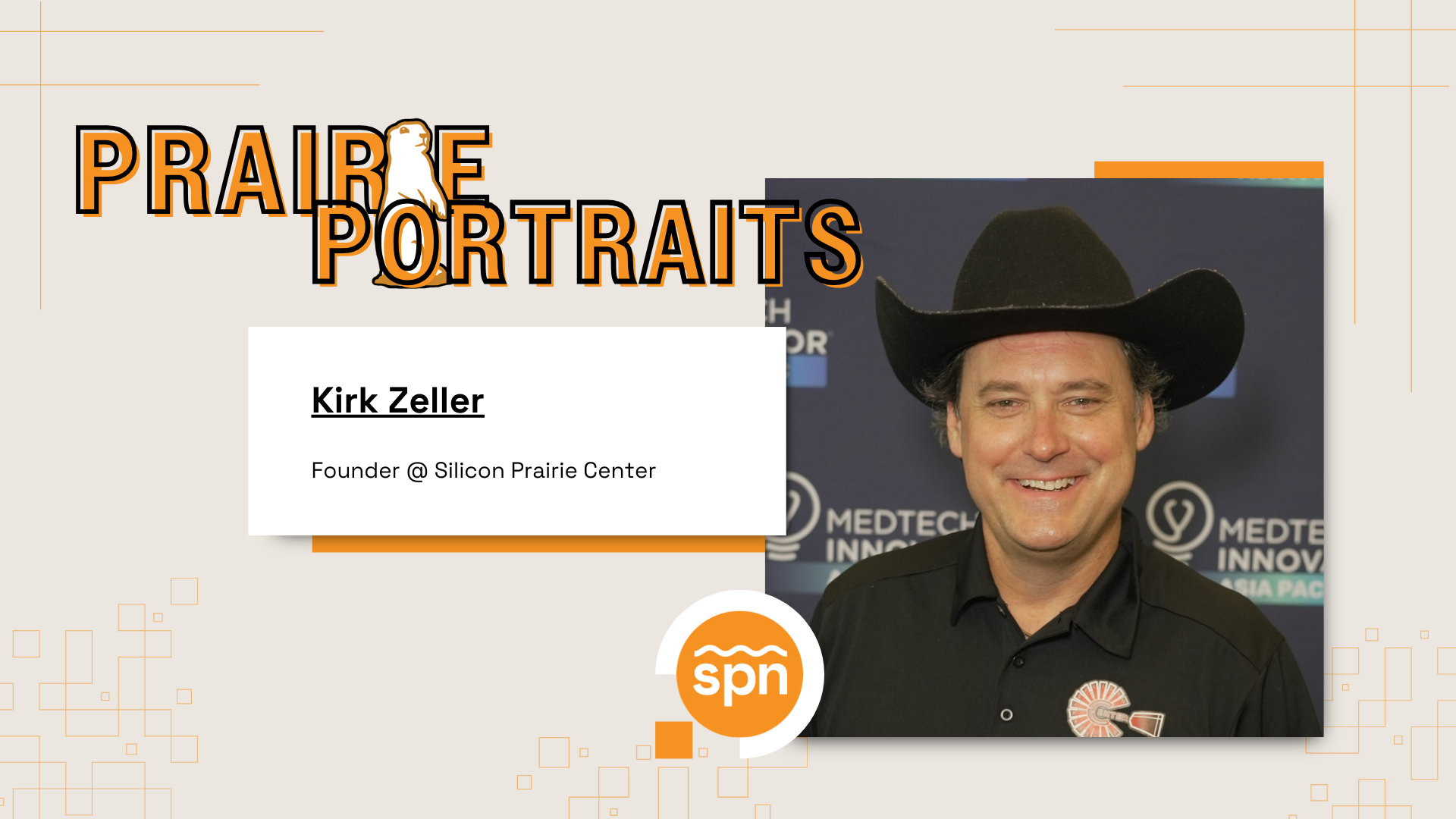
Meet Kirk Zeller, Founder @ Silicon Prairie Center
The Silicon Prairie Center is based north of Kearney in Ravenna. The center offers residential, office, media production and product development spaces for entrepreneurs and creatives.
Zeller also has established a career in both the medtech space and U.S.-Japan market relations. He is the co-founder of the medical device startup Progressive NEURO and a Bio Nebraska board member.
What inspired you to become an entrepreneur or support other entrepreneurs?
I think it’s a family legacy. My family came to the United States under the Homestead Act and have effectively been ag entrepreneurs in one way or another. One of my grandpas was also a judge, an electrician, a plumber and a farmer/rancher. My dad had multiple things. My other grandpa had multiple things.
It’s just in my blood.
I always wanted to come back to Nebraska. My vision was to go do the Silicon Valley thing, which I did do for a long time, and just bring that all back here. In 2018, I was invited to come back to give a talk in Lincoln.
I learned a lot about the stakeholders: UNeTech, UNeMed, Nebraska Innovation Campus, Invest Nebraska — I think even the Business Innovation Act.
I’m like, “Wow, maybe I can do this now. Can’t do it on the grand scale I was hoping for, but maybe I can start early at a smaller scale.” Within a few months of coming back, I bought the first building here in Nebraska.
Here, we’re probably a fifth or sixth or seventh or a tenth of what it costs to get a residence and office space in the Bay Area. You can take a small amount of capital, build working prototypes, maybe even get issued IP, before you really have to go out and get a large amount of outside money.
You can build a lot of value with a small amount of capital — ideally minimize dilution — and give yourself a little more control of your business. That really is some of the core principles of what we’re trying to do.
What advice would you give yourself if you could go back in time to when you were just starting out?
I’m very much about staying lean, staying in control: Trickle in capital. Don’t take way more than you need until you build a lot of value. Then go out and do an ambitious round at a high valuation.
But if I could do it over again, I would have taken any money that was available to me because we didn’t know what was going to happen with COVID and the aftermath of COVID. If I could have done it over with Progressive NEURO, I would have taken a lot more capital and built quickly. If we would have hit first-in-human trials or some other key milestones, it would have been much easier to raise capital.
There are certain thresholds, particularly in medical devices, where it’s really hard to raise money until you’ve proven that it works in humans. The financing environment has — just like for everybody else — been a tricky thing.
I’ve had so many mentors over the years say, “Kirk, whenever you’ve got money offered, take it.” And I’m like, “I don’t want to dilute.”
Many entrepreneurs go through that thought process. There’s a reason why so many people take investment when it’s offered. Because you never know if you’re going to have money on the table again.
How do you stay motivated when things feel overwhelming — or stagnant?
It’s been really good having multiple entrepreneurs in one place. That was part of what I was thinking from the beginning with the Silicon Prairie Center: You have lots of people innovating together, you have lunch together and somebody’s always going to be at a good point.
I have these different startup leadership groups that I’m a part of, and we started to call it startup CEO therapy because it’s so good to be talking to each other. Like, “OK, I’m not the only one.” That really helps a lot to be in an environment, whether it’s virtual or in-person, to have frequent engagement with other startup founders.
What I found is if you get in those times where you spend too much time by yourself grinding away, you can really get depressed. But you take time to pick up the phone and get advice from people, you can really turn a day around.
That’s been a real big thing — having been back here long enough to build and have a sense of community. The community that we have in Nebraska is very unique, and people are very genuine and very helpful. They always make time.
What is the biggest challenge you’ve overcome and how did you overcome it?
We were supposed to start shooting a movie, The Picture of Daria Gray, on May 4, 2020. Then of course everything happened with COVID. Because it was a SAG-approved production where we were going to be using SAG actors — in the midst of safety concerns and uncertainties — it shut the whole thing down.
Because I’m a guy who comes from a long tenure in Silicon Valley, I’m thinking technology oriented. I rang the director because we were stuck in a bind with no way of moving forward on the planned production.
And I’m like, “What about if we did do this other film that we have an idea for? What about if we do it non-union? Don’t do it SAG? And what about if we direct it remotely?”
The end product was reported by the Hollywood Reporter as the first feature film in history to be directed totally remotely.
That was probably a good example of how you run into a roadblock, and you’re just like, “How do I think about this problem differently?” Like, “What if we use my apartment building? What if people don’t leave their apartments, and we come in and just shoot their scenes in the place where they’re staying?”
There’s just so much synergy between filmmaking and startups because you’re wearing lots of hats, taking a very small amount of resources and trying to do something big.
How can the Nebraska community support you?
I think it’s more of the same in the sense of all of us banding together, like Scott Henderson and I and others are doing for the Business Innovation Act. We have a lot of the stakeholders — Invest Nebraska, Silicon Prairie News, all these folks — we all kind of band together.
I think doing more of that — getting more organized. We have a lot of organizations now and a lot of events. I think just continuing to do more of that — finding ways to unite.
A lot of places are secretive and they’re standoffish and they don’t collaborate. We’re not like that. We find ways of collaborating. I think that’s the strength and that’s what we can and should continue to build on. There are some people in the state who are very dedicated to that.