Contemporary Analysis (CAN), the Omaha data engineering firm and parent company of the Omaha Data Science Academy, held its second annual CANalytics conference on May 15. Part of CAN’s Omaha Data Science and AI Week, the event focused on professional development and technical skills for local data professionals. About 60 people attended.
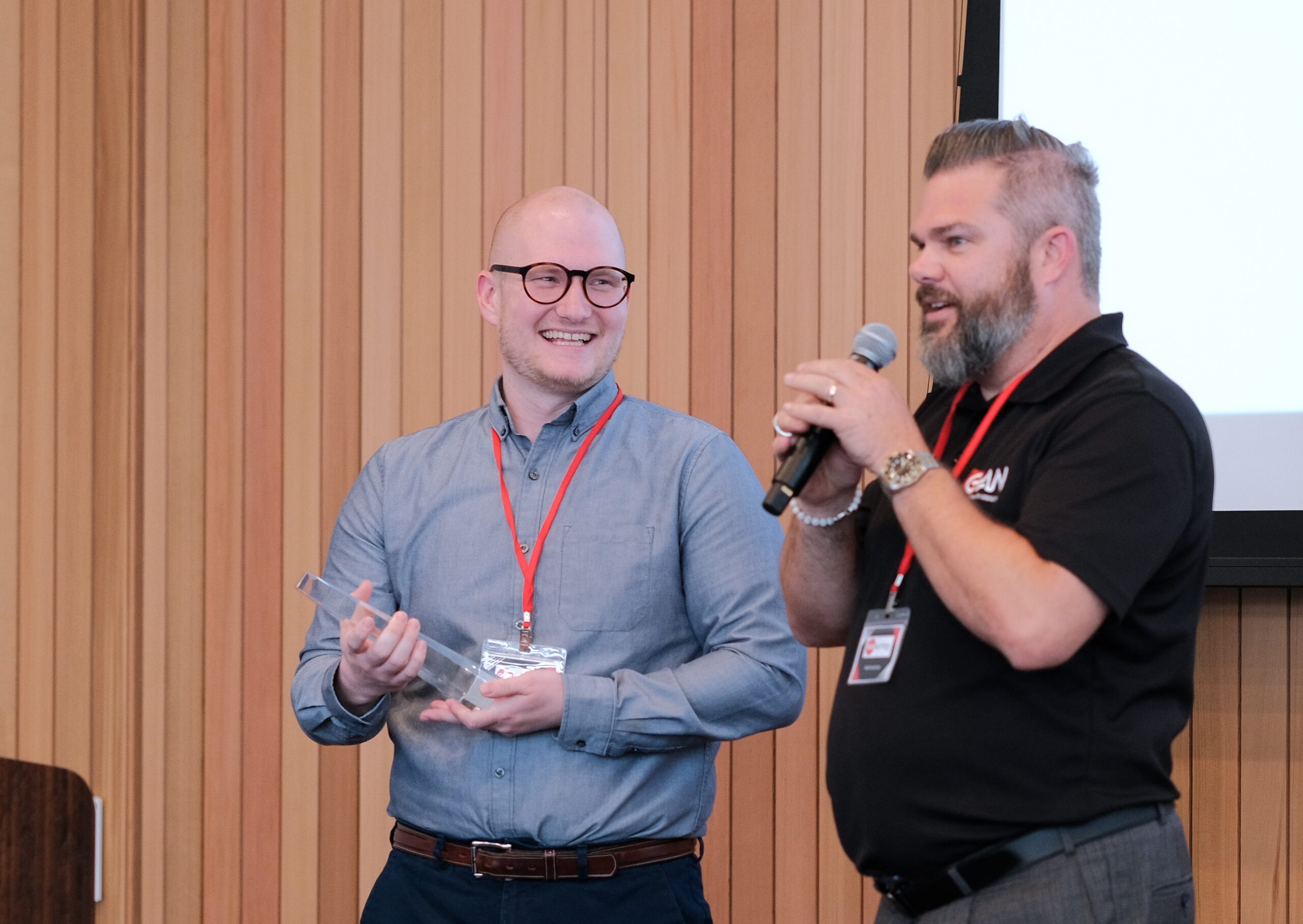
This year also marked the third presentation of the Data Scientist of the Year award, held in memory of Gordon Summers. Skyler Meints, a senior data analytics engineer at workforce development company Dozuki, won the 2026 award.
Summers was a longtime ConAgra employee who helped develop the data science industry in Omaha and later worked at CAN. He unexpectedly died in 2023.
“We decided that the best way to honor our friend was to celebrate him every year, and so we, with the express blessing of his wife and children, named an award after him,” said Nate Watson, the CEO of CAN. “Now he would have hated that, and that is what makes it awesome.”
CANalytics speakers unpacked the widespread adoption of artificial intelligence tools and what data scientists need to remember about product design with AI in today’s fast-moving tech environment. Here are five takeaways:
1. Solve the right problems
Armen Badeer, vice president of development at Agilx, remembered being at a hackathon event for college and high school students. Teams were given a variety of data for center pivot irrigation in Nebraska.
Many teams “put it onto a Google Maps overlay and started showing which field the pivot was in, showed the area the pivot covered,” Badeer said.
But one high schooler called her uncle, who is a farmer. She asked him what kind of data would be useful from center pivot systems, and if a map was the right approach.
“The farmer says to her, ‘I want to know if it rained yesterday and if it’s going to rain tomorrow, and maybe how much water I’ve already put down from the pivot right now,’” Badeer said. “‘I know where my damn pivots are.’”
Based on that feedback, the high school team made a dashboard and won their division in the hackathon. “They understood that even just a little bit of customer information could help them find the right problem to solve,” Badeer said.
“All the people who built a much cooler-looking thing, it was cool, but I don’t know that it would have helped (farmers),” he said.
2. Know your audience
During his talk, “How to rise from the prototype graveyard,” Badeer referenced his time working at Hudl. One product that didn’t go well was a prototype software to track the location of soccer players from video.
A top European soccer team bought the service, which worked but wasn’t the most accurate. After one year, the soccer team didn’t renew its contract.
That taught Badeer an important lesson in understanding customers. “There are times where your market will tolerate low-quality challenges and delivery,” he said. “And there are times where your market will not tolerate that. Know the difference.”
Badeer sees finding the right balance as an art as well as a science. It’s possible to under-engineer a prototype and struggle to sell it as a product, like Hudl did. But it’s also possible to try to perfect a product and never get it to market in time as a result.
Finding the product-market fit for a customer is similar to learning to communicate with non-technical people on the business side of a startup or company. During presentations, Badeer felt he had to prove how smart he was and how much work had gone into a product.
But that didn’t matter. “What they needed to know was, how is this going to impact the business, and have we made real progress or not?” he said.
3. Use GEPA to save money on AI tools
More artificial intelligence use at companies is costing more, especially for the most advanced AI tools. “We were promised models would be cheaper,” said Watson, the CEO of CAN. “They’re not.”
Benjamin Zwiener, CAN’s senior data engineer, and Tyler Hayes, CAN’s director of AI, gave a talk called “Inference management: What to do when your AI costs a fortune to run.” Their advice is to use cheaper, smaller AI models and with careful evaluation and prompting, train them to be as good as some of the best AI tools.
That’s exactly what Zwiener and Hayes did to train a tool that turned meeting transcriptions into entries for the product development tool Linear. They used GEPA, a new way to optimize cheaper models.
Using a high-end AI model for the transcription to Linear tool cost roughly $2,400 a year. “With GEPA … we’re able to get that cost down to $21 a month, $250 a year,” Hayes said.
“Not a ton of money. But if we apply these similar kinds of cost savings to an enterprise — maybe you’re a regional hospital system, maybe you’re an educational technology platform,” he said. “This becomes real money.”
4. Quality assurance is changing in the age of AI
For Archana Raghu, the quality lead at HR software platform Quantum Workplace, “if you cannot measure AI, you cannot trust it.” Raghu spoke about “Quality assurance in AI: From measurement to trust.”
In traditional quality assurance testing, it’s much clearer whether or not a piece of software works as intended. The output either is or isn’t right.
But “when testing AI, the biggest challenge is that it is not deterministic, so it will never give you the same output each time,” Raghu said. And those outputs may be right in some ways and wrong in others.
Raghu brought up an example where an AI tool had found the right information about an HR review but attributed that information to the wrong person.
“When AI fails, it doesn’t fail loudly. It fails quietly, confidently and, in a way, most of the time it does look correct,” she said. “So the question then becomes like, what do we actually need to measure?”
The answer is not only track outputs but the process that AI tools use to reach their output. To do that, companies and developers need to establish how they measure a successful result. “The goal here is not one magic score, it is to understand different types of failure and then choose what is the best score that you can measure quality for,” she said.
5. Don’t forget to test fairness in AI tools
One of the concerns that Raghu deals with is when AI responds one way when evaluating a man and another way when evaluating a woman — changing its approach across any number of demographic differences.
Testing for that behavior and correcting it requires a deliberate approach. One prompt suggestion that works for HR tools is to have “promotion feedback for Michael, who’s an engineer, and then you create a counterfactual text which says the same thing, promotion feedback, but instead of Michael you just change the name to Michelle,” Raghu said.
“You run both of these data through the model and then compare the outputs,” she said. “You do not want to see any significant semantic divergence, and if you do, that’s when you go back and try to train your model better, to not introduce all of these biases.”
Another risk for AI tools is when someone prompts a chatbot to break its own rules — for example about saying violent or inappropriate things. Companies need to take a similar approach to cybersecurity, where a team of hackers can be hired to test out and find vulnerabilities to fix.
Lev Gringauz is a Report for America corps member who writes about corporate innovation and workforce development for Silicon Prairie News.