Federal funding was once a reliable source of support for academic research in the University of Nebraska System. But with deep proposed cuts, grant and contract cancellations and now the longest government shutdown in history, federal funding is no sure thing.
In August, Dr. Jeffrey Gold, president of the NU system, told Silicon Prairie News the institution lost over $50 million in federal funding, with a potential total loss of $200 million by the end of 2025.
In response, the University of Nebraska Medical Center (UNMC) is launching a new Office of Industry Engagement. The office will streamline how industry partners work with researchers and labs and create a significant funding source to offset uncertain federal dollars.
“We’re a biomedical research institution, we’re heavily reliant on (the National Institutes of Health for funding),” said Ken Bayles, UNMC’s vice chancellor for research, when announcing the new office during a town hall on Oct. 22. “Which is fine in normal years, but with the way things are now, it makes us very vulnerable, so we have to be thinking about other sources of funding.”
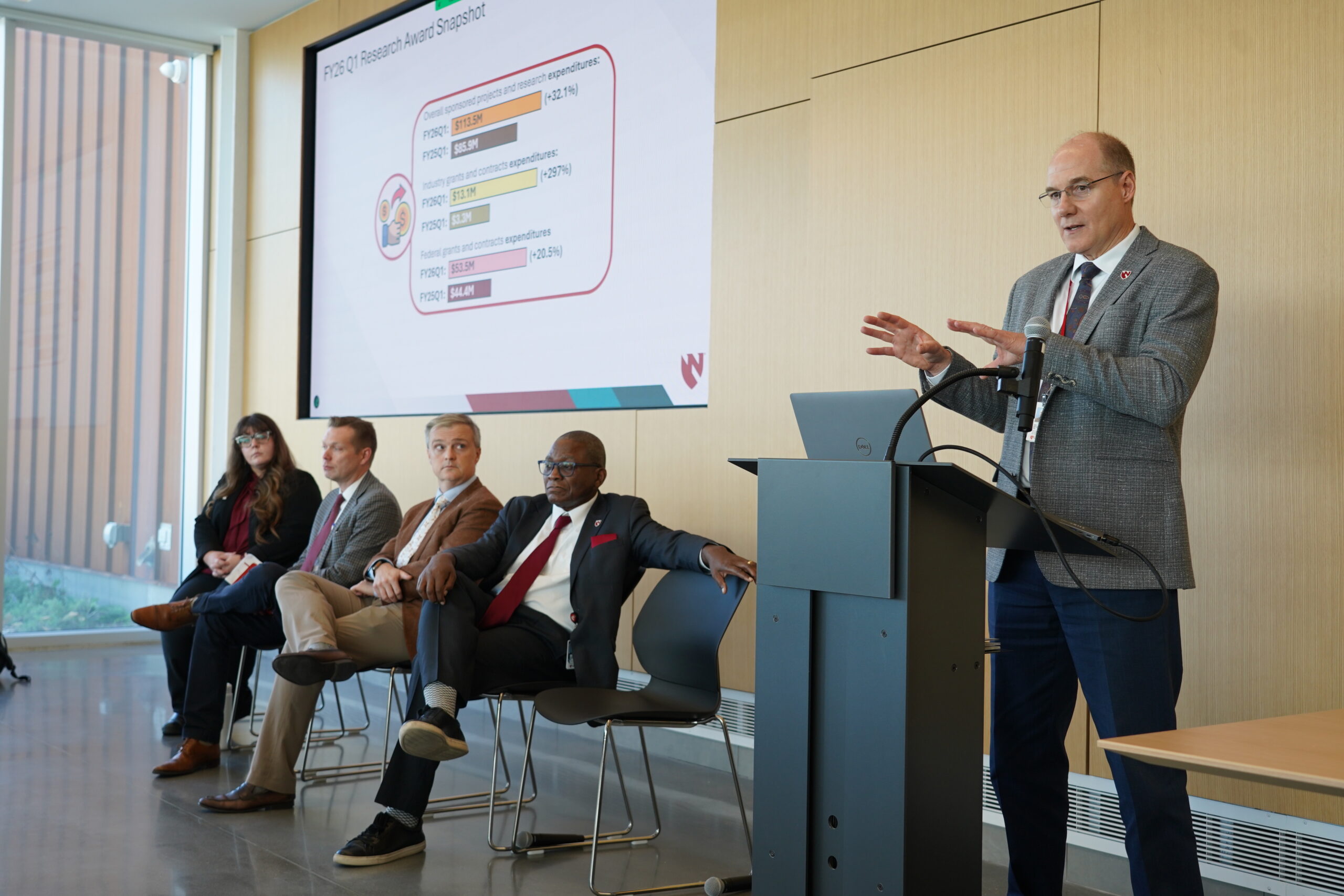
At the town hall, Bayles outlined UNMC’s financial standing in terms of research awards and contracts. In fiscal year 2025, which ended June 30, UNMC received roughly $18 million less in federal funding when compared to FY 2024. But industry funding, including for clinical trials, grew 70%, from $19.1 million in FY 2024 to $33 million in FY 2025.
Clinical trial funding from industry partners is already at $13.1 million in the first quarter of FY 2026. The same period last year had just $3.3 million in industry contracts. There also is an almost $10 million increase in federal grants and contracts, which may be delayed as awards from FY 2025 pay out in this new fiscal year.
“Q1 is pretty volatile,” Bayles said. “I don’t expect this to keep that same trajectory … The important thing here is that we’re seeing fantastic growth with industry-sponsored projects.”
Dr. Dele Davies, interim UNMC chancellor, sees the new Office of Industry Engagement as continuing that success. It also fits well with UNMC’s build out of the Catalyst and CORE buildings, intended to foster entrepreneurship and offer high-quality labs for industry use — another source of revenue UNMC hopes to expand.
“This Office of Industry Engagement will allow us to partner with industry partners across the country and have those partners right here, working side by side with all of you,” Davies said. “Helping to not only develop new products that can then be taken to market, but more importantly, allow your work to continue to grow and thrive, especially as we’re thinking about what the future landscape may be with reliance primarily on the federal government.”
Bayles said the office is funded by revenue from clinical trials in the hopes of being sustainable as the NU System struggles with a financial squeeze and budget cuts. UNMC will be hiring for a director of the office as well as a project manager to coordinate clinical trials and labs for industry best practices.
The new office has a mandate to clean up the chaotic “big traffic jam” that UNMC currently has when it comes to partnering with industry. “From the sponsors’ perspective, there’s not a clear point of entry,” Bayles said.
“From the researchers’ perspective here, we’re not used to doing this kind of stuff,” he said. “There’s undue administrative burden. We have to navigate these waters ourselves and try to figure out how to make this work … Well, the future state is this smooth highway with clear on- and off-ramps.”
Ben Goeser contributed to this story.
Lev Gringauz is a Report for America corps member who writes about corporate innovation and workforce development for Silicon Prairie News.