By Yanqi Xu and Naomi Delkamiller of Flatwater Free Press
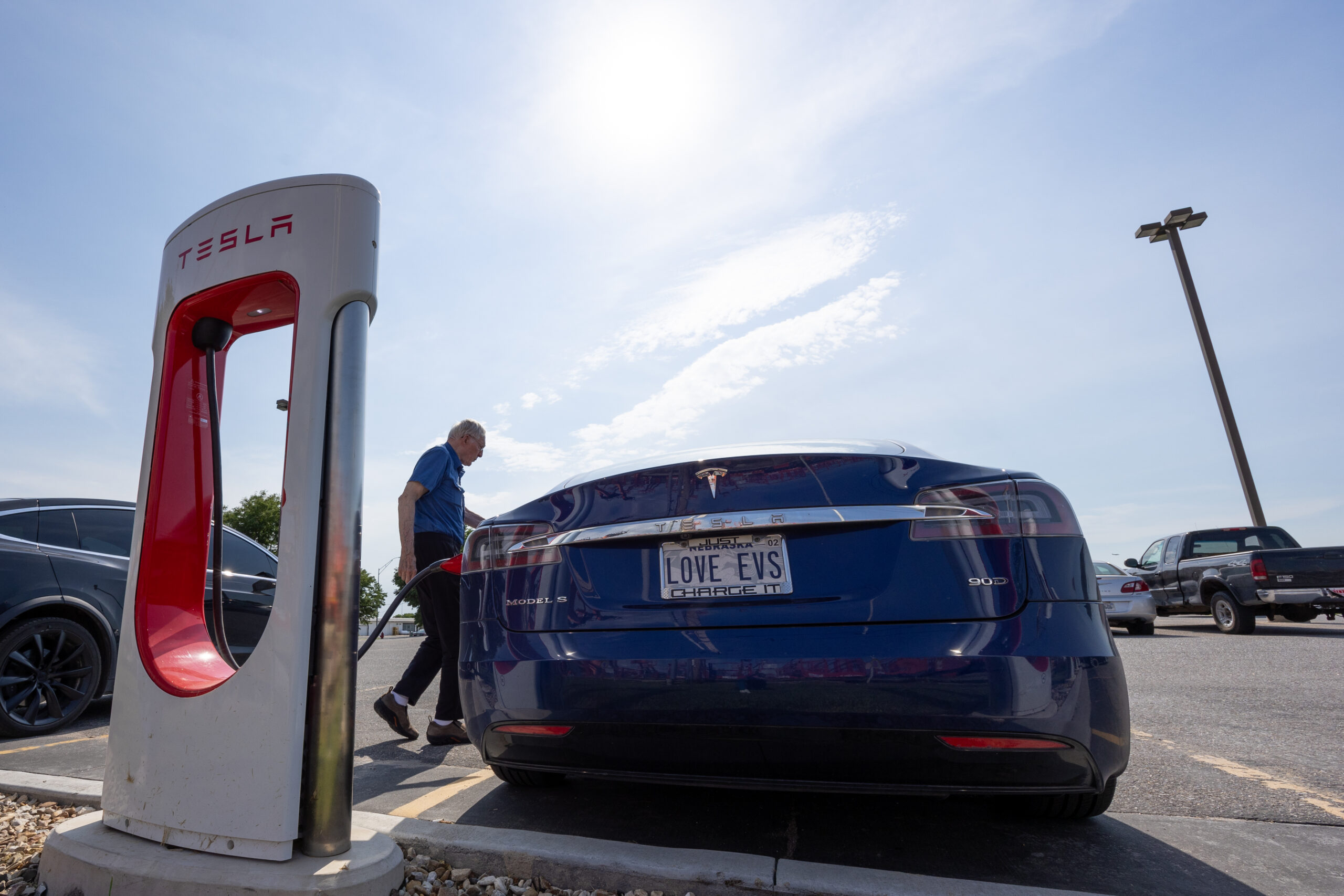
Don Cox, one of the first Nebraskans to own an electric vehicle, has put more than 400,000 miles on his EVs since 2008. In that time, he’s never once gotten stranded.
Today, there are 265 charging stations, and more than 500 individual ports, scattered across Nebraska, most clustered along the Interstate 80 corridor. There are also many more drivers like Cox—the number of EVs in Nebraska has grown sixfold just in the past six years.
Despite this growth, Nebraskans continue to lag behind other states in EV ownership. Only one out of every 362 registered vehicles in Nebraska is electric, a lower adoption rate than all but eight states.
A major deterrent: Widespread worry that there aren’t enough EV charging stations.
Nine out of 10 respondents to a 2022 Nebraska Department of Transportation survey said Nebraska’s charging infrastructure was insufficient for practical EV ownership.

But the reality, say the dozen EV drivers interviewed by the Flatwater Free Press, is that the charging infrastructure is getting better and more reliable, though it will take more charging options to unlock new owners.
“It’s come a long way,” Cox said while charging his car at a Lincoln Runza.
Many public charging stations are concentrated in the eastern half of the state, near the population centers. They then spread west, roughly following the path of I-80, which Nebraskans and out-of-staters alike use to traverse the state.
In some way, that charging map mirrors where EV owners are and aren’t in Nebraska.
There are now 7,000 registered EVs in Nebraska, but 23 Nebraska counties, many located in north-central and northwest Nebraska, don’t have a single EV registered in them. Cherry County, larger than the state of Connecticut and home to 5,455 residents, has zero registered EVs, according to data provided by the Nebraska Department of Motor Vehicles.
Among the likely reasons for this low ownership: So-called charging deserts and fears of getting stranded.
Range anxiety—the fear of not making it to the next charger before the battery dies—is widely cited as a major barrier to American EV ownership. This anxiety can be lessened in two ways: Increasing battery size, which also drives up vehicle cost, or adding charging locations, said Steve Pekarek, a Purdue University professor specializing in power systems for EVs.
Nebraska’s power grid has the capacity to support more charging infrastructure, according to the Nebraska Public Power District and Omaha Public Power District.
OPPD hasn’t observed any overloads from areas with denser charging areas in the past five years, said Mark Gibilisco, manager of distribution planning, even as more contractors install home chargers in new Omaha-area homes.
Home charging remains the most convenient way to top up an EV. It’s also cheap. In the Omaha area, it costs no more than 10.5 cents per kilowatt-hour to charge at home, meaning you could charge to travel 300 miles for roughly $10.
But the growing home charging network still needs to be complemented by public charging, according to a report by the National Renewable Energy Laboratory.
Nebraska’s 577 charging ports are low for a state its size, said Jaap Burger, senior adviser for a Brussels-based energy research think tank. That’s especially true since less than 200 of those ports are fast chargers, which can fill up a battery in less than an hour.
“It’s not a charging network that enables people to use EVs for all of their driving needs in their state (or) across states for longer distances,” he said.
Many current Nebraska EV owners say the chargers that do exist now need to be well-maintained and functioning. That’s especially important for EV owners like Danny Martin, who doesn’t own a charger at his rental home.
“I’ve seen broken chargers from pretty much every brand,” said Martin.
Martin parks his Hyundai Ioniq at a lower-level charger at work near the Bob Kerrey pedestrian bridge.
Four hours of level-two charging gives him about 80 miles of juice for the price of $1.
Level-two chargers near workplaces, grocery stores, gas stations and hotels typically work for those who have something to do while charging.
But for road trips, EV owners and experts alike say Nebraska needs more fast chargers.
Tim Kimpson, who bought a Tesla this year, is ready to take his Model Y on a road trip to Idaho in September. He and his wife Cindy will hit up the Black Hills along the way, planning to use Tesla Superchargers and calling hotels ahead to make sure their low-level chargers work.
“I wasn’t an EV believer,” Kimpson said, but changed his mind after a recent gas price hike. He also owns a pick-up that costs $85 to fill and gives him 250 miles before he has to fill up again.
“I can’t afford to put gas in my truck,” he said.
There are drawbacks, Alan Meyer points out. After being caught in a Texas snowstorm, his Tesla’s battery charge dropped significantly in the cold weather, and the car’s smart control system told him not to go over 60 mph on the couple’s return trip to Lincoln.
Meyer has used Tesla’s website, which allows owners to suggest new charging locations, to urge the company to add more chargers on U.S. Highway 20 and U.S. Highway 275, which both cut through northern Nebraska.
The charging landscape is worse for EV truck owners. Doug Allpress’ Ford F-150 Lightning includes a battery powerful enough that he used it to power his house’s essentials, including his refrigerator and freezer, after a recent storm knocked out electricity at his home.
But that big battery also requires a fast charger, and the only viable chargers Allpress has found, aside from those off I-80, are in Norfolk, Ainsworth, O’Neill, Thedford and Chadron.
“The biggest issue would be getting to Chadron,” he told the Flatwater Free Press, noting the city is 150 miles away from another public charging port, which could become dicey if a charger broke down.
Experts and EV owners alike think that if Nebraska continues to build its EV infrastructure, more electric vehicles of all kinds will grace its roadways.
“As you increase the number of stations, and you break down deserts, then there will be an increase in adoption,” said Pekarek.
The Flatwater Free Press is Nebraska’s first independent, nonprofit newsroom focused on investigations and feature stories that matter. FFP is a sibling publication of Silicon Prairie News under the Nebraska Journalism Trust umbrella.