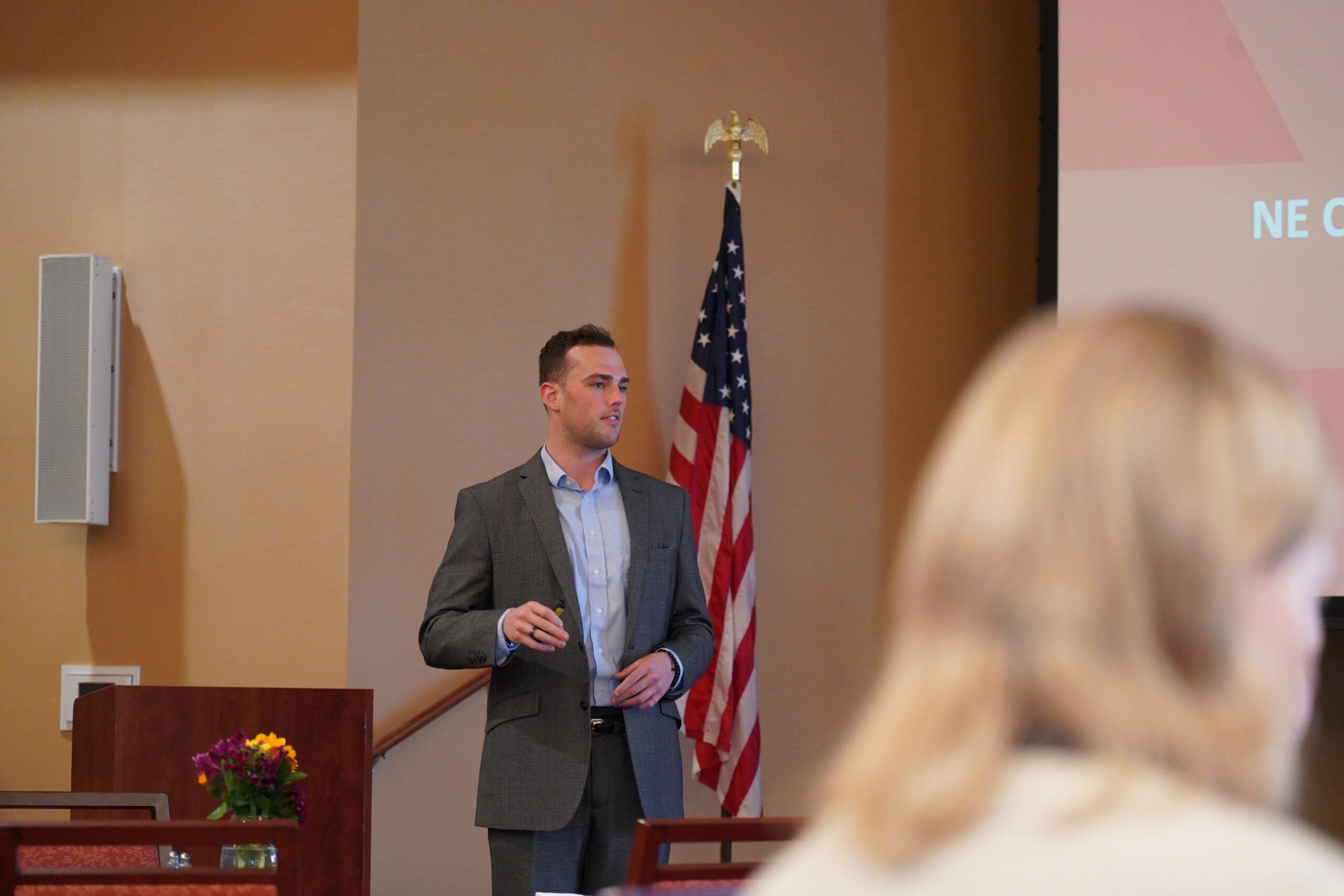
Property taxes, economic development and the future of Nebraska’s energy supply were front and center at the Nebraska Chamber of Commerce Road Show stop in Papillion.
Executive Vice President of Legislation and Policy Hunter Traynor led the discussion with local business and community leaders, filling in for Chamber President Todd Bingham, who was traveling in western Nebraska. Traynor recapped key legislation from the 2025 session and outlined ongoing challenges as part of the chamber’s statewide tour, which also included stops in West Point, Auburn, Fremont and Falls City.
Here are five takeaways from the event:
1. Property taxes remain the top concern
Property taxes are the topic Traynor said he hears about at every road show stop, no matter the community. He walked through how Nebraska spends billions in credits and aid to offset property taxes — from tax credits to the state taking over community college funding — but said those efforts often leave homeowners feeling little relief. To illustrate the challenge, he compared the system to “chasing a greyhound rabbit,” where the goal always stays just out of reach.
He advocated for more money to flow through the state’s TEEOSA school funding formula, which equalizes resources for 243 school districts, rather than continuing to expand credits. Traynor said there is probably a “sweet spot” around 45 cents for school district levies, though he cautioned the politics of reaching that level could be difficult.
2. Targeted incentives highlight the importance of Offutt Air Force Base
Traynor pointed to Sarpy County’s close ties with Offutt Air Force Base, which he said represents about 2% of Nebraska’s GDP. He highlighted a new wage credit for defense contractors, passed in the last legislative session, as an example of how targeted incentives can support that sector. Beginning in 2027, companies that pay new employees at least 150% of the state’s median wage and provide annual raises would qualify for a payroll credit.
Traynor described the program as a “rifle-shot incentive,” focused, performance-based and directly tied to outcomes. “If companies don’t meet the requirements, they receive nothing,” he said. Traynor framed the measure as part of a larger debate about incentives, arguing that Nebraska must remain competitive with other states that are courting the same industries.
3. Paid sick leave legislation brings changes for employers and workers
Traynor also addressed Nebraska’s new paid sick leave law, which voters approved in 2024. He said the chamber helped draft LB 415, a bill passed this year to clarify how employers can comply. In his remarks, he said the revisions were meant to clear up ambiguities in the initiative and balance employer flexibility with employee rights.
4. Nebraska must build more power
Energy policy was another major topic. Traynor said a recent chamber report showed Nebraska’s electricity demand is growing faster than expected, with the state projected to fall short of generation capacity by 2035. That estimate, he noted, moved up from 2037 just a year earlier.
Traynor argued that Nebraska must pursue an “all-of-the-above” energy strategy, building out wind, solar, natural gas and nuclear. “We have some of the cheapest, most reliable energy in the country,” Traynor said. “But if we don’t build, we risk losing one of our biggest advantages.”
SPN wrote more about the findings in the energy report here.
5. Housing and local control complicate growth
Traynor connected Nebraska’s housing shortage to workforce retention and economic development. He said the state has been underbuilding homes since the early 2000s and that people under age 35 often cite housing and child care as reasons for leaving. Without more construction, he said, even businesses that benefit from new incentives may struggle to expand.
But growth, he said, often runs up against Nebraska’s tradition of strong local control. Zoning and property rights debates can slow or block new housing and infrastructure projects. While he acknowledged the value of community input, Traynor said the state will need “outside-the-box thinking” to balance private property rights with broader public needs.
Future outlook
Traynor emphasized that Nebraska’s economy is resilient, with agriculture and manufacturing anchoring its future. But he cautioned that without progress on property taxes, housing, child care and energy, the state could lose ground to competitors.
“This is hard stuff,” Traynor said. He went on to reflect that complex policy problems rarely have silver-bullet solutions and that Nebraskans need to engage in more honest conversations with their neighbors.You can read the Nebraska Chamber’s 2025 “Results for Business” report for a full overview of the last session’s legislative wins and ongoing challenges here.