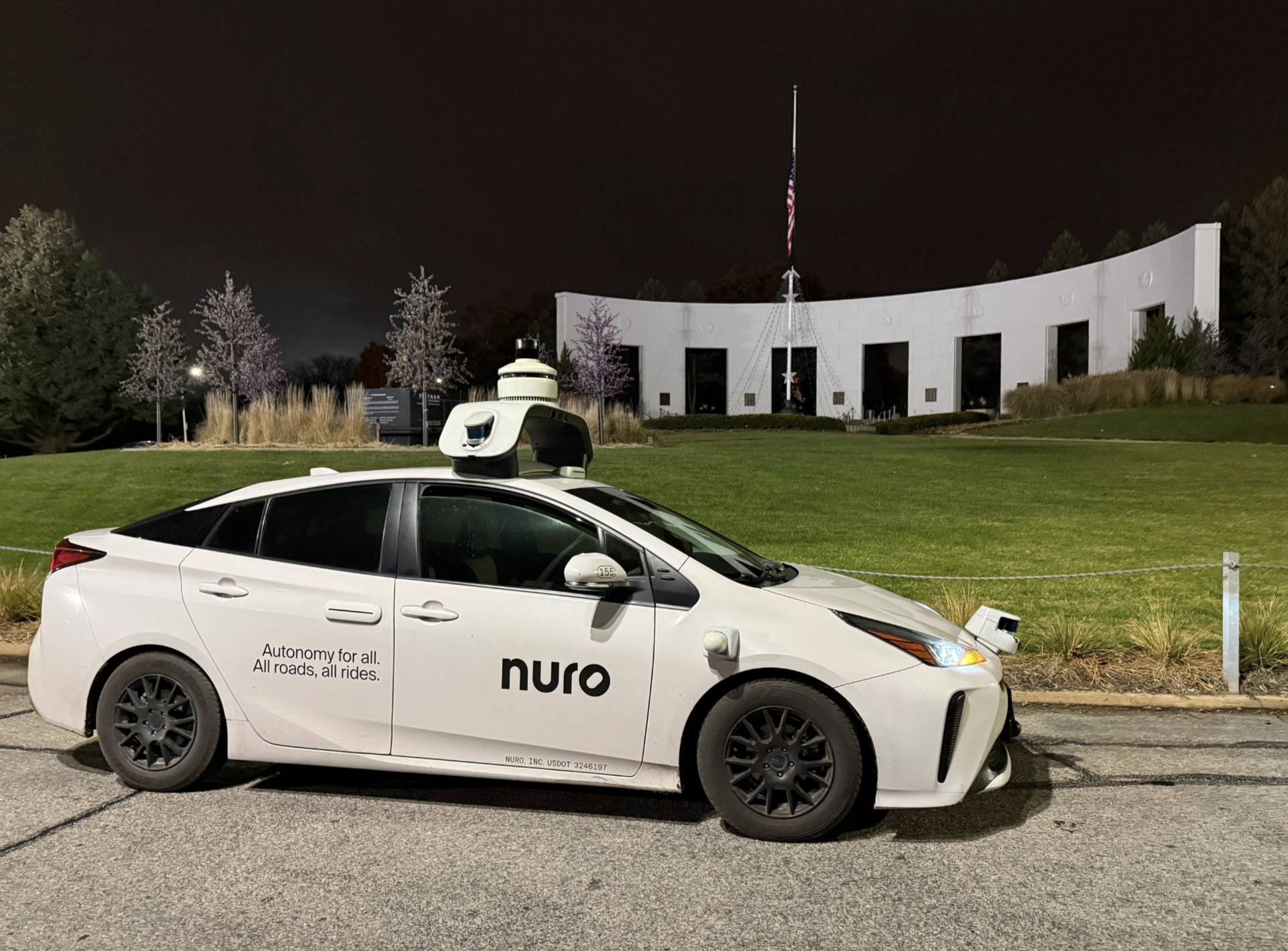
As downtown office dwellers filed into work on a gusty Monday morning in November, a white Toyota Prius rounded the block near Omaha City Hall.
This was no ordinary commuter on their way to work — the car was already on the job.
Specialized cameras and sensors mounted on the hood, roof and sides of the Prius gathered information on road conditions, pedestrians and other vehicles.
A phrase appeared in black letters on the rear passenger-side door: “Autonomy for all. All roads, all rides.”
Nuro, the owner of the car and the slogan, plans to equip 20,000 driverless Ubers with its signature technology in the coming years. But the trip through Omaha was a brief stop on a nationwide tour for the Silicon Valley company — a chance to see and be seen in a city barely touched by autonomous vehicles.
While robotaxis and self-driving food delivery vehicles have become a part of life in places like San Francisco and Phoenix, the technology has yet to take off in Nebraska. That’s despite lawmakers’ attempt to put the state at the cutting edge of autonomous vehicle development with sweeping legislation in 2018.
That bill, mostly written by an industry lobbying group, allows driverless cars to use public roads with few restrictions and bars cities from imposing their own rules on the vehicles.
It has been largely irrelevant in the years since, but that could soon change.
The human-driven car that spent six days in Omaha last month, similar to those that visited 150 cities this year, was collecting real-world driving data to train Nuro’s autonomous driving system, said company spokeswoman Sophia Cavalluzzi.
Nuro will bring robotaxis to dozens of cities starting next year, but “I can’t say if or when Omaha will be on that list,” she said in an email.
Many local leaders said they want to see the industry gain a foothold in Nebraska. With human drivers as distracted as ever, self-driving vehicles would make the roads safer while offering greater mobility to seniors and people with disabilities, supporters say.
As a growing city, Omaha needs to embrace the futuristic technology and attract companies like Nuro, said State Sen. Dunixi Guereca, a Democrat representing downtown.
“My initial reaction is how can I get a hold of them to encourage them to add Omaha to their designs?” Guereca said.
Some officials are open to self-driving vehicles but would like to see state law amended so cities can regulate them.
But other Nebraskans are skeptical of the unfamiliar vehicles and their adaptability to the state’s winter road conditions.
Former State Sen. Curt Friesen, a Republican who opposed the 2018 law, believes the Legislature still hasn’t answered a complex legal and ethical question at the heart of the conversation.
“If your car is hit (by a self-driving vehicle) and a family member is killed, are you just going to accept that it was an accident? Who’s gonna pay?” Friesen said.
Early adoption, little return
When Nebraska gave autonomous driving the go-ahead, few state legislatures had addressed the burgeoning field, and even fewer had seriously considered allowing driverless cars on the road.
Democratic Sen. Anna Wishart brought a proposal in 2018 to let her city, Lincoln, run a pilot project with limits on where and how fast the autonomous vehicle could go. Local leaders wanted to trial a driverless shuttle bus downtown, and the bill would allow them to do it, she recalled.
But when the bill reached the floor, Republican Sen. Tyson Larson floated a change with Wishart’s blessing that would swap her narrow pilot project for a full-throated authorization of autonomous cars on public roads.
Larson told the Flatwater Free Press he doesn’t recall where the language of his amendment came from, but it closely mirrors a model bill drafted by the Self-Driving Coalition for Safer Streets, an industry lobbying group formed by Ford, Volvo, Uber, Lyft and robotaxi company Waymo.
Tesla, which had begun offering partial automation in its cars, paid local lobbying firm Nebraska Strategies more than $63,000 in 2018 to support the amended legislation and one other bill, according to state records.
A fierce debate over the bill followed.
Friesen, who chaired the Legislature’s transportation committee, said the bill had been “hijacked” and raised questions over who would be held accountable for accidents caused by driverless cars.
“We’re just opening the state up for a test ground,” Friesen said in 2018. “There is too much risk, too much liability, too many unanswered questions.”
Wishart and Larson contended that having self-driving vehicles on the road would significantly cut down on car crashes and traffic injuries since most were caused by human error.
“We can’t say that automated vehicles are perfect or will ever be perfect, but I guarantee you that there will probably be more humans made in automated vehicles than they will kill,” Larson said, generating laughter in the chamber.
Recent reports back up the enhanced safety of self-driving vehicles. Waymo, which operates in a handful of warm-weather cities, released data suggesting that its robotaxis were involved in 80% fewer injury-causing crashes compared to human drivers over the same distances.
The bill passed and then-Gov. Pete Ricketts signed it into law, telling reporters, “It puts us at the forefront of this industry.” Wishart predicted Nebraska was “going to be the leader in this innovative technology.”
The autonomous shuttle ran routes that summer at the University of Nebraska-Lincoln Innovation Campus, but after a few months, the project that prompted the bill was over. Lincoln later lost a bid to expand the program.
Cities in California, Arizona and Texas became the testing grounds for self-driving vehicles, leaving Nebraska in the dust.
But with Nuro’s data collection tour stopping in Omaha, the state’s first robotaxis might be on the horizon. And long term, Nuro likely won’t be alone. On Wednesday, competitor Waymo announced it was expanding its robotaxi testing to St. Louis, Pittsburgh and Baltimore.
Whenever the industry targets Nebraska, local authorities will have no power to regulate them under the 2018 law.
Lincoln Mayor Leirion Gaylor Baird said she would like to see state law revisited after self-driving vehicles arrive in Nebraska. Local governments can respond to problems and challenges with the tech more quickly than the Legislature, she said in a statement.
Omaha City Council President Danny Begley, who represents part of downtown, said he doesn’t have specific reservations about self-driving vehicles. City leaders will work with legislators to update the law as needed, he added.
“I’m all ears, and I’m excited about it, but we just want to get it right,” Begley said.
Erin Grace, a spokeswoman for Omaha Mayor John Ewing, said “technology often outpaces government,” and autonomous vehicles are an issue “we need to get up to speed on.”
There has been little movement on autonomous vehicle laws in Nebraska since 2018.
A bill to require human drivers to be at the wheel of highway-driving autonomous vehicles fizzled out in 2023 despite heavy backing from unions representing truck drivers. Several trucking companies, including Omaha-based Werner Enterprises, have begun experimenting with driverless routes. A spokeswoman for Werner declined to comment.
Having now enjoyed a robotaxi ride in Texas, Larson remains confident in the legislation he helped pass.
“It’s never been changed because it hasn’t had to be,” Larson said. “It was written with that much thoughtfulness.”
This story was originally published by our sister publication Flatwater Free Press.