Roric Paulman took stock of the 100 or so people sitting in front of him and held out his arm. The owner of Paulman Farms — one of just two “smart farms” in Nebraska outfitted to test new agriculture technology innovations — Paulman honed in on the biggest challenge for agtech: adoption.
“This is my arm. This is where y’all reside — right out here,” Paulman said. “That’s where the trust factor is. It isn’t that (farmers) distrust anyone. It’s, ‘How do you get inside of this arm’s length?’”
That question was the driving force behind the new Spur AgConverge conference, which brought together academics, startups, industry leaders and farmers to build a stronger agtech ecosystem in Nebraska. The conference, held Nov. 24 in Gothenburg, is the brainchild of Ankit Chandra, the director and lecturer for entrepreneurship in the Department of Biological Systems Engineering at the University of Nebraska-Lincoln.
The AgConverge, hosted by the Bayer Water Utilization Learning Center, included attendees from Nebraska, North Dakota, Iowa, Missouri, South Korea and Brazil. For some, it was a welcome change of pace from how agtech often operates.
“When people think about innovation, they think about the ways that they can make money,” said Hollie Mackey, CEO of the NSF AgTech Engine in North Dakota. “What nobody wants to talk about are the ways that (agriculture) industry players are oftentimes exploiting the growers.”
But Chandra and the AgConverge are focused on “how do we best support growers to get resources into local communities and ensure those local resources stay there,” Mackey said.
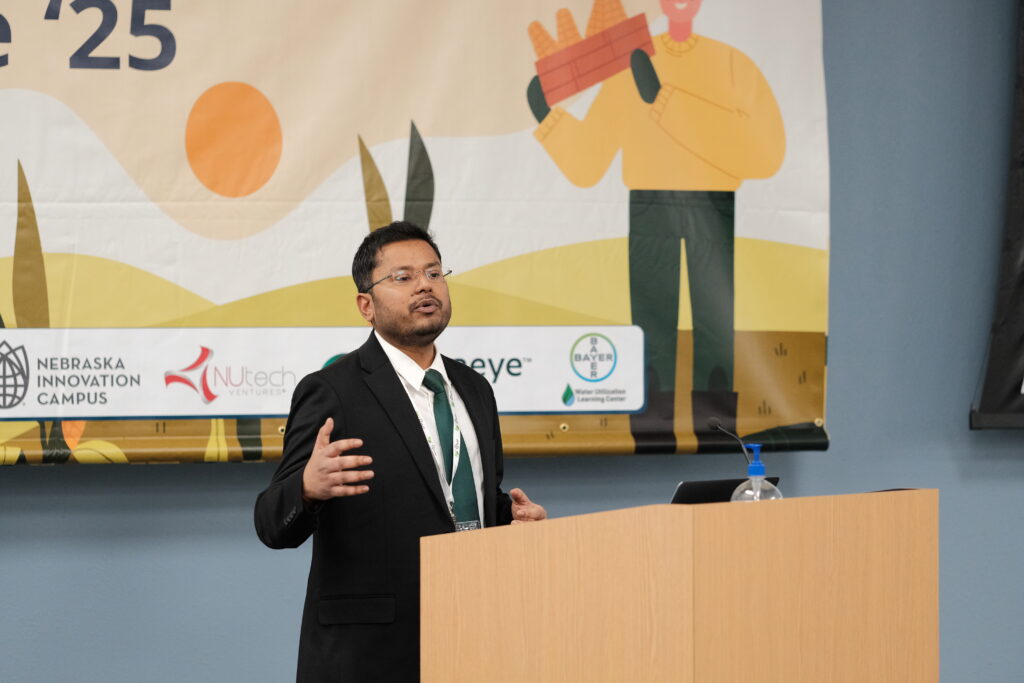
As the keynote speaker, Paulman set the tone for the day. On one hand, there’s a sense of possibility with agtech.
Innovation is moving faster than ever, and new ideas take just months to hit the market. Startups are tackling some of the biggest issues facing agriculture, from managing water and fertilizer use to repurposing older tractors for autonomous operations.
On the other hand, growers and producers are in tough straits. Low crop prices and trade wars mean Nebraska farmers are earning less, taking on more debt and struggling with rising costs.
Paying for new technology and dealing with the burden of adoption is increasingly out of the question. If startups or academics don’t prove their value in an easy, trustworthy and cost-effective way, their work is on the chopping block.
“We’ve had to make some difficult choices on our farm in the last few years,” Paulman said. “What’s the first thing to go … You’re the first to go. Everybody talks about (return on investment), and I certainly do myself.
“But the bottom line is, I have to have the ground. I have to have the seed, have to have the fertilizer, have to have the equipment, have to have the marketing, have to have the crop insurance. That’s inside that system. You are not inside that system, no matter what kind of product you have.”
A revamp on startup-producer relations
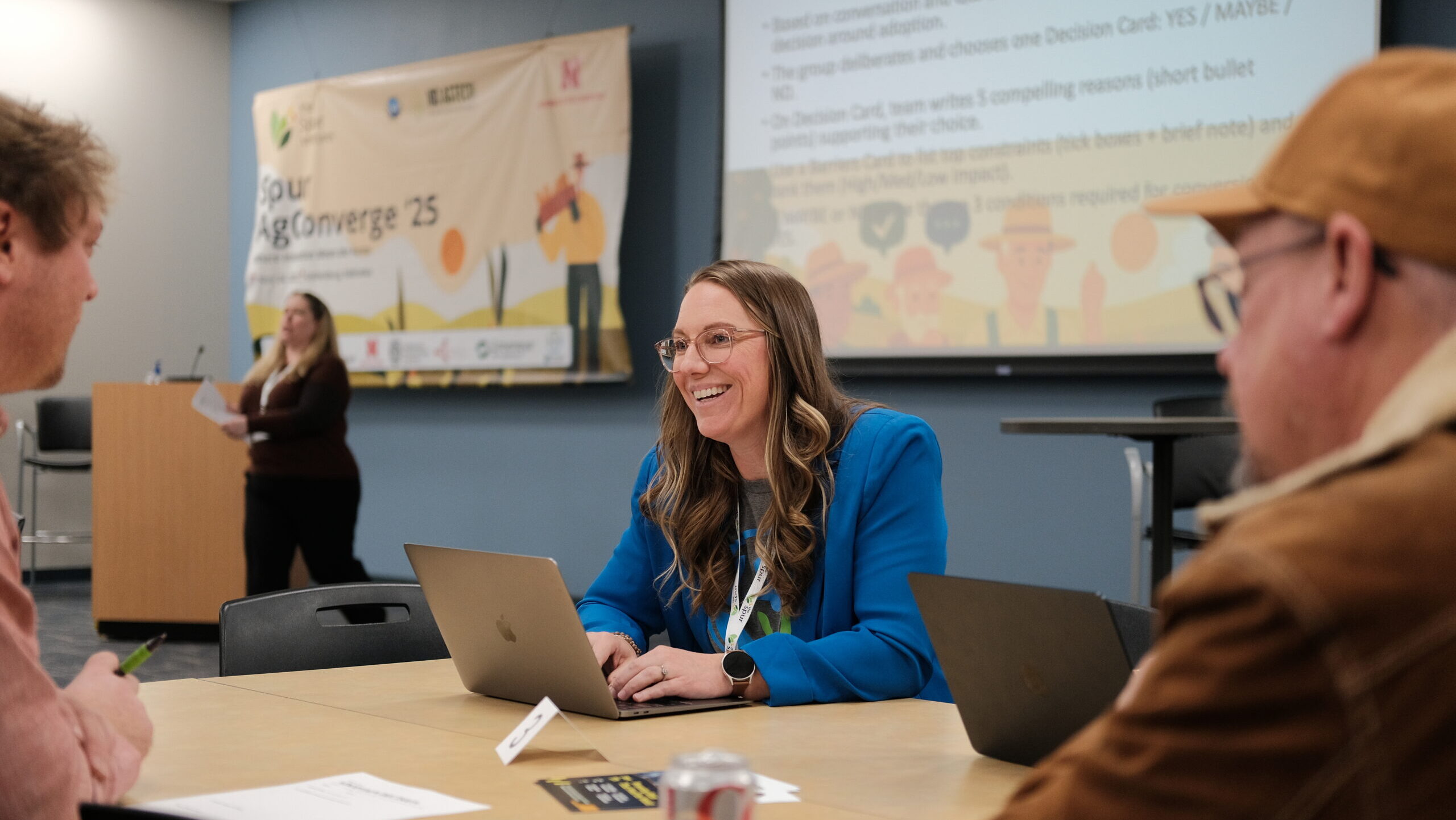
After lunch, nine startups sat down with farmers across five tables. Instead of the usual pitch competition format, the startups pitched themselves directly to potential customers — with the farmers presenting their thoughts on the startups’ viability to judges for a chance to win prize money for agtech adoption.
Conversations between farmers and startups revealed many of the nuances to real-life agtech adoption. Clark McPheeters, a fifth-generation Nebraska farmer with a background in engineering, mused on the state of moisture probes while evaluating two startups, iCrop and Nave Analytics, that are doing probe-less irrigation data analysis.
“One thing I’ve observed about probes specifically is that a certain reading on a probe at the beginning of the season doesn’t necessarily mean the same thing … at the end of the season, because the water has infiltrated and the soil all fits tighter around the probe,” McPheeters said.
Thinking about his family’s 7,500-acre farm, which is almost entirely run with center-pivot irrigation, McPheeters was upbeat about trying out the startups and signed a commitment to do so. He already checks three or four different weather apps to try to manage planting times and water use — why not try more in-depth data modeling?

The risk of new tech for producers also came up as farmers presented their takeaways to the competition judges. One farmer was interested in The Pennycress Company, a Nebraska startup that is bioengineering the hardy weed to be a sustainable aviation fuel source.
But “as someone who has been burned by very niche-grown commodities going to single-end users, if that single-end user isn’t there at the end of the year, what do you do with the storage bin full of this material that no one else wants?” the farmer said.
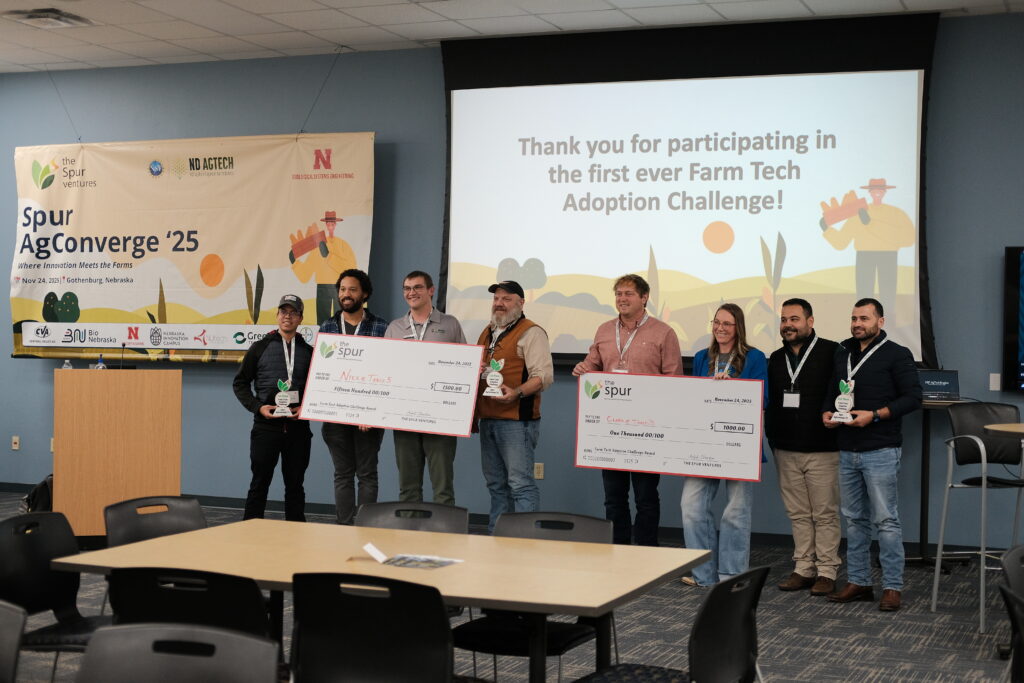
In the end, McPheeters took home the second-place $1,000 prize, with another farmer taking the first-place $1,500 prize to cover working with startups. Despite the economic squeeze farmers face, McPheeters sees an opportunity for startups to keep their heads down and hone their products for when the agriculture industry recovers.
For founders, having this opportunity to pitch farmers felt refreshing. “I love the idea of the new format, and the opportunity for us as startups to get the direct feedback from our customers,” said Jessi Korinek, CEO of Nave Analytics.
“Rather than having to make the connections on our own and drive out and go try to find a time to talk to a farmer individually,” Korinek said, “we got access to several opinions all at the same time.”
More producers and momentum wanted
A closing panel on industry and academia highlighted the aspirations and challenges to a cohesive agtech ecosystem in Nebraska. Many innovations start in places like the University of Nebraska System. But they don’t easily translate to real use.
“Research needs to be simple and also proven at the same time,” said Xin Qiao, an associate professor at the University of Nebraska-Lincoln. “A lot of the time, it’s not about the science itself, but the usability.”
Qiao talked about a disease-monitoring tool for sugar beets that took three years of testing — the first year to prove the science and the next two years to adjust the tool for industry needs.
On the industry side, there can be a hesitancy to partner with academia because of intellectual property and licensing costs. “Obviously, we’re a for-profit company,” said Kurtis Charling, vice president of global agtech sales and product management at Lindsay Corporation. “We have to … essentially mark up anything that we’re licensing, which gets passed to the farmer, and then we don’t have that ROI.”
Overcoming these challenges means building lasting relationships that don’t just vanish at the end of a conference like the AgConverge. It also means centering farmers — which can be a challenge with relatively few coming to these kinds of events.

“There are a number of other farmers who should be here,” said Don Batie, manager of Batie’s Farm in Lexington. “It’s a problem that I knock my head in the wall many times (over). How do I get my fellow farmers to show up and to try new things? And I don’t have that answer, but that would be a success story.”
Success also hinges on financing for both agtech and for farmers to drive adoption. Paulman tested one idea on the panel: A voluntary tax checkoff program for farmers and agriculture companies to contribute funding to innovation, which other states have.
Panelists were open to the idea, but struggled to see a viable implementation in today’s political climate. Still, they agreed that bolstering agriculture in Nebraska will require creative solutions and strong leadership.
“Technology has brought us to this point where, the economic viability of rural areas, there should never be more possibility than there is today,” said Bobby Brauer, director of geospatial data engineering at Bayer Crop Science.
“It doesn’t necessarily feel like that … You go to any rural high school in this state and easily encounter a really remarkable young person who would love to farm, but just has no viable path to that.”
Lev Gringauz is a Report for America corps member who writes about corporate innovation and workforce development for Silicon Prairie News.