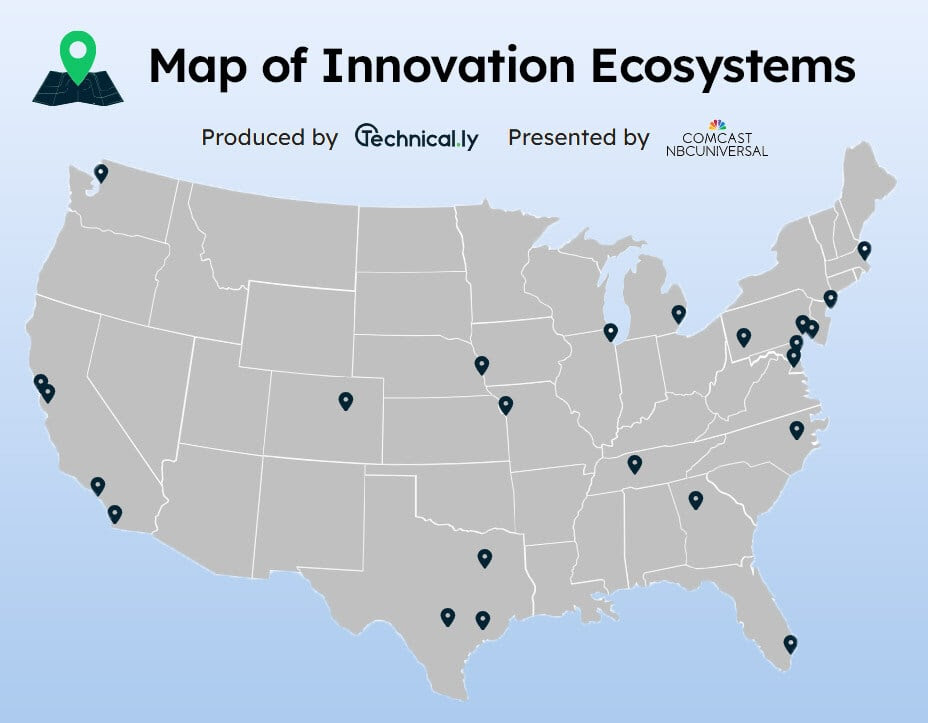
Founders, investors, policymakers and economic developers have a new resource to turn to for understanding the dynamics of startup ecosystems across the United States. The Technical.ly Innovation Ecosystems Map pulls data together to create snapshots of entrepreneurial communities in each state.
State summaries include their respective strengths, weaknesses, notable community connectors and best times to visit.
Technical.ly is a news organization that covers startup hubs, tech innovations and workforce patterns nationwide. SPN has partnered with Technical.ly to expand its own storytelling efforts.
In an article about the Ecosystems Map, Technical.ly Co-founder and CEO Christopher Wink said entrepreneurial ecosystem building initiatives have spread beyond being some “coastal niche.” He said these initiatives have played an important role in spurring economic activity, adapting to industry trends and creating new businesses.
Wink said that creating a ranking system is not the goal of the Ecosystems Map.
“It’s closer to a Michelin Guide,” Wink said. “It’s not telling every region to become Silicon Valley, but documenting what excellence, experimentation and ambition look like where they already exist.”
In addition to narrative summaries, the map provides data on such things as startup creation rates, the share of workers employed at new companies and research and development (R&D) expenditures. Data sources used include the US Census Bureau, the Economic Innovation Group’s Economic Dynamism Score and Technical.ly’s own Storytelling Score.
The Ecosystems Map builds on Technical.ly’s previous work breaking down the strengths and weaknesses of a limited number of startup ecosystems in its inaugural Innovation Index and map released in 2024.
Omaha placed last among the 24 selected hubs then, touting affordability and economic mobility but struggling with R&D spending and startup valuation and scalability. Ecosystems that led the pack included San Jose, San Francisco and Austin.
Under the updated map, Technical.ly highlighted Nebraska’s strengths in the agribusiness, logistics and finance industries. Additional advantages include its strong corporate base for these key industries, stable economy, long-running storytelling push and cheaper costs of living.
The weaknesses Technical.ly pointed to include Nebraska’s poorer showings in venture density and national visibility, as well as the “dependence” on only a few large employers in the market.
“The next step is turning consistent community-building into more breakout companies and a clearer statewide identity tied to agtech, logistics and B2B software,” according to Technical.ly. “Founders here tend to build practical B2B products that reach national customers early, but local capital is thin and many later-stage companies move or raise money elsewhere.”
Patterns noted by Wink when looking across state profiles include the important roles community support organizations and universities play in ecosystem success, as well as the repeated challenges of limited capital and workforces.
Wink said consistent collaboration and leadership is important to effectively convene, organize and communicate what hubs are accomplishing. Without the means to share accomplishments and opportunities, he said, communities can lose visibility, coherence and legitimacy.
“As competition for funding intensifies and attention fragments, the regions that succeed will be the ones that treat ecosystem narrative not as a campaign, but as shared civic infrastructure,” Wink said in Technical.ly’s Builders newsletter.
You can explore the Technical.ly Ecosystems Map here.