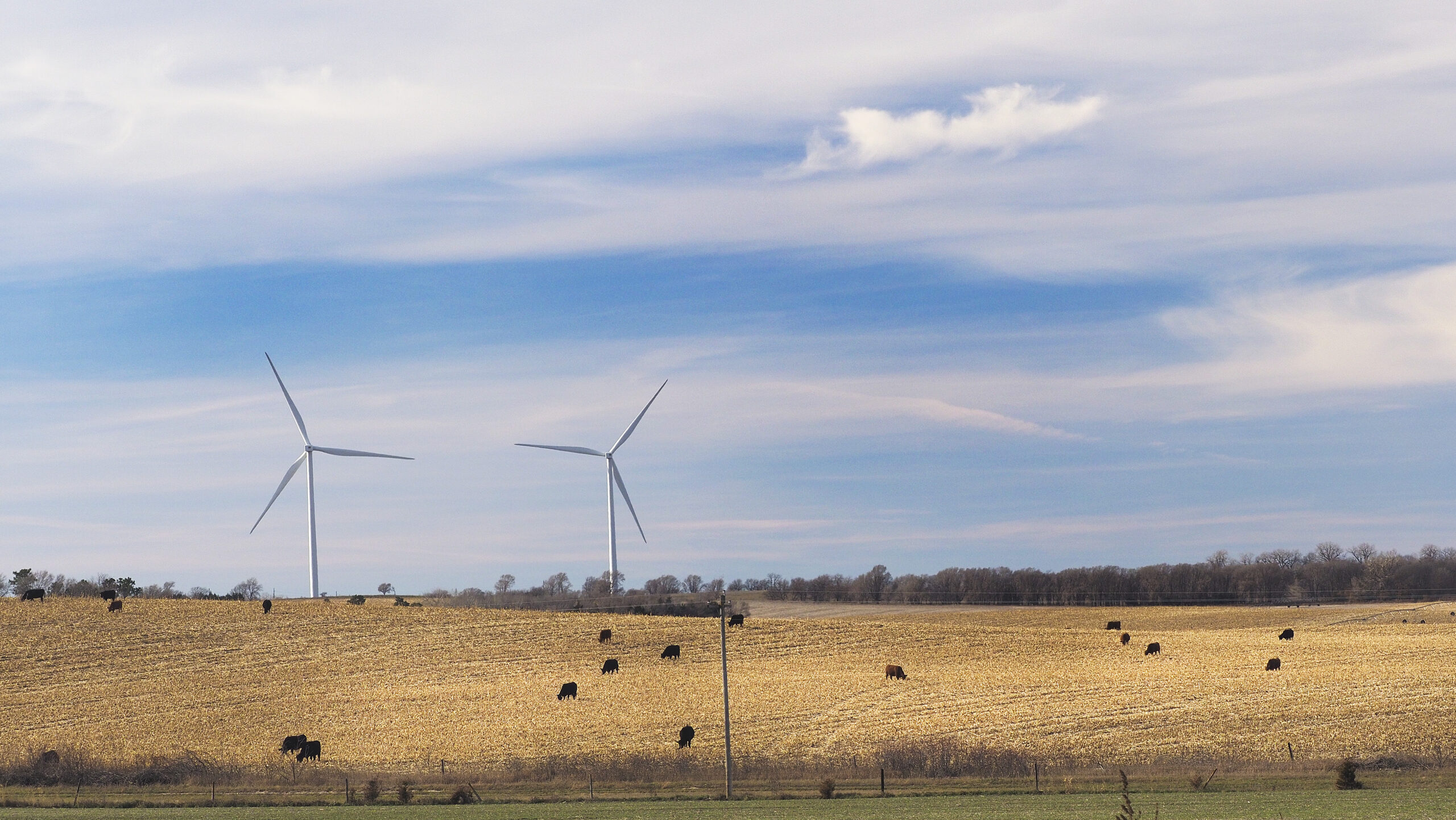
Nebraska versus Saudi Arabia. What could be a setup for a sports competition is instead an example of the global scramble for energy infrastructure squeezing economic development and innovation in Nebraska.
In this case, Omaha Public Power District, the electrical utility serving Nebraska’s most populous region, competed with Saudi Arabia to buy turbines to generate electricity.
“We have fundamental equipment that we need to serve (energy demand) that has five-year lead times on it,” said Joe Lang, OPPD’s director of generation strategy and origination. “If we enter into a contract today to buy a turbine, a transformer, a circuit breaker, etc., it’s five years before we can even have that piece of equipment here.”
Lang spoke at All The Above Energy, a March 26 event in Norfolk organized by the Nebraska Chamber Foundation as part of its Go Big Future series. The event was held in partnership with the state’s public power districts and energy companies such as Black Hills Energy, a natural gas utility.
The chamber convened energy developers, utility staff, state policymakers and local government officials. Conversations focused on how to address rapidly increasing demands for power driven by industrial clients such as data centers and high-tech manufacturing companies.
Attendees recognized that Nebraska is playing a chaotic game of catch-up to serve these large electricity loads. “I always thought the weather in Nebraska was one of the most unpredictable issues for us,” Lang said. “But I think load forecasting might have just passed it here in the past couple years.”
Staff from Aurora Energy Research, a consulting firm, presented early results from an upcoming report about Nebraska’s energy sector commissioned by the chamber foundation.
In it, they referenced data from OPPD showing that in 2022, residential, commercial and industrial clients each used about a third of OPPD’s energy. By 2032, industry alone is projected to use roughly 57% of OPPD’s power.
A generational shift
As demand increases, much of Nebraska’s power infrastructure will need to be updated or replaced. Aurora’s data showed that across generation types — like coal, steam gas turbines and gas peakers — power plants are often operating past their expected lifetime.
“There’s many ways in which plants can have lifetimes extended in very practical ways,” said Paden Williams, advisory senior associate at Aurora. “As these units approach end of life, that needs to be considered through the lens of reliability and meeting future load growth.”
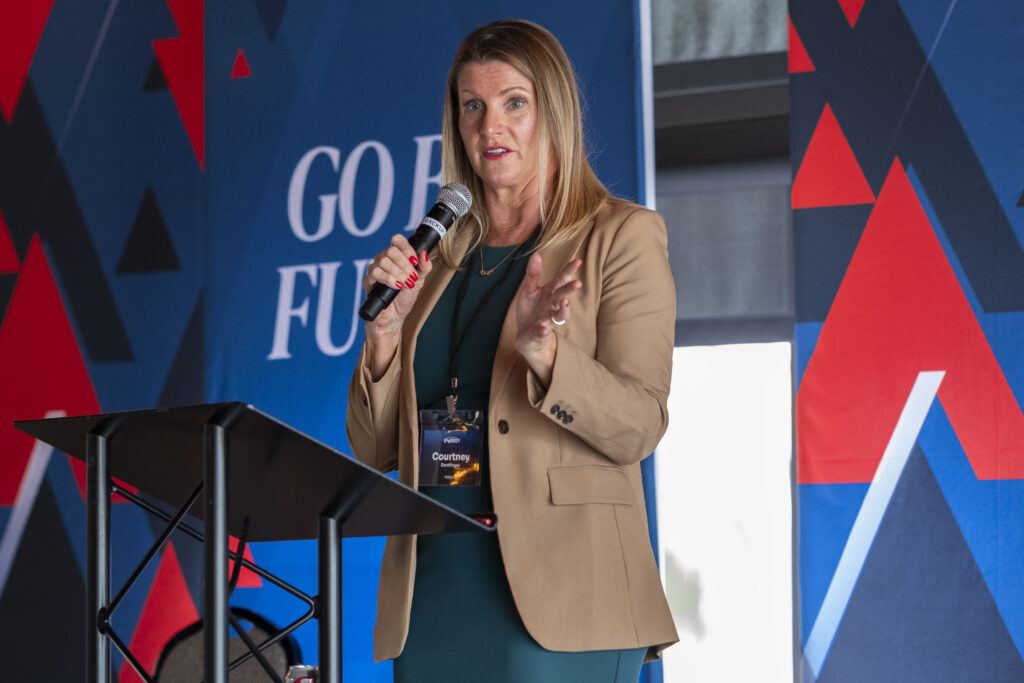
That’s exactly what Nebraska’s power utilities are doing, said Courtney Dentlinger, vice president of customer service at the Nebraska Public Power District.
NPPD is in the process of relicensing Cooper Nuclear Station for an extra 20 years of operation. The station, which came online in 1974, was previously relicensed to operate until 2034.
“We’re also looking at doing an upgrade, which would give us additional megawatts from that same (station) for minimal investment compared to a new facility,” Dentlinger said.
At the same time, new power generation is coming online. For a sense of scale, the city of Norfolk can use up to 85 megawatts, enough to power over 12,000 homes.
“Just in the last two years, we’ve added (the equivalent generation of) three and a half Norfolks to our grid” to NPPD, Dentlinger said. NPPD’s total power capacity is now around 3,000 megawatts.
“We haven’t seen growth like this since the 1950s, and the last time we had a really major buildout was in the 1970s,” she said. Meanwhile, potential customers with “huge” energy demands are knocking on the door — some asking for the equivalent of a third of NPPD’s entire power supply.
Local residents make or break energy development
The pressing need to meet rising energy demand is also a national security issue, said All The Above Energy speakers. The energy crisis sparked by the U.S. and Israel’s war with Iran made energy independence top of mind.
“I don’t want to go back there and fight for somebody else’s oil. I don’t want to fight for energy coming into the U.S.,” said Jennifer Herron, director of development at NextEra Energy Resources and a U.S. military veteran.
For all the pressures to deliver more energy, local obstacles regularly stand in the way.
When it comes to new development, county officials “often have the power to indefinitely sit on or deny the conditional use permits that you need for power plants,” said Gaurav Sen, the market lead at Aurora Energy Research.
“When developers receive an unfavorable ruling, they might not fight it due to the cost and expense and time of litigation,” Sen said. “One developer told us it’s not the cost that kills the project, it’s the uncertainty. It’s not knowing what the timeline is.”
Building new power generation can already take years. Herron spoke about NextEra’s investment in the Pierce County Energy Center, a solar farm and battery storage project expected to be completed by the end of 2026.
“We made multimillion-dollar bets in 2018 for a project that we knew couldn’t be built for anywhere from seven to 10 years later,” Herron said. NextEra received permits for the development in 2020 and 2024.

Finding a site for development, and getting approval, means navigating the needs of local officials and landowners, regulatory restrictions on location and the practical reality of transmission placement to connect power plants to the electrical grid.
Developers across Nebraska are struggling to convince residents that new energy projects, like wind and solar, are worth building. Meanwhile, areas that have welcomed development, like the northeast part of the state, have benefited from the nameplate capacity tax on renewables.
“Our county commissioners are seeing that on their bottom line,” said Luke Virgil, the economic development director of the City of Wayne. “Our school districts are seeing that on their bottom line. I don’t want to say they love it — nobody likes to say that they love a tax. But it makes their jobs easier year over year when it comes to budget planning.”
Event speakers, and Aurora’s survey data, made clear that energy stakeholders in Nebraska want state-level leadership to make development easier. Doing so will mean supporting county and municipal officials.
“Taking away control is not necessarily going to be something that wins the argument here in Nebraska, and so it’s finding a way to support the counties, to give them the resources at the state level that might help facilitate some of that economic growth,” Sen said.
Lev Gringauz is a Report for America corps member who writes about corporate innovation and workforce development for Silicon Prairie News.