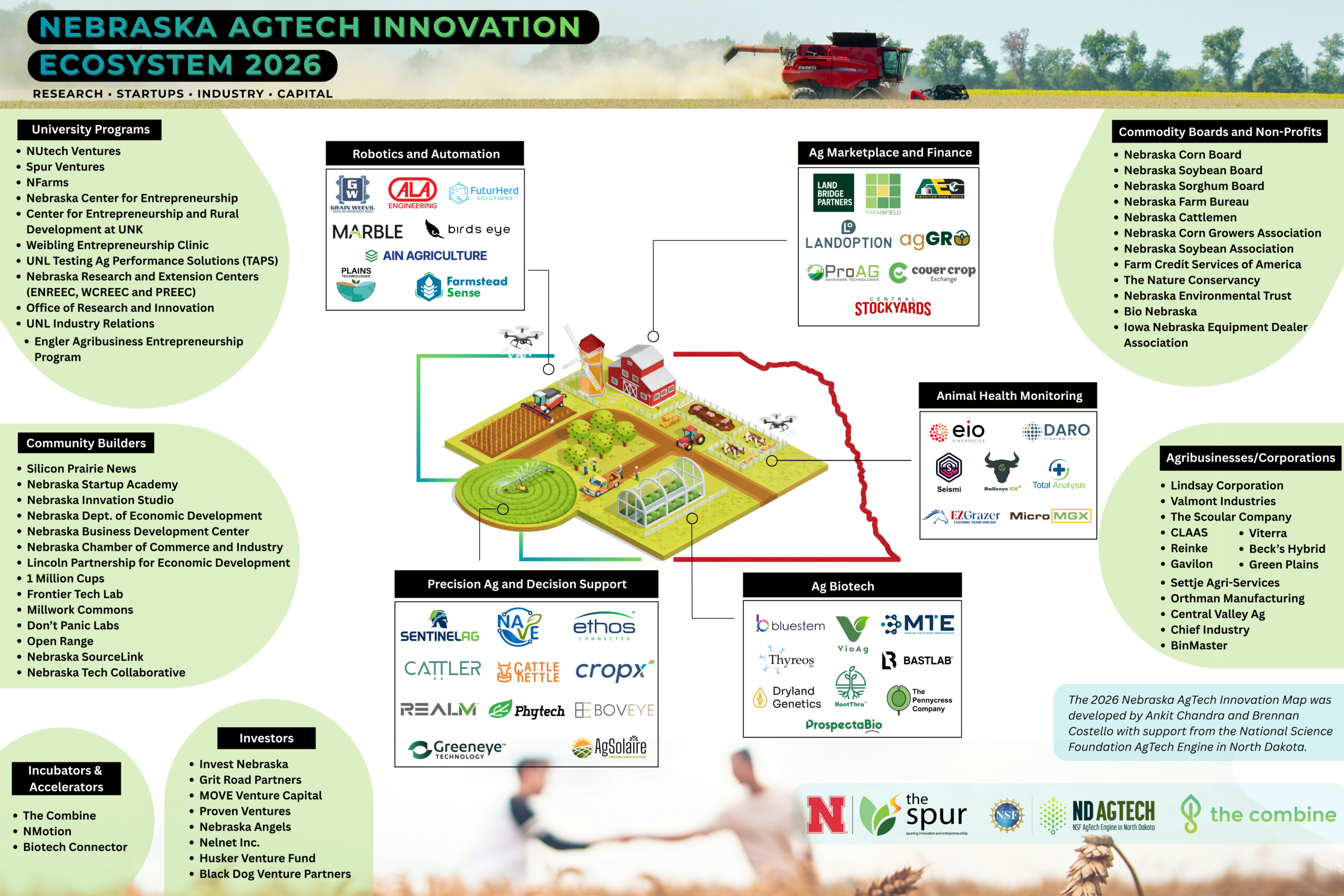
Nebraska’s agtech ecosystem has added roughly a dozen new startups since 2024, with a growth in such categories as animal and livestock monitoring, but few exits in that same time period. That’s according to a new 2026 Nebraska AgTech Innovation Map, the third such effort to track agtech in the state since 2020.
The map was developed by Spur Ventures, an initiative out of the University of Nebraska-Lincoln, and The Combine, the Nebraska agtech startup incubator and accelerator. It signals that the local agtech ecosystem is maturing quickly and that there is more support than ever for innovation in agriculture.
Ankit Chandra, the director for entrepreneurship in the Department of Biological Systems Engineering at UNL and founder of Spur Ventures, sees the map as an important way to help all agtech stakeholders navigate the ecosystem.
“As an investor, you can look around the map and see, OK, these are the startup companies … that hold value for you, where you can bet on them,” he said.
“For startup companies you can think of, ‘This is our competitor,’ or, ‘This is a business model,’” Chandra said. For researchers, “they can think of what kind of new innovative technologies they should work with.”
The map showcases about 45 startups and 60 supporting organizations across venture capital, ecosystem support groups, university programs and agriculture commodity boards.
Many of Nebraska’s agtech startups can be categorized as precision agriculture, robotics and animal health companies. Chandra also noted startups focused on novel business models, like Landoption and Land Bridge Partners, both helping farmers with land management.
But as it shows growth and areas of strength, the map also highlights potential holes. For Chandra, among the most notable is the lack of momentum around irrigation. That goes hand in hand with what seems to be tepid engagement from corporate Nebraska with agtech startups.
“It’s been interesting to see, what are some of the larger agribusiness companies and industry folks who are supporting these startup companies, and how that dynamic is working,” Chandra said. “Not a lot of success there. But companies like Lindsay have acquired two or three companies over the last couple of years.”
Corporate players like Lindsay, Valmont and Reinke are known for irrigation technology, which makes an opportunity for startup innovation all the more clear, Chandra said. Another potential hole: few startups working on the bioeconomy and turning Nebraska’s corn into other value-add products.
Chandra received funding support from the National Science Foundation AgTech Engine in North Dakota for the innovation map. It’s a sign that Nebraska’s startup ecosystem isn’t just important to the state but to the region as a whole.
The NSF AgTech Engine has “an interesting role to play, because they are looking into regional Midwest expansion around partnerships and collaboration,” Chandra said. Working with The Combine, meanwhile, is a great way to get and check data on startups, especially as many listed on the map are companies The Combine has helped incubate.
A more in-depth report based on the innovation map is coming at the end of May. Chandra interviewed agtech stakeholders for a closer look at what is and isn’t working in the state. That report will also compare Nebraska agtech funding and venture capital to other states.
That report will likely bolster what this map shows: Nebraska’s agtech ecosystem is continuing to find its feet. “We are getting there — learning to innovate, I would say,” Chandra said.