
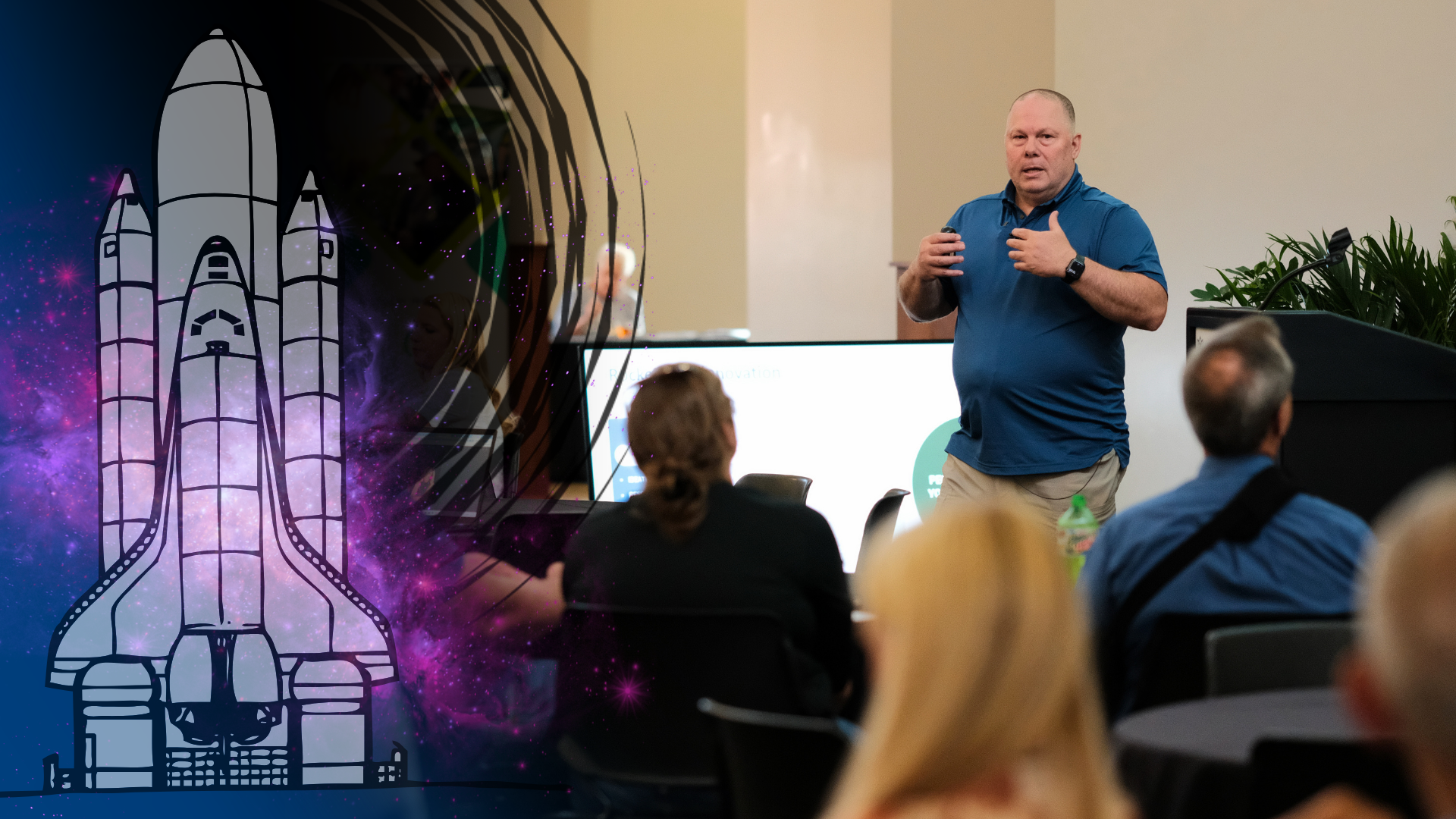
Chad Johnson’s usual titles are co-founder and CEO of Grain Weevil, the Nebraska startup building robots to make grain management safe for farmers. But over the course of learning about startup leadership, he has settled on a different title: Chief fuel attendant.
“My role is not to drive this rocket,” Johnson said. “My job is to provide rocket fuel.”
At the Agtech Connect conference in mid-July, Johnson gave a lunchtime talk about the aspects that make up Grain Weevil’s success and what other founders can learn from his approach.
Johnson celebrated Grain Weevil for going from rough prototype to 156 deployed commercial robots worldwide over the last five years. But he’s also clear the startup has a long way to go to fully realizing its goals.
“What is the process of going from a project in a garage to the company that we’re at now, which is barely at the beginning?” Johnson said. “We’ve learned how to fly with a paper airplane. And how do we get to the moon? That’s a big leap.”
Innovation is a strategy
Johnson often sees people thinking about innovation as a linear process. First comes research, then eventually prototyping and later business considerations for actually selling a product.
But that approach, he says, is a mistake. Founders can become enamored with their product and never realize that it has no market potential.
“As we start talking about an invention, an idea, and the research and testing … we’re nerds, man. We’re building robots in a garage — but is this a business?” Johnson said. “How much of my time and money and effort am I going to waste for five years to realize there’s no business here? I should have done that at the very beginning.”
Every stage of being a startup needs to be considered at the same time. That can, of course, be challenging with small startup teams.
But that’s also why it’s so important for founders to talk to and learn from everyone, be it business professionals or potential customers. Figuring out how to create a product breakthrough or adapt to customer needs can’t be done alone — or with artificial intelligence tools.
“We’re at a time right now that research seems to be pretty easy because you just hit (up) your best (AI) friend Claude and say, ‘Hey, tell me everything I need to know about this,’” Johnson said. “Well, yes, but there’s a lot more to it than that. As we really start to dig in on how to do research, well, it takes people, and I think we forget that a lot.”
Testing and learning
As Grain Weevil started to test robots in grain bins, Johnson said it was important to hear from a variety of people about how the robots worked. That can be a challenge in Nebraska, where the culture of “nice” meant many people told Johson how great his robot was.
“There are very few people that challenge us and push us,” he said. “Someone that rips off the Band-Aids … you have to have that. You have to have someone that’s going to take your robot, tell you it sucks.”
There’s often more to learn from someone disliking a product, something Johnson learned early on. In two trials Grain Weevil did, one farmer loved the robot and had a great experience.
But another farmer was annoyed by having to haul the robot up to the grain bins, and he practically never used Grain Weevil’s product for two years.
“We have learned as much from that as we did from the guy that loved the robot,” Johnson said. “Why? Because we didn’t move him. We didn’t provide him enough reason to use the robot, and that’s powerful.”
No startup success without help
Johnson considers the people willing to help and consult with startups to be additives to their rocket fuel. He had never stepped foot inside a grain bin before working on Grain Weevil, and he relied on insights from lifelong farmers and agriculture professionals to guide the company.
His three takeaways for startup founders:
1. Learn from everybody, be it from a 30-second conversation at a conference or a long-standing relationship.
2. Founders should also return the favor and be willing to help others.
3. “Build great machines.”
“That’s what we’re here for, right? Whether it’s software, whether it’s a company, whether it’s an ecosystem — build great machines,” Johnson said. “But celebrate the people on your path. Celebrate every person that has done anything for you along the way to building your company.”


Leave a Reply