
It’s been one year since Ankit Chandra officially launched Spur Ventures, the agtech technical support initiative, at the inaugural Spur AgConverge conference.
Chandra is already busy as the director and lecturer of entrepreneurship at the University of Nebraska-Lincoln’s Department of Biological Systems Engineering.
But with Spur, he’s still managed to help farmers and startups work on new tech adoption, brought international agtech startups to Nebraska to validate their technologies, created an agtech ecosystem map and planned for the 2026 Spur AgConverge on Nov. 17 and 18.
Now, as Spur Ventures hits its anniversary, the initiative is in growth mode. Chandra will soon be hiring for two full-time staff as well as interns.
And this year’s AgConverge is two days instead of one, aiming to spark more conversations and to help match farmers to the startups that can help them.
“AgConverge is not just another set of events where you’re networking or meeting with people or presenting your research and pitching,” Chandra said. “We try to make it an agenda (about) technology adoption and commercialization as one of the biggest ways (startups) can move forward and make progress and make an impact.”
Building in Nebraska
Nebraska’s agtech ecosystem has been supercharged over the last few years thanks to The Combine, the startup incubator, and agtech venture capital firm Grit Road Partners. But there is still a ways to go for the state to be the kind of agtech powerhouse that stakeholders want it to be.
Chandra saw a few ecosystem gaps that led him to create Spur and the AgConverge. He noticed that while traditional agriculture business was represented in UNL’s educational curriculum, there were fewer resources at the intersection of engineering and entrepreneurship in agtech.
“That’s a really different ball game because you can think of agribusinesses, you can think of general businesses and rural communities — there are (academic) courses for that, education for that,” Chandra said.
With the engineering side of agtech, there was also an opportunity to create a better academic structure around testing startup claims about their technologies. Independent research can help agtech startups have an easier time pitching farmers and investors.
But Chandra also knew that farmers have more than enough new technology to choose from. The core issue in agtech, instead, is whether and how they adopt those new technologies.
“You go to field demonstrations … farmers, they will chat with each other, ‘Okay, this technology was really good, maybe we can do something with that.’ Or, ‘It wasn’t really meant for our operations,’” Chandra said.
But there are few, if any, formal opportunities to let farmers tell startups what they need or to give feedback on ideas.
That led Chandra to the cornerstone program of the Spur AgConverge conference: The Farmers Tech Adoption Challenge (FTAC).
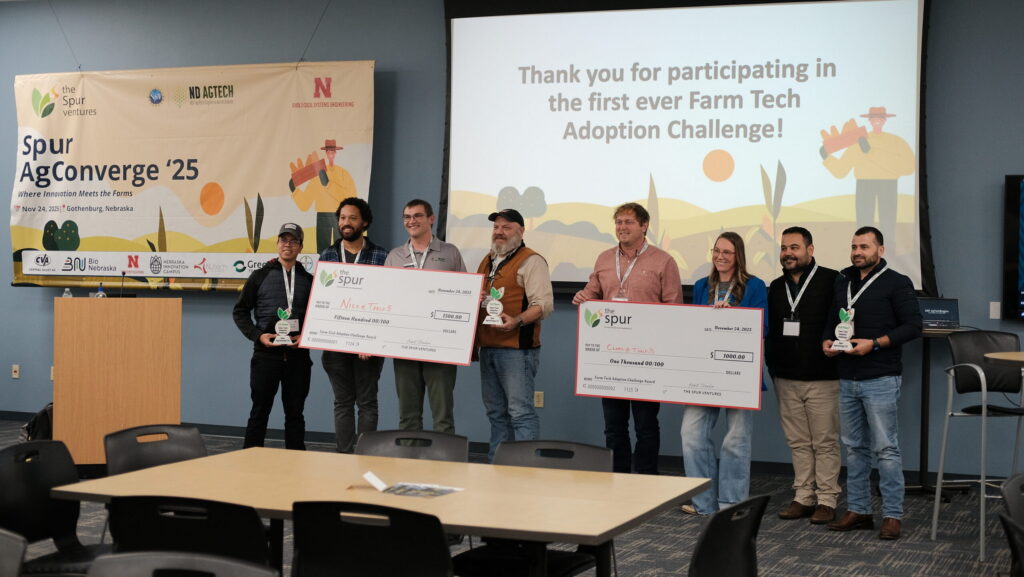
Instead of a classic pitch competition, startups present to farmers and then farmers can ask questions and dig in during a roundtable format. Money is set aside for farmers to help them test out startup technologies — if they see value in their conversations with the startups.
Last year, nine startups pitched during the FTAC, with five receiving commitments from farmers to adopt their technology.
“We were not expecting that so many startups will move to on-farm deployment,” Chandra said. “That was a big success for us. And that really gets me emotional because that was the whole intention.”
Digging in at AgConverge
AgConverge will look back at the past year of the FTAC startup tech adoption with a “Founder x Farmer Fireside Chat” to see what did and didn’t work for one startup and Nebraska farmer.
Chandra also hopes to have conversations about other aspects of agtech emerging recently, like the joint Iowa-Nebraska NSF RuralSTAMINA Biomanufacturing Engine that lines the region up for up to $160 million of federal investment.
One panel will include NSF engines from Tennessee, Colorado, North Dakota and RuralSTAMINA to talk about the model and how federal dollars are commercializing more agtech.
Another will, on a similar note, discuss the state of the bioeconomy industry in Nebraska, which RuraSTAMINA is aiming to boost.
And to celebrate the International Year of the Women Farmer, a mix including a startup founder, farmer and staff from agtech support organizations will be represented on a “Women in Midwest Agtech” panel.
With any luck, more farmers will walk away this year with funding and a partnership with a startup to try out new technology on their farm.

Leave a Reply