The holy grail of anti-inflammatory drugs may have been invented at the University of Nebraska Medical Center — and now a $6.5 million seed raise will help a startup test if it really works in humans.
If successful, what is known as the 11h drug could help alleviate the symptoms of, or directly treat, diseases from Alzheimer’s to multiple sclerosis. It could make difficult treatments for many illnesses easier to tolerate for patients. And it could become as ubiquitous as Tylenol.
But proving that the drug works (and doesn’t have negative side effects), plus getting through the tangled regulatory framework for pharmaceuticals, won’t be easy. The journey highlights the opportunity and pitfalls for therapeutics startups.
“The promise is huge. You’re basically Dora the Explorer. You’re going where no one else has,” said Dev Chatterjee, CEO of Goldenrod Therapeutics, named after Nebraska’s state flower. “If you do it, it’s going to be transformative. But can you do it?”
With a first close at $3.25 million and more investors lined up to complete the seed raise, Goldenrod can get started applying to the U.S. Food and Drug Administration to have 11h designated as an Investigational New Drug.
With that in hand, Goldenrod can gear up for phase 1 clinical trials to check safety in humans. Initially, the trials will be to test 11h as a co-treatment for Friedreich’s ataxia, a rare neurodegenerative disease.
With any luck, within two years the startup will know if its miracle drug can make it to the big leagues or if it is too good to be true.
“Drug development is one of the areas where the impact is so potentially big,” said Michael Dixon, the CEO of UNeMed, the tech transfer office for UNMC. UNeMed holds the patent for 11h, and is a partner with Goldenrod and its development of the drug.
“We’re also realistic that it’s incredibly difficult to get a drug approved — safety, efficacy, all the things that you need,” Dixon said. “So I’m not counting chickens before they hatch yet. I’m cautiously optimistic.”
Homegrown
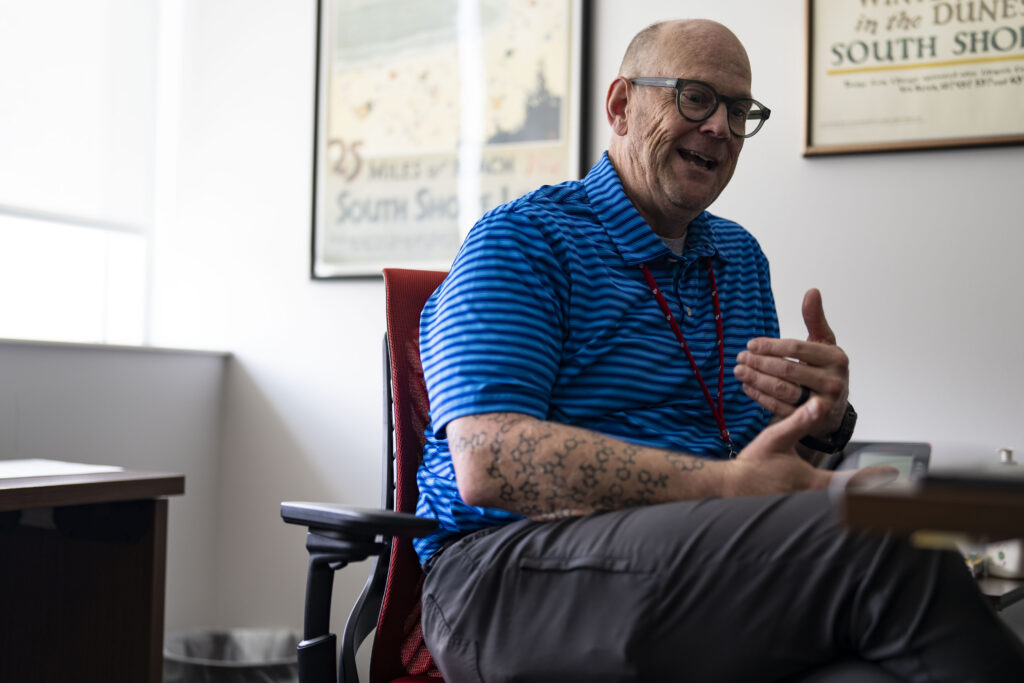
In 2016, Corey Hopkins, a professor and chair of the UNMC Department of Pharmaceutical Sciences, joined the medical center after working on drug discovery in both industry and academia.
At the time, pathology professor Tammy Kielian was testing if an inhibitor drug for the enzyme phosphodiesterase-4 (PDE4) could treat Batten disease, an incurable genetic disease in children. The drug showed promise, but with it being owned by pharma company Pfizer, there were certain conditions for research.
“We thought we could try and maybe make something new and novel that wouldn’t have any restrictions for research,” said Hopkins, who is also director of the UNMC Center for Drug Design and Innovation.
PDE4 is a complex protein involved in inflammatory pathways across many diseases. For decades, researchers have been testing ways to stop the protein from having an effect.
But so far, inhibitor drugs have caused nausea and vomiting when used to treat conditions in the brain — one of the most effective places to treat diseases. So most PDE4 inhibitors are targeted at specific body parts and at low doses.
Finding an inhibitor that doesn’t cause nausea and vomiting, and can be used at higher doses, may very well change modern medicine. It was an enticing challenge for Hopkins.
Using a crystal X-ray computer model of the PDE4 proteins, Hopkins and the students in his lab tested different chemicals that might block it.
“It’s sort of a lock and key. So the lock is the protein, we’re making the key, and sometimes you have a door that the key doesn’t quite fit, but if you jiggle it enough, it’ll work,” he said.
After about 150 tries, they created the chemical 11h. That’s relatively fast in the world of drug discovery. “There are many times you make 5,000-6,000 compounds before you find the one that’s going to be the drug,” Hopkins said.
Seeing the potential, UNeMed filed for a patent for 11h in 2019. Hopkins’ lab continued to test the chemical and published a paper in 2020 on how 11h could treat cocaine addiction in mice.
Most patents don’t find a home or get spun out into startups. But at a conference in 2020 where Hopkins’ mouse cocaine paper was presented, Fannin Innovation Studio, a Houston-based company, was paying attention. Soon, they were in touch with UNeMed.
A different model for drug development
Away from his CEO duties at Goldenrod, Chatterjee is also the managing director at Fannin. Its innovation studio model helps take on the risk of new technologies that universities, corporations and venture capital may be hesitant to invest in as part of a larger shift in the tech transfer world.
“If there’s a finishing school for the technology, where somebody completely unbiased takes a look at it and sees whether it has got the legs or not, then if it spins off, the investor feels a lot more confident,” Chatterjee said.
Fannin looks for research that not only is promising but supported by inventors and tech transfer offices that are willing to collaborate. With 11h, UNeMed and Hopkins, Fannin found a winning combo.
The company licensed 11h from UNeMed in 2020 and continued testing if the drug was viable for clinical trials. The results were encouraging.
In one set of experiments in ferrets — the gold standard for nausea testing — 11h didn’t cause nausea or vomiting even at the highest tested doses, outclassing another PDE4 inhibitor on the market today.
But Fannin also needed to be strategic. Clinical trials and drug approval can be long, expensive and grueling processes if treating well-known diseases like Alzheimer’s. Aiming to help with a rare illness, however, could fast-track that process, making it much more viable for a startup.
A rare disease may mean clinical studies with fewer participants that are less expensive and easier to manage. It also includes the opportunity to apply for the FDA’s orphan drug designation.
That can give Goldenrod incentives such as tax credits and a drug priority review voucher, which can be auctioned off to other pharma companies to recoup a startup’s costs.
Eventually, Fannin settled on trying to get 11h to market to help treat the rare disease Friedreich’s ataxia, in part because of support from its advocacy group, the Friedreich’s Ataxia Research Alliance.
“They actually took the drug and sent it to one of the experts who tried it out, and then they came back and said ‘We really encourage you to take this forward,’” Chatterjee said. “So that was a huge stamp of approval, and we think that that’s going to help us.”
While the legal shell of Goldenrod was created in 2023, the startup fully launched this year. It is sub-licensing 11h from Fannin, and its seed round is supported by Ataxia Ventures, a VC firm focused on ataxia treatments.
Small wins on a long journey
For Hopkins, watching his chemical take baby steps toward full-fledged human testing and approval is gratifying. He has had many patents, most of which go nowhere or, in at least one instance, have been picked up by a company that found no success.
“I think for every 10 compounds that start clinical trials, one becomes a drug. And before that, (out of) 1,000 compounds, one goes into clinical trials,” he said. “The odds are not good, but we’ll take whatever we can, whenever we can.”
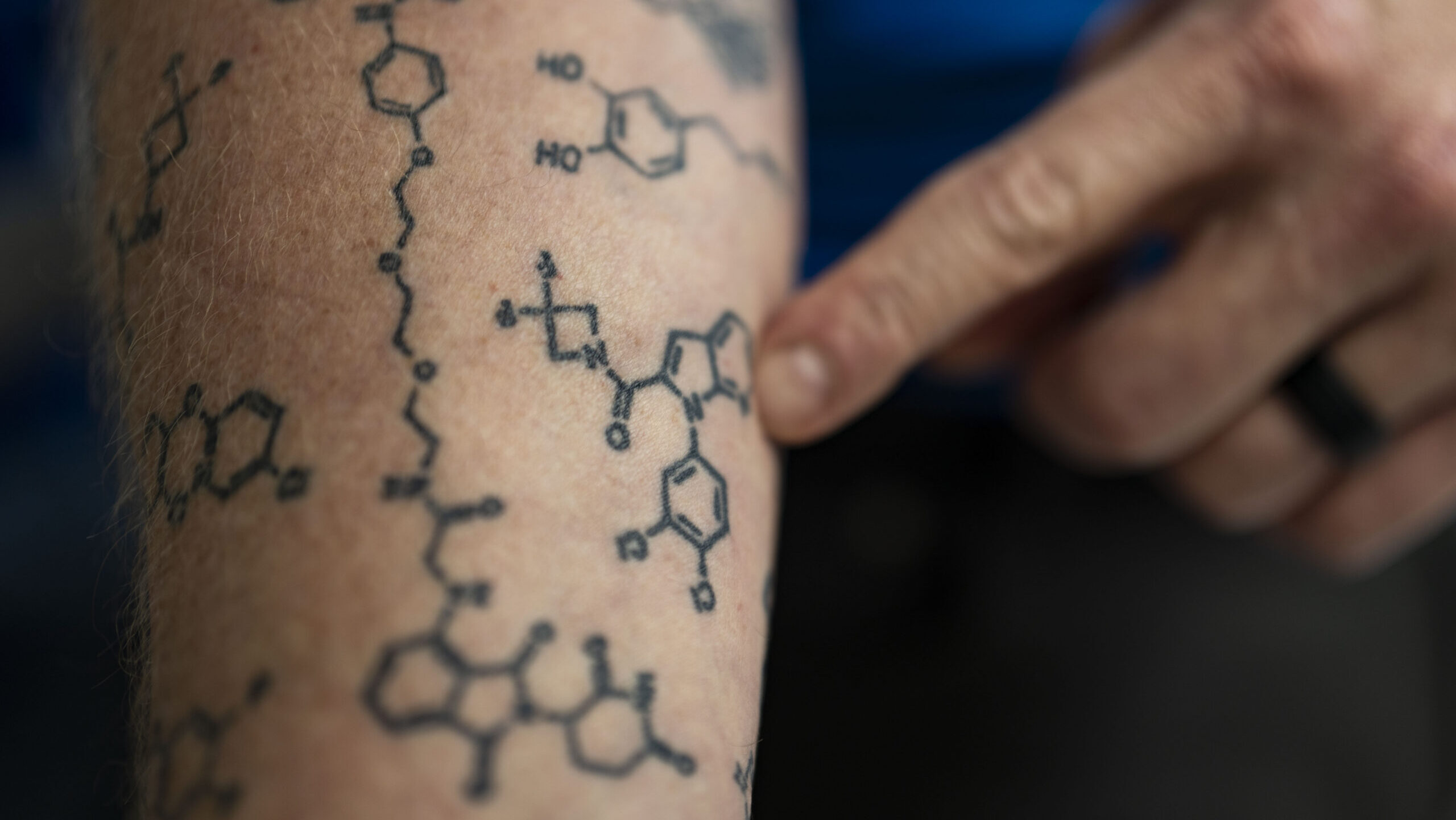
One of the ways Hopkins celebrates small wins in the drug discovery process is by getting tattoos on his arm of chemicals, created in his lab, that are successfully tested in animal models.
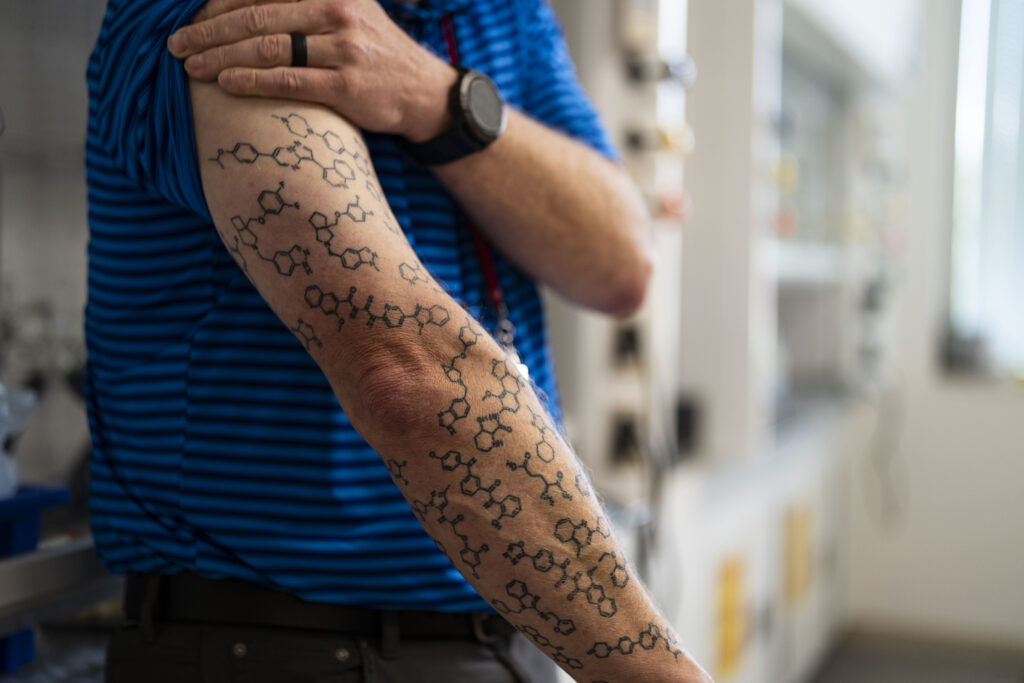
Inspired by people who tattooed the chemical form of caffeine on themselves, Hopkins started about four years ago with an image of a brain and the formula for dopamine.
The second tattoo — and the first of about 36 patented chemicals now on his right arm spanning over a decade of work — was 11h.
Hopkins continues to be a scientific adviser for Goldenrod. And while he’s happy to be involved, he’s just as glad to not be in the weeds on commercializing 11h.
“I worked in industry for nine years … so I do have a lot of that expertise of what it takes to get a compound” to market, he said. But now, “I already have a full-time job that I enjoy … so having (Fannin) come in and take the helm is great. Otherwise, I don’t think it would be done if it were simply up to me.”