Before Carrick Detweiler became co-founder and CEO of Drone Amplified, the Lincoln-based startup that uses drones for fire and avalanche management, his company’s foundation was quietly laid at the University of Nebraska-Lincoln. There, Detweiler was a full-time professor and researcher working on unmanned aerial vehicles.
Detweiler was motivated by questions like, “What can you do with drones that’s beyond taking pictures? How can you interact with the world and change the world?” He and other UNL researchers explored leveraging drones for such uses as water sampling and firefighting.
Along the way, the researchers handled what might seem like banal paperwork: Filing invention disclosures with NUtech Ventures, UNL’s tech transfer organization, for new ideas the team developed.
The new ideas included methods to stop and start fires with drones and new control systems. NUtech decided the ideas were unique enough to apply for a federal right to exclusivity and, around 2014, filed for several patents on which Detweiler is listed as a co-inventor.
Doing so was a risk for NUtech. Filing just one patent can take $20,000-$25,000, and there’s no guarantee patented technologies will get commercialized. Patents also take years to be approved.
That’s the kind of risk that tech transfer offices take all the time. It’s how they support Nebraska’s university innovation to spin out into real products that help people.
This tech transfer pipeline can take years, even decades. And it involves a smorgasbord of work that supports the earliest technical research all the way to established startups.
NUtech’s patent filings were foundational for Drone Amplified, which was built on Detweiler’s UNL research. He started the company in 2017.
The patents, now licensed from NUtech, helped gain investor confidence and legally protect Drone Amplified from knockoff products. Both would have been more difficult without NUtech.
As a professor, Detweiler said, “I didn’t have $20,000 that I was like, ‘OK, I’m gonna patent this idea.’” In the years before starting Drone Amplified, he wasn’t sure about what direction the startup might take.
NUtech “paid that upfront cost that I would have been pretty hesitant on,” he said. “These were pretty early ideas that we developed in the lab and had a lot more work that needed to be done to actually … make a market for it.”
A helping hand
Universities take in millions of dollars in state, federal and industry funding every year to support faculty and students toiling away in labs. They often work on early stage research that is nowhere near ready for commercial applications.
Tech transfer offices are there, even at the earliest stages, to support research as it works toward making the world a better place — ranging from new disease therapies to agriculture startups like Sentinel Ag.
“For every dollar that we take in federal research, the taxpayers want to see that the research that they’re investing in is meaningful,” said Cheryl Horst, the executive director of NUtech Ventures. “Not just something that gets stuck in a laboratory.”
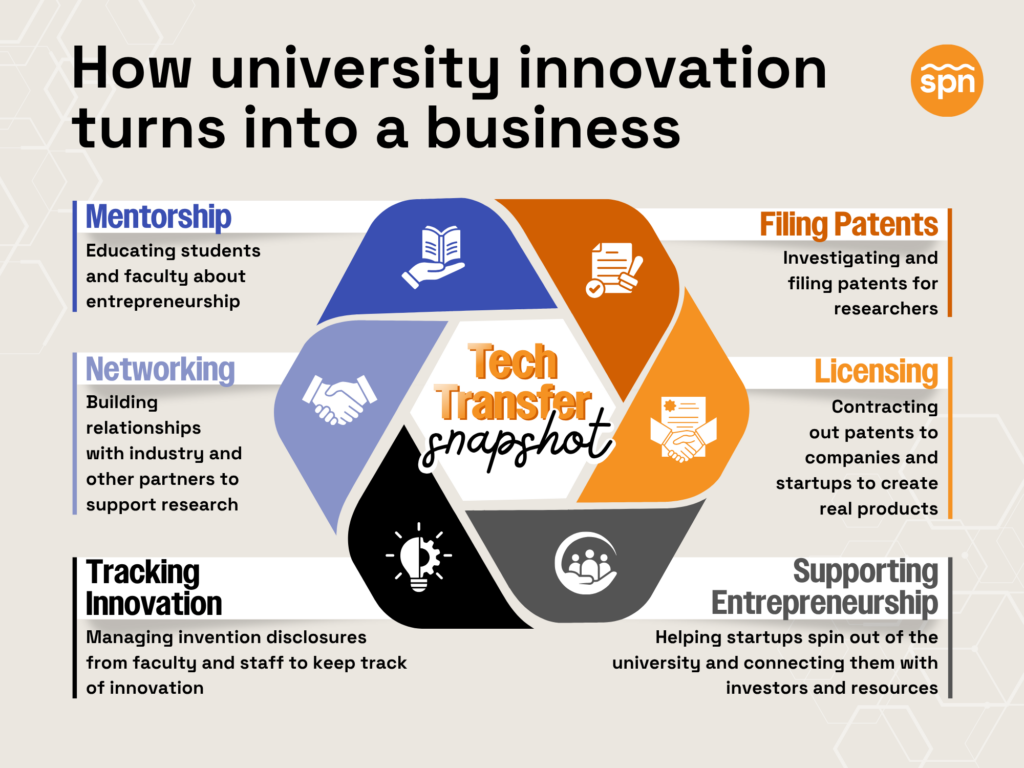
That means facilitating material transfer agreements to get faculty research tools. Or, if some early research develops enough, contracting with industry or nonprofit partners to mature a technology that can be licensed to a company or spun out as a startup.
This occurs as the tech transfer offices keep track of invention disclosures and evaluate ideas for patents, copyrights and other intellectual property filings.
Unlike the “built in a garage,” move-fast-and-break-things kinds of startups that often catch attention, university research generally takes more time to develop commercial uses.
Regulatory hurdles abound, especially for medical- and health-related technologies. That’s a specialty of UNeMed, the tech transfer organization for the University of Nebraska Medical Center and the University of Nebraska at Omaha.
Jason Nickla, the director of intellectual property at UNeMed, remembers working on early patents for what later became Virtual Incision, the Nebraska robotic surgeon startup, as an intern at UNeMed’s precursor office in 2003.
It was only in 2024 that Virtual Incision’s robot was approved for use by the U.S. Food and Drug Administration. It’s not unusual to see similarly long journeys for other university startups.
“The researcher might have been here 20 years ago, where we got that first material transfer agreement,” Nickla said. “Then five years later, disclosed an invention. Ten years later, we’re licensing a patent application to (their startup). And then five years after that, we’re talking with them about competitors in the market.”
Beyond the paperwork
Tech transfer isn’t all about the bureaucracy of contracts, patents and licensing. Instead, core to the work is building relationships — with researchers, industry partners and entrepreneurship support systems.
That networking is what benefited Xiaoqing Xie the most as the co-founder and CEO of A+ Berry, a food tech startup. Over a decade ago, Xie was a professor of food science and technology at UNL researching the nutritional value of aronia berries.
Every time she went to pick aronia, farmers asked if Xie knew anyone who wanted to buy them. Despite health benefits, aronia has little market because of their dry and bitter taste.
So Xie, together with her husband, then a UNL researcher, figured out a way to process aronia to keep its health benefits and improve the taste without adding sugar. NUtech helped patent the technology, which Xie expected to get licensed by food companies.
“For faculty, once they have a patent, they just want to give it to some big players in the market,” Xie said. “That was our plan at the beginning.”

But many aronia companies closed during the COVID-19 pandemic. So Xie felt there was only one way to go, given that they had the patent and the industry connections. “Why don’t we just build up the business,” she decided.
NUtech coached Xie and A+ Berry along the startup path after its 2021 founding. They helped put together a business plan, introduced A+ Berry to the NMotion startup accelerator and connected the startup to retail stores to sell aronia products.
It can be a difficult transition from academia to entrepreneurship. “With my professor hat on, it’s like, ‘OK, we’ve done 80% of the work. We’ve demonstrated (a new technology),” Detweiler said.
“Then I put my Drone Amplified CEO hat on: ‘Well, that was really only 20% of work. We still have 80% of the work to do to make it something that people can use in the field,’” he said.
But the process is also important. As Xie sees it, A+ Berry is opening the market for aronia berry products, including using the juice as a recovery drink for UNL sports teams — giving farmers a much-needed extra income stream in the process.
For tech transfer staff, helping researchers become business leaders is meaningful work. It feels part and parcel of the university mission to educate and develop the talent of tomorrow.
“It’s so fun to watch how they start thinking like a researcher first, to an entrepreneur towards the end,” said Jeewan Jyot, the director of licensing at NUtech Ventures.
And like the rest of the startup ecosystem, tech transfer can also support the economic success of Nebraska. Growing university research into tech companies can attract and retain highly skilled workers and boost innovation.
“We are able to bring in talent which is more (science, technology, engineering and math) focused,” Jyot said, “creating the opportunities and economic impact for the state and the community as a whole.”
Lev Gringauz is a Report for America corps member who writes about corporate innovation and workforce development for Silicon Prairie News.