

For tech transfer offices in Nebraska working to strengthen the university research to commercialization pipeline, there’s an essential tool: the U.S. Small Business Innovation Research (SBIR) and Small Business Technology Transfer (STTR) programs.
Federal agencies set aside money for SBIR/STTR, which, often nicknamed “America’s seed fund,” support early stage small businesses and startups.
The funding is for turning highly technical and specialized technology into market-ready products. While often a good match for entrepreneurs coming from universities, any startup can apply and be eligible.
SBIR/STTR were briefly shuttered while Congress worked to reauthorize the programs this spring. Now, some of the rules have changed. But agencies are still encouraging people to apply.
“Around forty percent of our awards go to first time awardees,” said Adam Sorkin, a small business policy manager at the National Institutes of Health (NIH). “So if you’re new and just getting started, I really hope you’re not dissuaded from working with us. We’re very used to working with companies and entrepreneurs like yourself who are just entering the program.”
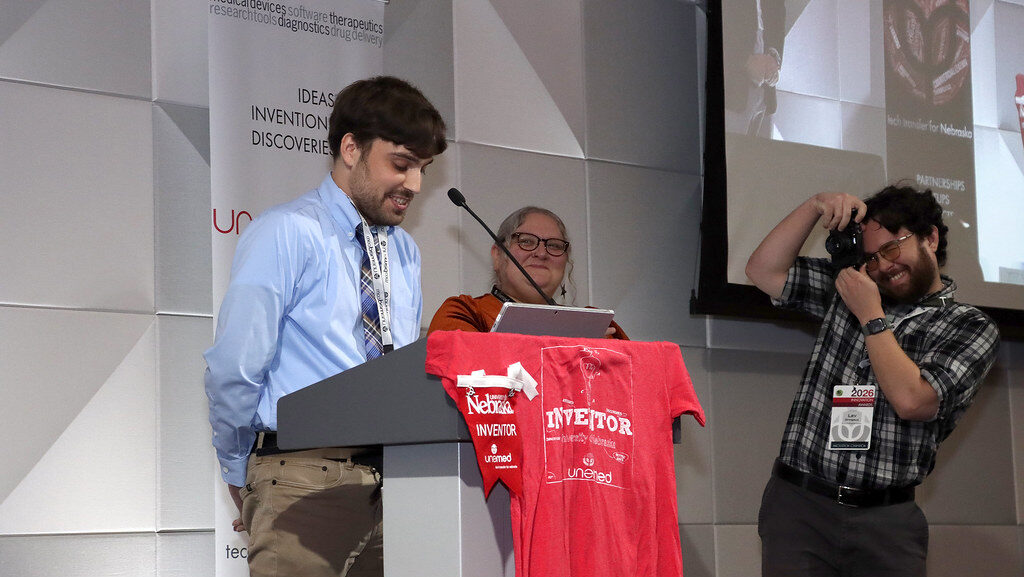
Sorkin spoke during an Oct. 16 virtual panel hosted by UNeMed, the tech transfer organization for the University of Nebraska at Omaha and the University of Nebraska Medical Center.
Held as part of UNeMed’s Innovation Week, the panel featured various institutes under the NIH to speak about their SBIR/STTR programs. While the institutes are naturally more health-focused, their advice can apply to any entrepreneur pursuing SBIR/STTR funding from any federal agency.
Why SBIR/STTR
For entrepreneurs wary about funding from the federal government, the SBIR/STTR programs are a proven success.
The NIH has spent roughly $1.4 billion each year over the last few years on the programs. At the National Institute of Neurological Disorders and Stroke (NINDS) alone, data from 2008-2016 speaks to what that funding unlocks.
“One out of four of the companies (funded then through SBIR/STTR) have exited already through an IPO, a license deal or a merger,” said Annette Gilchrist, the program director for drug development at NINDS. “Over $15 billion in private and public funding have followed the $420 million that we put in (in that time).”
Best of all, SBIR/STTR grants are non-dilutive, so federal agencies don’t take any equity stake in the startup.

Federal agencies also have a wide range of technologies that they will fund. The NIH, for example, is keyed in on medical breakthroughs like vaccines, drugs and medical devices that can help people.
But in an age where computers are integral to healthcare and medicine, digital health products and software solutions are also on the table.
Do’s and don’ts
But the overlapping interest from different federal agencies and institutes toward similar technologies means that entrepreneurs need to be prepared and informed when applying for SBIR/STTR.
The NIH program managers on UNeMed’s virtual panel all emphasized that startups should reach out early to speak with SBIR/STTR managers at federal agencies. That way if an application is better suited for another agency or needs to be adjusted, changes can be made in time.
The program managers also emphasized that late applications are no longer accepted, so startups need to apply on time to be eligible for funding.
Otherwise, entrepreneurs coming from academia need to be self-aware when applying. One mistake they often make is approaching the SBIR/STTR program as a funding source for new research, rather than business development and commercialization.
“For example, if you are developing a new therapeutic for asthma, one of the things that we’re going to be looking for is to support things such as preclinical screening, testing, and development of a drug,” said Stephanie Davis, the small business program coordinator at the National Heart, Lung and Blood Institute.
“We’re not necessarily going to be looking for a very in-depth identification of the molecular pathways that this drug activates,” she said.
Another mistake is not putting together the right team for the funding program. Entrepreneurs need to bring on people to flesh out expertise they may not have –– and federal agencies are paying attention when they do.
“Maybe you’re great at discovery, but you haven’t done a lot of neuroscience and you’re not familiar with the animal models for epilepsy,” Gilchrist said. “You have somebody join your team even as a consultant that has that expertise, and it’s clear within the application that you have already defined who is going to be your role person in that particular area.”

Leave a Reply