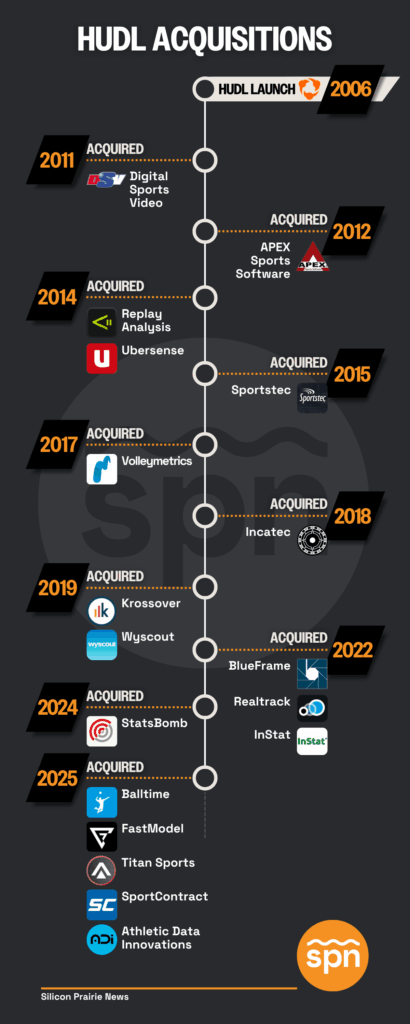
Lincoln-based sports tech company Hudl announced in late October the acquisition of Athletic Data Innovations (ADI) out of New Zealand. This deal marks Hudl’s 18th acquisition since its founding in 2006.
In an email to SPN, Hudl leadership said the company has scaled from three co-founders to over 5,000 employees across 25 countries. Hudl offers a range of software solutions and smart cameras to assist athletes, coaches and athletic departments with their operations, such as capturing and analyzing athlete performance data.
According to the announcement, ADI Founder Andrew Gray will join the Hudl team. Gray’s expertise and platform will help Hudl advance its data collection and analytics capabilities. Currently, the Nebraska company supports more than 344,000 sports teams worldwide with its offerings.
Hudl has deep ties to Lincoln. Co-founders David Graff, Brian Kaiser and John Wirtz began working on the company during their time at the University of Nebraska-Lincoln’s Jeffrey S. Raikes School of Computer Science and Management. Hudl’s headquarters is still located in the state’s capital.
“Lincoln is where our story began and where we continue to find the right mix of ambition, creativity and community,” Hudl Co-founder and CEO Graff said.
A known force in the sports industry, Hudl is an example for fellow sports tech founders to turn to when envisioning their own ventures. Leadership of local startups FanWord, SheMate and SportsTrip said they shared Hudl’s drive to solve unique problems in the world of athletics while scaling within the state of Nebraska.
Finding a niche in the market
FanWord Founder and CEO Christopher Aumueller said entrepreneurs interested in pursuing the sports industry need to do their due diligence with research, talking with potential customers and networking with founders in the space.
“I feel like some people just get so passionate about their idea that they sometimes neglect thinking about it from a business perspective,” Aumueller said.
FanWord began as a self-described ESPN-like news platform for college sports not typically given the limelight, such as tennis and track.

Aumueller said the modern rendition of his company started in 2019. The Lincoln-based startup now helps athletes and school communications departments by providing them with software and service solutions to quickly create sports-related content.
Always having the desire to humanize those “underneath the jersey,” Aumueller said opportunities sprung up for his company when college sports faced a shakeup with name, image and likeness (NIL) policies in 2021. Since then, colleges, universities and players have had to navigate the new landscape.
An example of local efforts seeking to tackle these new markets and customers can be found in the JumpStart Challenge that took place in the fall of 2021, in which the University of Nebraska Athletic Department was a community partner. The hackathon-like event encouraged participants to create a tool to assist student athletes with NIL-related activities.
Both Aumueller and SheMate Co-founder and CEO Teresa Friesen took part in the JumpStart Challenge that year. While Aumueller would walk away as the winner of the UNL Athletics Challenge, Friesen said she would walk away with important community connections and the spark that would lead to her company.
SheMate is a women-led mentorship and support network aimed at coaching young female athletes. Involved in the NMotion Venture Studio 2021 cohort, Friesen said she thought her company in the works would be pairing athletes with NIL-related opportunities — similar to what Lincoln-based company Opendorse does — but with a focus on supporting women.
Meeting with Opendorse and Hudl and conducting interviews with women across college, professional, Olympic and Paralympic levels of sports, Friesen said she wanted to better understand the industry. She also wanted to find and fulfill a missing link in coaching athletes.
From her research, Friesen said she discovered a common desire among athletes to do something meaningful with their images and experiences and to help young female athletes in their own careers.
In the case of FanWord, the startup tapped into the market of students needing ways to promote their personal brands in order to attract paid sponsorships.
“We felt like there (were) a lot of solutions for the transactional side of NIL but not a whole lot to actually help athletes get to that point,” Aumueller said. “How do they market themselves?”

With the creation of SheMate, Friesen said over 3,000 athletes have applied to work as paid mentors and speak in sessions with school teams and clubs. The company also formed a partnership with Hudl, connecting Hudl customers with SheMate’s services.
“When you have 100 interviews with people — people who do not know each other and they’re open-ended questions — and you get recurring themes from them, that’s pretty telling of what is possible to explore in terms of problems and solutions,” Friesen said.
In a different journey, SportsTrip CEO Jasa Rhone said he purchased the Lincoln-based company in 2019 with the desire to lead and grow the business. Established in 2016, the sports travel management company had a focus on group hotel bookings for sports teams — a space that would prove difficult during the COVID pandemic.
“In hindsight, COVID gave us an opportunity to learn more about the market,” Rhone said. “I wouldn’t say it was a reset as a business, but it was a reset from a customer base.”
Surviving the challenge of the pandemic, Rhone said they were later presented with an opportunity in connection to the NIL space. As colleges and universities face the weight of new financial considerations and tightened budgets, Rhone said SportsTrip offers a solution to help these institutions save money — specifically travel expenses.
Pivoting to scale
Facing difficulties to scale a company centered on writing services, Aumueller said he and his team about two years ago started looking into AI tools to help streamline their own story production process. As their clients showed a similar interest in improving the speeds of their own story outputs, Aumueller said FanWord pivoted to offer its AI-powered writing software as a product.
He said FanWord is currently serving over 160 schools with its product and services.
Similarly, wanting to find a better way to scale, Friesen said SheMate is currently developing an app. This product would give users curated materials to access whenever they had time in their busy schedules — instead of having to wait for a coordinated meeting with a mentor.

Under Rhone’s leadership, SportsTrip has evolved into a full-service product, assisting with travel logistics such as transportation, as well as expanding into markets such as youth sports.
Rhone said the company has grown over 10 times the number of customers since COVID. Internally, the SportsTrip team has expanded from three members before the pandemic to 17 full-time employees.
“With Hudl and Opendorse, I think a lot of that’s built around … you’ve got good tech but then you’ve got a really, really good workforce,” Rhone said.
Finding a home in Nebraska
“The talent coming out of our local universities is exceptional, and the city’s growth and Nebraska’s quality of life (have) made it easier to attract professionals from across the globe,” Hudl Co-founder Graff said.
Aumueller, who moved to Nebraska from Germany to play tennis at UNL, said he fell in love with the state’s adoration for the Huskers. As a Husker himself, he also got the chance to connect with then UNL football players Blake Lawrence and Adi Kunalic — the co-founders of Opendorse. The two would act as mentors in his own journey, Aumueller said.
“When you see that in your hometown, you want to follow the lead,” Aumueller said. “Nobody’s competing with anyone — not that I would ever want to compete with Hudl or Opendorse — but we’re all in different verticals of sports.”

“Seeing them just absolutely crush it motivates me and motivates us to continue to carve out our niche and be a leader there,” he said.
Friesen said she was also thankful for the early conversations and relationships she has formed with local leaders in the sports industry. Acknowledging the “all-virtual” nature of her business, she said basing her operations out of Omaha instead of Lincoln can feel like a barrier to traction at times.
“I do think there is definitely something to be said about the culture and the connections that have been established in Lincoln that lean themselves very well to being a leader in sports tech development,” Friesen said.
Rhone furthered the praise for the Lincoln community and the talent and support he has received in the state’s capital.
“At the end of the day, this is always going to be a Lincoln-based company for me,” Rhone said.