Brian Zimmer, chief product officer of Don’t Panic Labs in Lincoln, thinks it’s time for companies to revisit their backlog of problems and see how artificial intelligence can help.
“Everybody’s trying to launch new products, reinvent existing products … and along the way, they’ve probably bumped into those problems that just aren’t solvable,” Zimmer said. “But given all the change that’s happening right now, it’s an exciting time (where) a lot of those validated problems can be solved.”
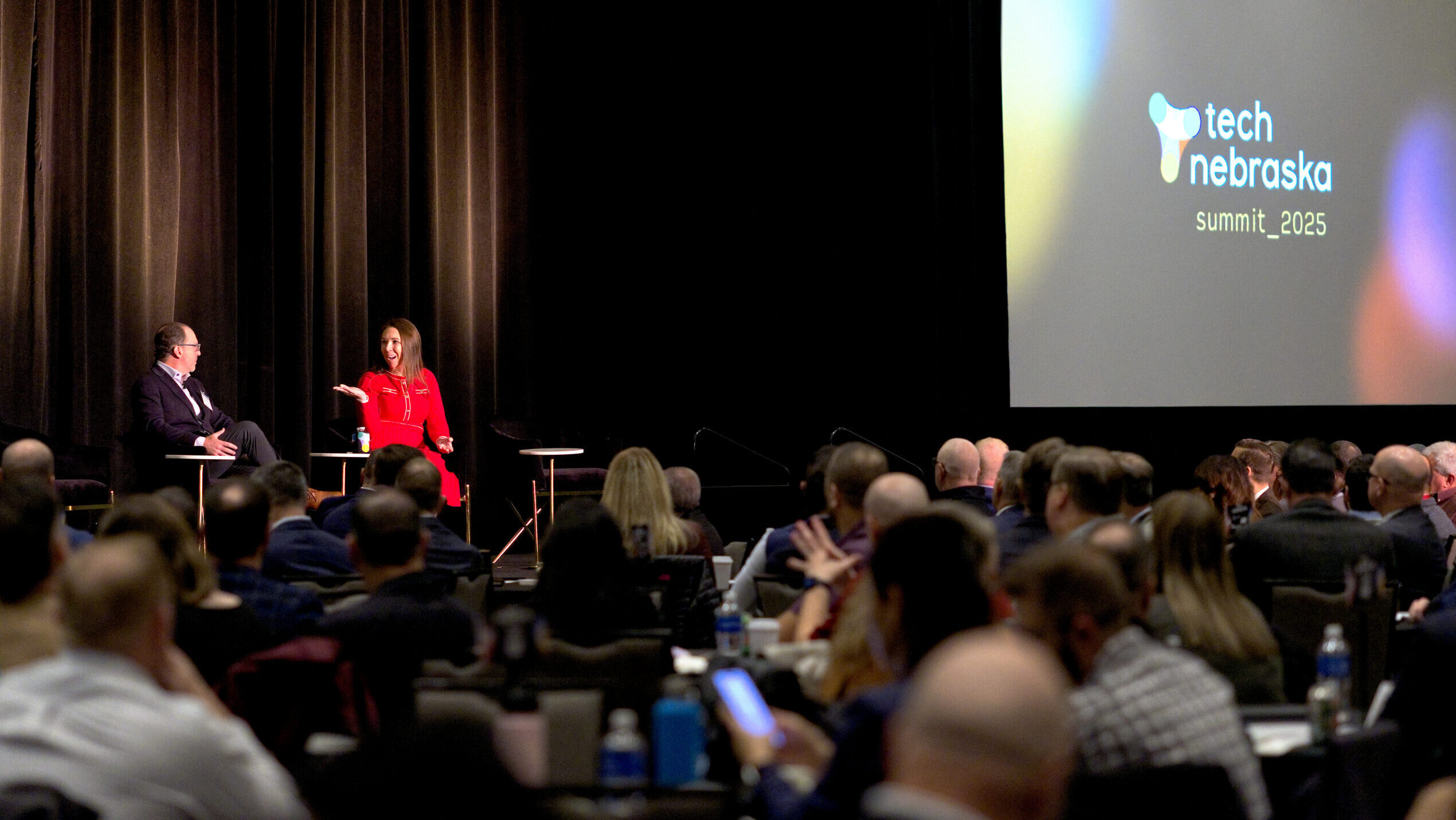
That was just one takeaway from the tech and innovation panel at the Nebraska Chamber of Commerce & Industry’s annual meeting on Jan. 29. Zimmer joined Dan Harbeke, regional head of external affairs and public policy, in a conversation dominated by the hopes and anxieties surrounding AI.
The technology raises many questions about the future of business, infrastructure and workforce needs in Nebraska. At stake are “Nebraska’s policy, principles and priorities,” said panel moderator Emily Allen, executive director of Tech Nebraska. “We want to be economically competitive. We want to have a pro-growth mindset.”
As the Nebraska Legislature considers several bills to regulate AI, Zimmer and Harbeke stressed that state policy needs to be thoughtful and flexible. That would benefit both big tech companies and local startups, who often work together to make Nebraska innovation happen.
“One might provide tools and capabilities to grow the other side — (and) the other might be looking for exits eventually,” Zimmer said. “Corporations frequently innovate by sponsoring a startup or eventually acquiring a startup, and so I see a lot of interconnection between the two, and that’s why you have to nurture both sides.”
For Harbeke, legislators’ lack of use and familiarity with AI is an added challenge. It’s important to be conscious of where “we draw the line between regulation and, say, outright fear of something that is an emerging technology,” he said.
Workforce leadership
One of the top anxieties around AI is about how it will make many jobs obsolete, putting people out of work and letting businesses get by with a smaller headcount. But for Harbeke, AI signals more of an evolution for workers.
The technology is very infrastructure intensive, needing data centers — which have high energy, water and land use — and workers who know how to implement and test AI tools. That means a stronger, rather than a weaker, demand for the tech and tech-supporting workforce.
As an example, Harbeke pointed to Google’s partnership with the electrical training ALLIANCE to train 100,000 new electricians and 30,000 new apprentices. “We know the infrastructure that’s coming,” he said.
“We need that (energy) workforce, and that’s not unique to our industry,” Harbeke said. “How do we develop a specialized workforce, not just for those of us who are already in the workforce, but obviously for those coming up, and what are those jobs tomorrow going to be?”
That’s a concern Zimmer hears from the students he mentors at the University of Nebraska-Lincoln. “For the last two years, for the first time ever for some of these young technologists, I’m getting questions like, ‘Hey, Brian, did I pick the right profession?’” he said. “Is there going to be a future? Is it going to get automated away?”
Zimmer also attributed those worries to the difficult job market, where new graduates are struggling to get hired. He cautioned that technology is still a viable career path. But companies need to spend more time reinforcing the early career pipeline.
“We have to help people, one, see the path,” Zimmer said. “And two … we need to, as leaders, kind of lean in and push past that and say, ‘Yeah, junior-level talent is important. We have to create the space for it. We need to embrace that. Otherwise, our pipelines might dry up, or they might go elsewhere.’”
To build that tech workforce in Nebraska, both Harbeke and Zimmer emphasized that Nebraska needs to have tech jobs, be it through startups or larger companies. And whether businesses want to be in Nebraska depends on how friendly the state is.
That means welcoming tech policy but also having resources like the Business Innovation Act, which has been an essential program for growing startups and supporting corporate innovation in Nebraska. The BIA has had a rocky year, with concern that the program may be cut or reduced.
“This is kind of basic economic development — you’re going to go to the place where there’s the least amount of friction and where they actually want to have you,” Harbeke said. “Nebraska is well positioned, but I think we’re at a moment (of), which direction do we want to go?”
State of the NE Chamber
At the NE Chamber annual meeting luncheon, CEO Todd Bingham celebrated the organization’s past year. The chamber has supported research on issues from energy to child care, increased its workforce development efforts and continued to advocate for businesses across Nebraska.
Bingham acknowledged that Nebraska is slipping in its economic development efforts. While the state does well across a variety of rankings, in business surveys, other states like Georgia, Texas and Ohio take top billing for attracting new business.
“They’re focusing on ready-to-go sites, streamlining, permitting, reliable energy infrastructure and workforce alignment … not just incentives or tax breaks,” he said. “We need to compete, we need to be aggressive, and we need to get outside the box.”
That’s all the more important in a time of technological and societal upheaval, Bingham said. Manufacturing, a core Nebraska industry, is taking a hit because of increased tariffs on materials needed for production. Health care is also a top concern, as companies are expecting to pay more to cover employees because of federal policy changes.
“Open the newspaper on any given day and you’ll see technological disruption, demographic shifts, international trade uncertainty and global unrest,” he said. “Fear, uncertainty and doubt —- three things the market doesn’t bear and three things that stifle capital investment and economic growth. Now, more than ever, we must stay focused on the long game.”
Bingham also called to avoid polarization and find a way to work through policy disagreements in a respectful way. “Disagreement isn’t just inevitable in our work, specifically in policy,” he said. “One might argue that it’s necessary.”
“It’s how ideas evolve, it’s how democracy thrives. But when the tone becomes divisive and accusatory, we all lose,” he said. “The next generation is going to inherit whatever culture we build, or whatever culture we allow to deteriorate. That choice is ours to make.”
Afterward, Nebraska Gov. Jim Pillen declared February as Chamber of Commerce Month in Nebraska.
“People of our state are incredible, and we think we’re just normal Joes and Susies … I lived way too much of my life taking things for granted,” Pillen said. “It’s really important that we appreciate each other, who we are and what we believe in.”
Lev Gringauz is a Report for America corps member who writes about corporate innovation and workforce development for Silicon Prairie News.