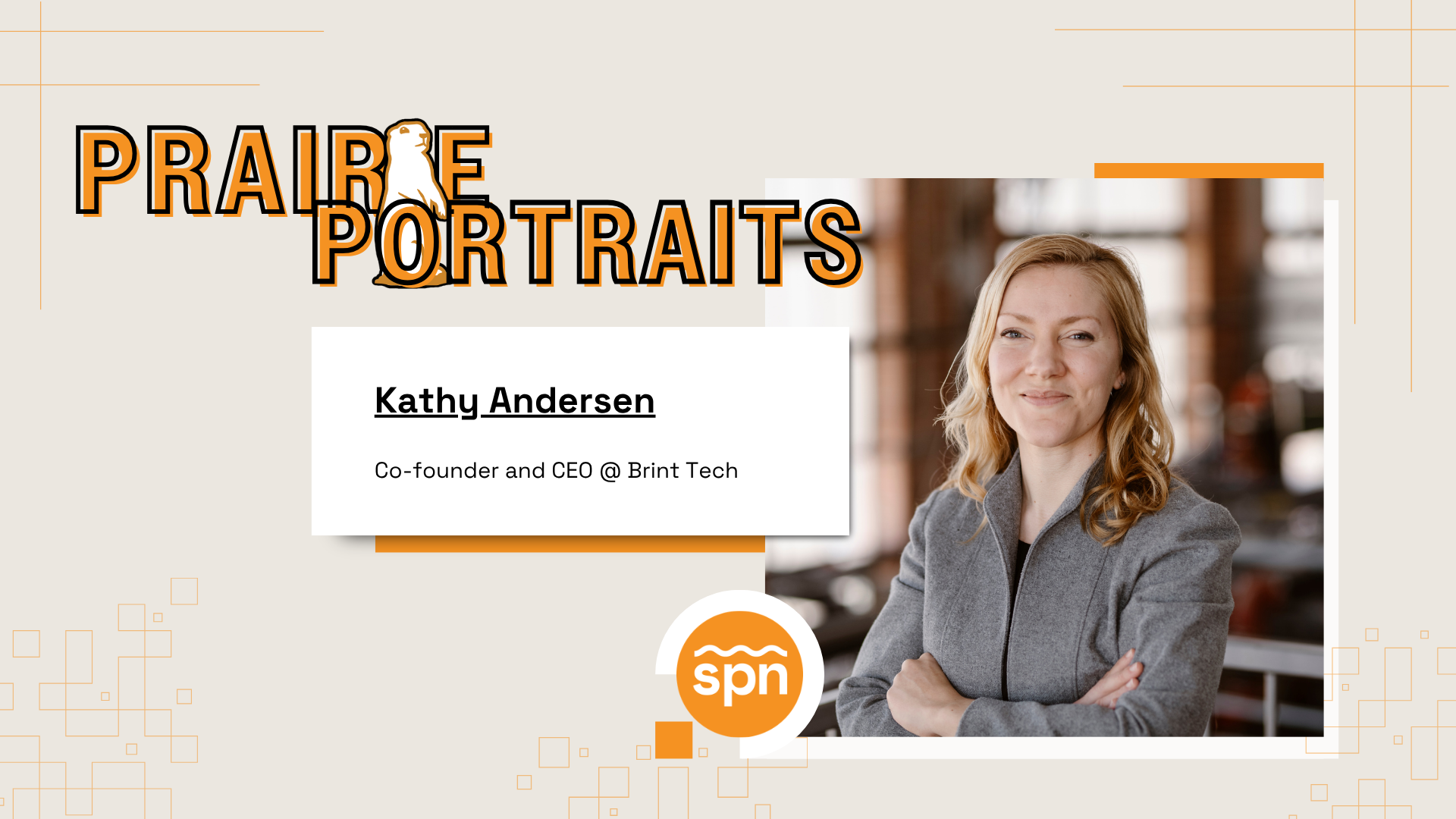
Meet Kathy Andersen, Co-founder and CEO @ Brint Tech
Brint Tech is a startup developing hydrogen emission detection and monitoring technology to prevent leaks and improve industry operations. The company has been accepted into various entrepreneurial programs, including Rose Rock Bridge, Chevron Studio and Innosphere’s Earth and Space Systems Accelerator.
Andersen has taken on roles as leader and mentor in the ecosystem. She previously served as director of Innovation and Entrepreneurship at the Lincoln Partnership for Economic Development.
What inspired you to become an entrepreneur or support other entrepreneurs?
I am inspired by the great challenge of our generation in meeting our energy demands and energy transition goals. The energy transition is a massive undertaking to both diversify and enhance our energy mix to achieve multiple goals: for abundance, for resilience, for security and decentralization, for clean air, for climate stability, for broad and expanded access to energy worldwide.
I knew for many years that I wanted to apply my time and talents to this challenge. I spent time looking for how to harness my combination of skills, background and passion. I seized opportunities for side projects, and I won a position in the Chevron Studio program. That road led me to found Brint Tech with two inventors.
Brint exists to change what’s possible in gas detection and measurement.
We are providing SaaS (software as a service)- and DaaS (data as a service)-based solutions for hydrogen detection and measurement, powered by a unique hardware edge. The core of our company is laser-based trace hydrogen detection engineered for tough industrial environments.
Hydrogen measurement is difficult. The H2 molecule is small, diffusive and prone to leakage. There are commercial hydrogen sensors already available but not offering the capability that we do.
I chose to build in this space because it sits at the intersection of market need, scientific innovation and long-term energy infrastructure. The hydrogen market is at a low point — high costs, low adoption, project cancellations and delays — but we see that as an advantage for our time to build and enter the market.
The 5-10 year looming demands of regulatory scrutiny, capital discipline and operational scaling tees up the moment where rigorous measurement becomes mission critical.
In summary, I found a sweet spot: I have aligned motivation, I have the appetite for taking calculated risks (and) I have the right adaptability and vision to be working in this space and on this technology at this stage and with this team at this point in time for an emerging market need.
We think we can serve (this market) with enough moat to be a compelling business and a leader in trace hydrogen measurement and quantification.
What advice would you give yourself if you could go back in time to when you were just starting out?
I would impart all of my learnings about our business’s ecosystem map. For any business, you need a robust map of partners and investors, comparable companies, industry players and exit pathways. That map develops over time and compounds in value.
My understanding of “proof” also matured. Lab proof is not field proof. Field proof is not bankable proof. Each requires different validation, different documentation and different discipline.
And I would have read “The Hard Thing About Hard Things” (Ben Horowitz 2014) and Peter Drucker books much earlier. Hardtech companies require clear thinking about management, incentives and reality.
How do you stay motivated when things feel overwhelming — or stagnant?
When things feel stagnant, I lean on other entrepreneurs. Being able to text or call up connections who understand the particular grind of building something new is essential for me. Those conversations remind me that the hard patches are normal, not a signal to quit.
Here I will quote Kristin Klaus (co-founder and chief operating officer at Total Analysis), who said in her Prairie Portrait, “Resilience compounds.” I’ve found that to be true, and it helps to remind myself that pushing through the current challenge or slump means that I’m growing and learning.
What is the biggest challenge you’ve overcome and how did you overcome it?
Sequencing technical validation in a way that is both scientifically rigorous and capital efficient.
For any hardtech startup like Brint, a core challenge is often moving from proof of physical principle in the lab to controlled validation under conditions that resemble actual operating environments without prematurely scaling hardware or burning unnecessary capital.
One of my mentors says, “One miracle at a time.” In practice, that means isolating the hardest unknown, designing experiments that generate consequential data and iterating over time.
We focus on the highest-risk assumptions first, we do not claim performance beyond what has been characterized and we remain focused on delivering measurement systems that operators can trust when big decisions, safety, emissions reporting or asset performance are on the line.
How can the Nebraska community support you?
The Nebraska community can support me and Brint Tech in customers and contracts, partnerships and talent. I want to connect with people and organizations who want to know more and plan a project with Brint Tech.
Speaking boldly, in 2026 we’re on the cusp of major developments in the exploration of geologic hydrogen resources. Research from the United States Geological Survey (USGS) estimates that there are 5.6 trillion metric tons of hydrogen underground globally. Even if only 1-2% is accessible, harnessing that resource could satisfy projected global net-zero hydrogen demand for 200 years.
Nebraska’s geology and industrial base position it to participate meaningfully in that opportunity. I want to see Nebraska capitalize on that resource, and Brint Tech’s technology can be a major unlock for the work that needs to be done in exploration and characterization of the resources available.
We want to make a positive impact here in Nebraska, and we welcome partnerships with similarly inspired public or private organizations.