As the CEO of Contemporary Analysis (CAN), the Omaha data science consultancy, Nate Watson has an inside view of the artificial intelligence wave that has swept the tech world over the last few years.
Today, business realities are taking center stage as the hype dies down. While AI is a powerful tool, the technology isn’t a cure-all or an easy replacement for workers.
“A lot of people have it in their heads that AI can replace people, because using AI doesn’t cost anything or costs low money, and that’s just not true at scale,” Watson said. “The cost of (AI for enterprise workflows) is a lot of times more than the people it replaced.”
Alongside the cost factor is a concern about cybersecurity and a worry that AI companies can steal internal data for their own benefit (or jeopardize trade secrets). That led businesses working with CAN to ask about hosting AI models on local private servers.
So a few months ago, CAN Chief Strategy Officer Preston Badeer launched AI Workhorse, a separate startup under the CAN umbrella, that does just that.
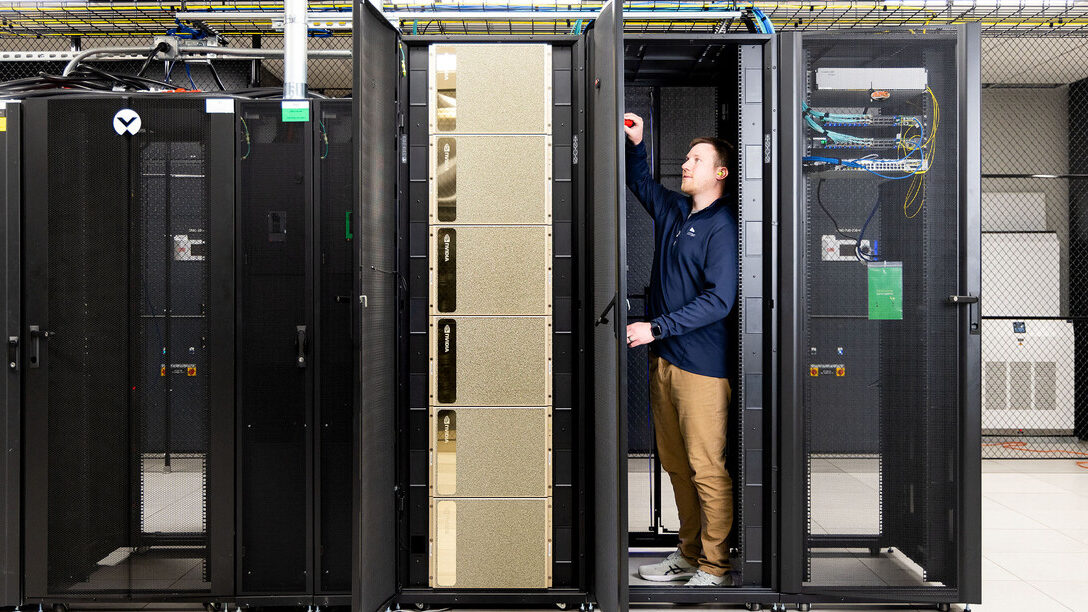
Workhorse assembles the computer servers necessary to run AI models. In partnership with Scott Data Center, the nonprofit Omaha data center, that hardware is then securely made available to local companies.
“That enables us to put custom models on your workhorse,” Badeer said. “So if you have specific models that you have built in-house, or we have security professionals that need to run models that normally you wouldn’t be allowed to run on cloud hardware, we can kind of run whatever … We’ll tune the model for the hardware and make sure that it performs well and set you loose.”
Companies can get access to that hardware (often called a node) by working with CAN, or directly from Workhorse. And with specific training methods, cheaper AI models can be optimized to work just as well as the most expensive high-end models.
“I can walk into (Scott Data), point to a piece of hardware, and say ‘My model lives right there, and right there only,’” Watson said. “Nobody is getting your data.”
A community play for AI
For CAN, Workhorse is the beginning of a local AI infrastructure build-out in Omaha and Nebraska.
Companies can use Workhorse as a secure platform for experimentation, or, as is increasingly the case, a place to implement workflows after experimenting.
“We see the mature side more often, just because it takes some experience to understand why it’s a losing game to give all your intellectual property away and to spend unlimited expenses on tokens when you have limited revenue,” Badeer said.
Badeer did not share information about Workhorse’s customers for security reasons. But for the moment, the startup has a handful of clients and is focused on courting enterprise companies.
Workhorse has a flat annual rate of $20,000 per AI node, which Badeer said is more affordable than several top-tier AI models on their own. The nodes are custom built to order, so while Workhorse is sold out for the moment, more are on the way.
As a bonus, for every five nodes that companies buy, Workhorse will donate one AI node to a nonprofit of their choice.
“It’s a crying shame that nobody has found a way to use AI meaningfully for social good yet,” Badeer said. “I wanted a model that would enable us to provide services to nonprofits that they didn’t previously have.”
While many nonprofits don’t have much of an IT department, access to a free AI node can open up a world of possibilities.
For the cost of just one software developer, Badeer sees AI helping nonprofits to streamline services and create better products to help people. He also hopes that will create more jobs at nonprofits.
The donated AI nodes come with free training and support from Workhorse and CAN, which also operates the Omaha Data Science Academy. ODSA has several data science and AI certificates, as well as funding available, to help nonprofit employees learn about AI.
For Watson, the CAN connection is an important way to add value to Workhorse for any organization in search of a secure AI node.
CAN is “filled with data scientists and AI engineers who build enterprise level applications for a living, (who can help) you take the application you have built that is sitting on your laptop and (put) it into the data center,” he said.