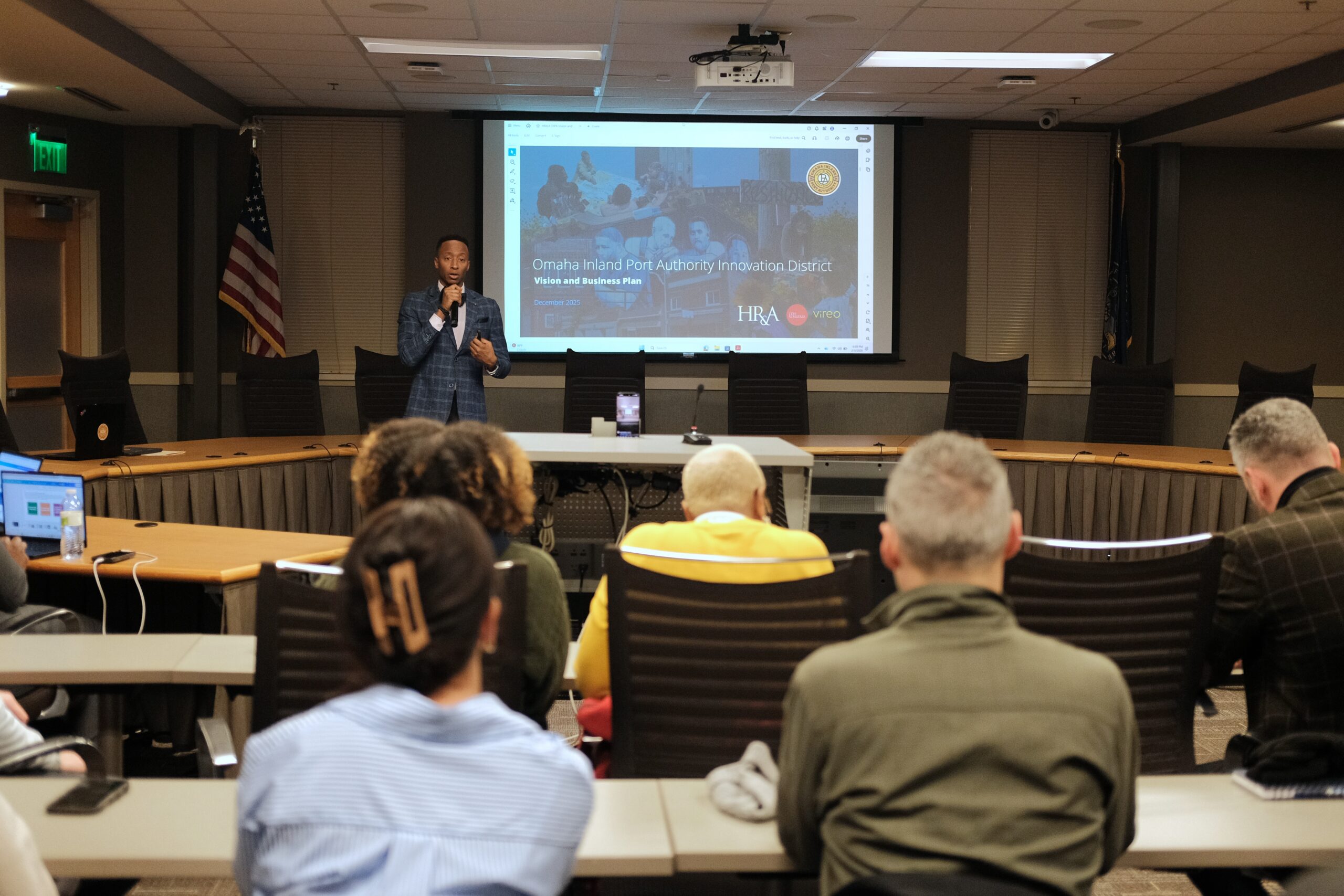
The Omaha Inland Port Authority (OIPA) has unveiled some details of its vision and business plan for an innovation district to support entrepreneurs and community development in North Omaha.
OIPA sees the district as being based in the area around 16th and Ames, with a roughly 100,000- to 150,000-square-foot innovation building offering office space and support programs for businesses.
As part of the district, OIPA would build housing — mandated by state law — and support programs such as rent assistance. In the next few months, the agency also hopes to be rolling out a support fund for entrepreneurs as “low-hanging fruit” until the district is more developed.
“It’ll repeat over and over again in this presentation: (The plan is for) wealth building, anti-displacement and innovation,” said OIPA Executive Director Garry Clark at a Feb. 3 community meeting about the district plan.
“When you’re trying to measure what we’re doing — if these three things are not seminal in that focus, that’s when you can ask us to have a sit-down and talk about if we’re following the plan,” Clark said.
OIPA is the economic development agency created by Nebraska state law to revitalize North Omaha. Its team developed the district plan together with consultant group HR&A Advisors. The plan and its recommendations build on events held last year where residents talked about their hopes and wants for the district.
While the public presentation included some details of the plan, Clark said OIPA is holding off on sharing all of it. “There is more to the presentation that is more internal, and that happens every time, because there is the business side … that we can push out once we know more numbers and details.”
On Feb. 5, the OIPA board voted to approve the overall plan and to acquire two properties for the district. But it tabled a vote on the overall boundaries of the innovation district until its March 5 meeting. That move may set back the timeline for due diligence and construction of the district’s main building and housing.
“What’s the best impact for the community here — is it in that Ames area? Is it the 20th Street, 24th Street area? Is it down closer to the Locust Street area?” Clark said. “Those are questions that the board has to answer for us.”
Present and future in North O
The innovation district presentation included a dire analysis of housing and commercial trends in North Omaha. Roughly 60% of homes were built before 1960, compared to 30% in the rest of the city.
Since 2013, the area has also seen a decline of about 1,000 Black households, while the number of white households increased by 2,000. Most new homes in North Omaha are too expensive for the median household, and over half of renters are “cost-burdened,” or spending more than 30% of their income on rent.
Meanwhile, only 3% of the city’s retail space is in North Omaha. Vacancy rates for office and retail space are lower, and rents are higher, in North Omaha than in the rest of the metro.
But there is some good news. “Arts, entertainment and recreation make up about 800 jobs in North Omaha and is one of the fastest-growing industries in North Omaha (30% increase since 2015) and the MSA (20% increase),” the OIPA presentation said.
That’s why the OIPA team wants the innovation district to focus on creative and media businesses, as well as new housing manufacturing. “We’re looking for companies that will want to come and be a part of a whole campus where we’re cultivating these innovative manufacturing companies to do housing differently,” said Jen McKeone, OIPA’s deputy economic development director.
It’s also why the innovation district plan emphasizes OIPA’s role in housing policy. The agency aims to support homeownership assistance programs, like gap financing for closing on homes. It will also pursue shared ownership models for real estate and housing like community investment and land trusts.
“When we have the powers based on statutory items and administrative capacity, we will lead,” said Myah Lanoux-Nguyen, OIPA’s chief of staff. “In other areas, we will partner. And then in a lot of situations, we will advocate for people who are … already doing this work.”
Funding and sustainability for both OIPA and entrepreneurs
OIPA has $30 million allocated to it by the state for the innovation district, though Clark said that won’t be enough to sustain the project. The agency is looking at other potential funding sources — all of which have their own challenges.
Earned income from programming, events and rent would mean higher costs for community members, going against the goal of affordable access. Infrastructure-related funding from potential vacancy, parking and sales taxes would likely be unpopular, and not contribute much given the current real estate situation in North Omaha.
Philanthropy and corporate sponsorship, meanwhile, is likely necessary but fickle as giving priorities change, while government dollars are not a reliable long-term support. But as OIPA figures out how to be sustainable, some North Omaha entrepreneurs have become frustrated waiting for promised help.
“What my trouble is, is that these funds were allocated over two years ago,” said Dorothy Johnson, a North Omaha business owner. “I feel like there’s this great gap that already exists with getting programming and funding to our founders. So how would you address the gap on what our entrepreneurs need, right now in real time?”
For Clark, that’s yet another financial challenge. He said OIPA was supposed to receive another $11 million in interest money from the state, part of which would go to an entrepreneur impact fund for grants and business loans.
But OIPA received only $2.3 million and is “in the process of trying to help the state find the rest of that money and give it to us as required by law,” Clark said.
“I would say by the March meeting, our desire is to get approval on rolling out at least that $1.5 million (entrepreneur impact) fund,” he said. “Now remember, we’re taking it from something that’s not as large as we expected, but we realized that there is, as you mentioned, a desire to see some action.”
OIPA also plans to have a temporary physical location for the innovation district, which Clark hopes to announce soon. “We have some partners that have come out and said, ‘Hey, we can provide educational services here. We’d like to do this now,’” he said.
Lev Gringauz is a Report for America corps member who writes about corporate innovation and workforce development for Silicon Prairie News.