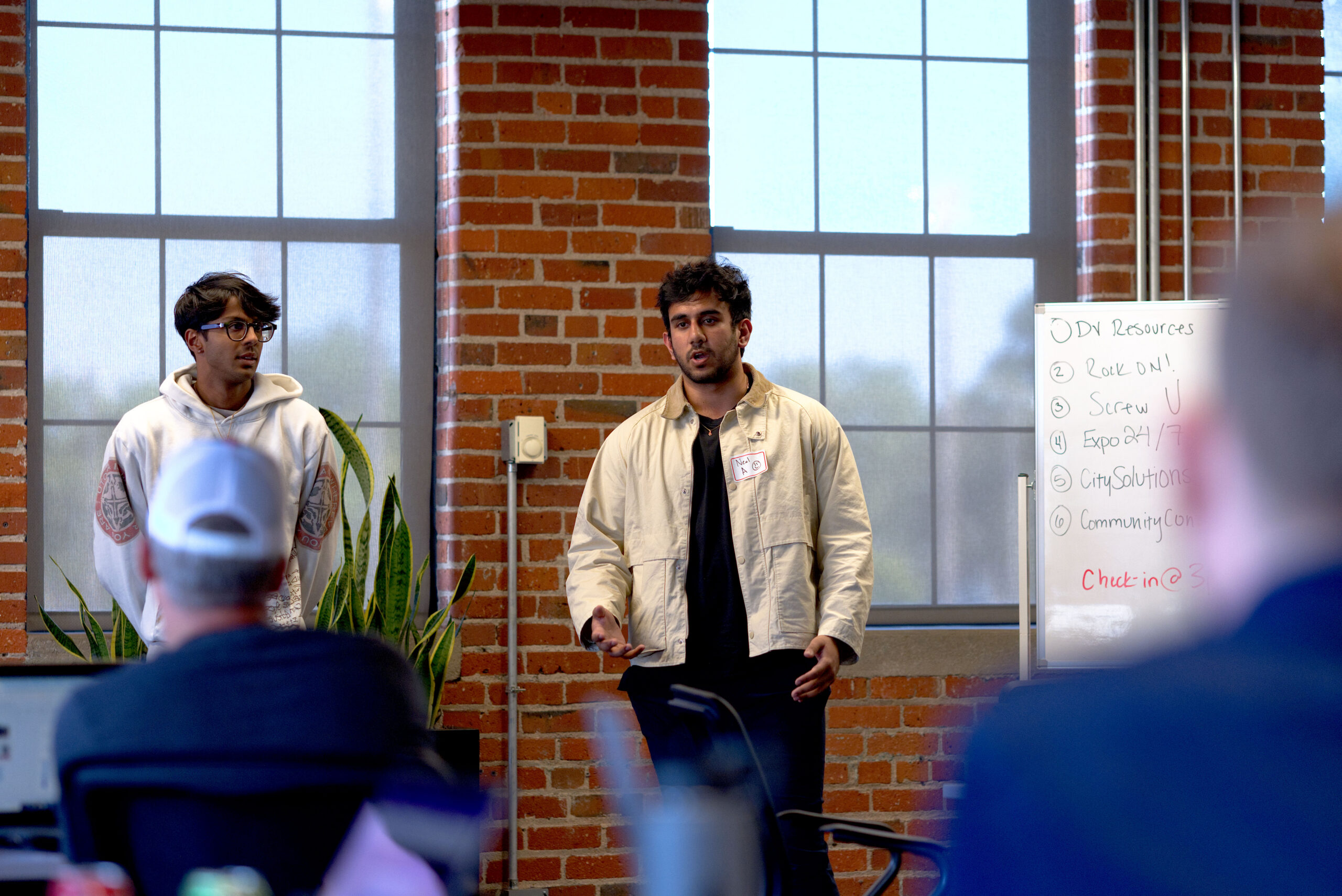
In November 2025, Neal Agarwal and Akash Setti set out on the short drive from Omaha to Fort Calhoun to pitch that city’s officials on their new startup: CityVerse AI, a tool that helps track and report maintenance work, including by pulling data from photos using artificial intelligence.
The 23-year-olds were “sweating bullets,” Setti said. It was their first pitch outside of Omaha.
As they drove, Agarwal and Setti had their pitch deck pulled up from a personal hotspot and worried about how the Fort Calhoun staff would react. “We’re like, ‘Oh, my God,’” Agarwal recalled. “What do we say?”
Months later, the pitch worked. After a pilot with the city, Fort Calhoun has signed on with a two-year contract for CityVerse AI — part of a cohort of Nebraska cities that include York, Omaha and Hickman now working with the startup.
“You never have enough time in the day to complete all the tasks that you have working for a city, and there’s always more you can do,” said Corban Helmandollar, the maintenance supervisor for Fort Calhoun.
“So the less time you spend documenting and trying to write down and make records for the public, or for the City Council, the more time you have to actually do the work, and with a small team, you need all the time you can get,” he said.
For co-founders and co-CEOs Agarwal and Setti, CityVerse AI is the latest in a winding startup path, influenced in large part by the 10-Hour Challenge x Jumpstart Challenge, a hackathon-style event held as part of Silicon Prairie Startup Week in the fall.
“We basically went to every single day of programming,” Agarwal said. “We were in this completely different mind space of how to actually build a startup … thinking about (attacking) the problem first and product market fit.”
Feedback and iteration
Agarwal and Setti grew up together in Omaha, both attending Millard North High School. Now, they are graduate students at Northwestern and Northeastern Universities, respectively.
Early last year, as Agarwal was working as a Wall Street trader and Setti was a software engineer at Texas Instruments, the two decided to start their own venture. The initial idea: A networking platform for basketball players and coaches.
“We did the classic mistake of first building a product,” Agarwal said. “Didn’t know product market fit, didn’t reach out to anyone. Kind of just started to develop this app … then we applied to NMotion.”
They were rejected from the Nebraska startup accelerator’s cohort. But Scott Henderson, the NMotion managing principal, gave some essential feedback. It can be hard to build a two-way market, he said, like a basketball networking app that requires getting both players and coaches involved.
So Setti and Agarwal started thinking about a new idea targeted to one market. They chose gyms, inspired by Setti’s experience at Northwestern with overcrowding on campus.
The two built a system for detecting foot traffic in gyms so owners could tell what equipment was getting more use. But that, too, didn’t go very far. So Setti and Agarwal took another pivot, thinking about how to help parks and recreation in cities.
Then came the 10-Hour Challenge x Jumpstart Challenge. One of the industry prompts was from consulting firm Olsson, which asked for “bold ideas that help make AI approachable, implementable, safe, secure and valuable for cities across the state and beyond.”
The co-founders pitched using their anonymous foot traffic analytics platform to help city staff have better data about how parks were being used, and as a result, how to invest in maintenance.
They didn’t win the challenge. But it sparked the effort that became CityVerse AI, even while the two were being warned that building technology for local governments is too difficult for startups. They consulted with City of Omaha staff and kept iterating.
“Neal and I actually gravitated towards things that (startup advisers) told us not to do because it was just ultimately challenging,” Setti said. “On top of that, we identified that there was a need when we were speaking with these parks people, and based on our technological background … We believed we had something here.”
CityVerse AI
As Agarwal and Setti talked with the City of Omaha, they realized there was a different need to address. When it comes to maintenance, city workers can be pulled between different projects, and then have to spend time writing reports — often on paper — while recalling details at the end of a busy day.
So they built CityVerse AI to be a better, faster record-keeping system. And with AI tools based on Google Gemini, Agarwal and Setti eventually hope to cut out the need for workers to record data at all.
“What we’re trying to do is, you take a picture (that generates a field report) and it goes to your final database,” Agarwal said. “That whole part in the middle of manual input is what we’re trying to get rid of.”
But maintenance workers still have to check and approve all reports. “AI will never have the expertise of an inspector,” Agarwal said. “We’re not trying to replace their jobs.”
In Fort Calhoun, Helmandollar, the maintenance supervisor, said that on a given day, he might be pulled into checking water, street and sewage issues. All are important, but in the rush, some details can get lost, especially with just two other maintenance workers.
With the CityVerse AI platform, though, Helmandollar now has one digital location for all maintenance reports. As a result, he can more easily track his team’s progress.
“Me being the supervisor, I can send guys out, and then I can look at the data myself and immediately see if there’s an issue going on,” he said. “Plus the AI also looks at it and says, ‘Hey, there’s something weird.’”
Helmandollar said the Fort Calhoun City Council is also happier with more detailed maintenance reports from CityVerse AI. “All of working in government is trying to be as transparent as you can about what you’re doing and how you’re spending the taxpayers’ money, or ratepayers’ money with the water system,” he said.
While CityVerse AI has received a positive response so far, there is plenty of AI hesitancy in the world, including around its risks of making up inaccurate data.
Agarwal and Setti are determined to educate municipalities about AI tools — both about how not to be afraid of AI and to understand that not every part of their platform is about using AI.
“When we do create these solutions for municipalities, the initial solution is to try not to use artificial intelligence in the first place,” Setti said. “If there’s a way that we can automate processes and then go on from there, then we can maybe introduce it, but … we have to be very, very careful.”
For the two co-founders, it is refreshing to see city officials excited about using their platform. And with the “Nebraska nice” culture, CityVerse AI is now getting referrals all across the state thanks to a friendly network of city officials.
“We’re planning on expanding within Nebraska first, as a lot of these different cities have been very open to giving us advice,” Setti said. “Neal and I are not satisfied at all — we know that (CityVerse AI) is something we can take to unbelievable levels.”
Lev Gringauz is a Report for America corps member who writes about corporate innovation and workforce development for Silicon Prairie News.