About a month ago at 1 Million Cups Omaha, the weekly startup community event, a group of military veterans, together with local venture capitalist Scott Henderson, decided to tackle a disconnect between the defense and startup ecosystems in Nebraska.
“I’m an Air Force vet, I was in for 10 years,” said Jorden Gershenson, now the chief technology officer at Aulendur Labs. But when he got involved in the startup world, Gershenson found himself practically alone with a defense-oriented business, despite a critical mass of tech talent at Offutt Air Force Base in Bellevue.
“I’m going, ‘Where are all the defense guys?’” Gershenson said. “The same in (the defense world) … we’re not bringing the startups and the people with the new bright ideas to come check this stuff out.”
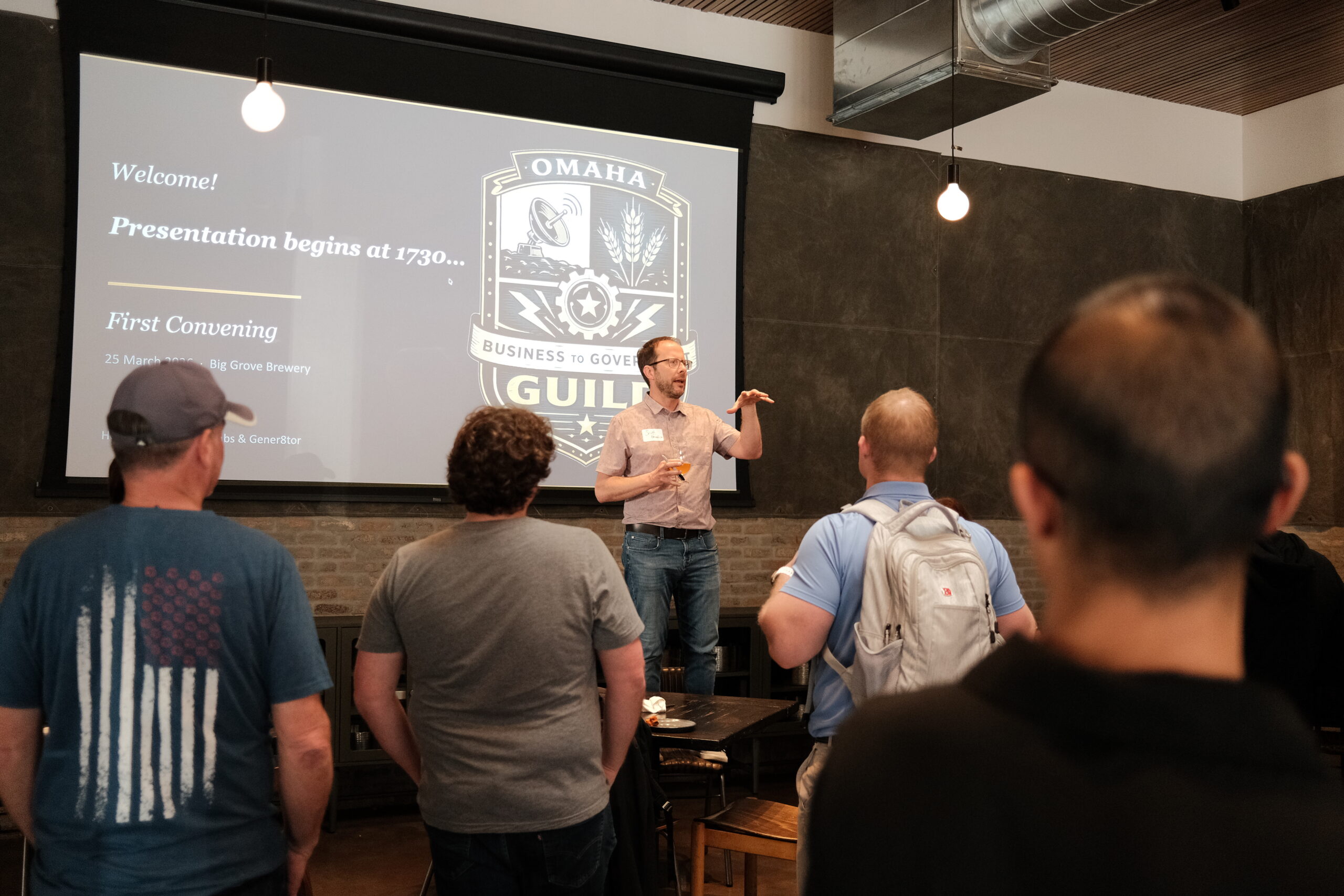
So on March 25 at Big Grove Brewery, Gershenson helped launch the B2G Guild (short for “business to government”) to connect the defense and startup worlds. The event was an experiment to see who would — or if anyone would — show up.
Roughly 40 attendees came, spanning tech, artificial intelligence, startups and defense, including from the Nebraska Defense Research Corporation, a University of Nebraska-affiliated organization helping small businesses work with the military.
“What NDRC can do (is give us) us a facility where we can get into the classified realms relatively easily, there are on ramps to get the clearances, things like that,” said Chris Wong, an Air Force veteran and Nebraska Innovation Fellow working on drones. “That’s how we can win out.”
Barriers
Navigating defense technology and the startup world isn’t easy. Technology built for the military doesn’t always have a direct application to consumers. Aulendur Labs, for example, specializes in using machine learning to predict nuclear fallout.
But to have a consumer product and to get venture capital investment, they pivoted to using machine learning to predict other markets, like energy forecasting. “When I go to talk to VCs and I start talking to them about defense, eyes glaze over,” Gershenson said.
“They look at me like I’m pulling teeth — like that is the worst thing they could ever possibly imagine, even though we’ve got companies making billions doing exactly that, and we’re here at (the United States Strategic Command at Offutt),” he said.
For Wong, an important strategy is bridging defense technology with all the other industries in Nebraska, like finance and agriculture. That’s how he approaches sustainability at his drone startup.
“We can really come together and provide that diversified business that can sustain ourselves through the ebbs and flows of working production,” Wong said.
Building community
But there is also an opportunity to use a startup approach to speed up defense innovation, Gershenson said. He pointed to startups like Palantir Technologies and Anduril Industries, now worth billions of dollars.
“We may have our personal opinions about how they do business,” Gershenson said, alluding to controversies about the companies’ use of technology and ethics. But an important takeaway is their approach to “building product first,” he said, instead of waiting for the long process of government requests for proposals.
“Raise your hand if you’ve ever said, ‘The government customer has no idea what they actually want,’” Gershenson asked the B2G Guild event attendees. Several raised their hands. “We know what they want better than they do, and when they see it, they’re going to buy it.”
But building that technology — and those companies — requires venture capital and other resources from the startup world. The B2G Guild hopes to facilitate that, especially given the clear interest from attendees.
Meetings will now take place the last Tuesday of each month at the Catalyst building in Omaha. “The hope is that this can be a group of like-minded individuals who are in the same community, who are trying to solve problems,” Gershenson said. “Because this world of government work, especially military work, is very weird and complicated, and no one really understands it.”
Lev Gringauz is a Report for America corps member who writes about corporate innovation and workforce development for Silicon Prairie News.