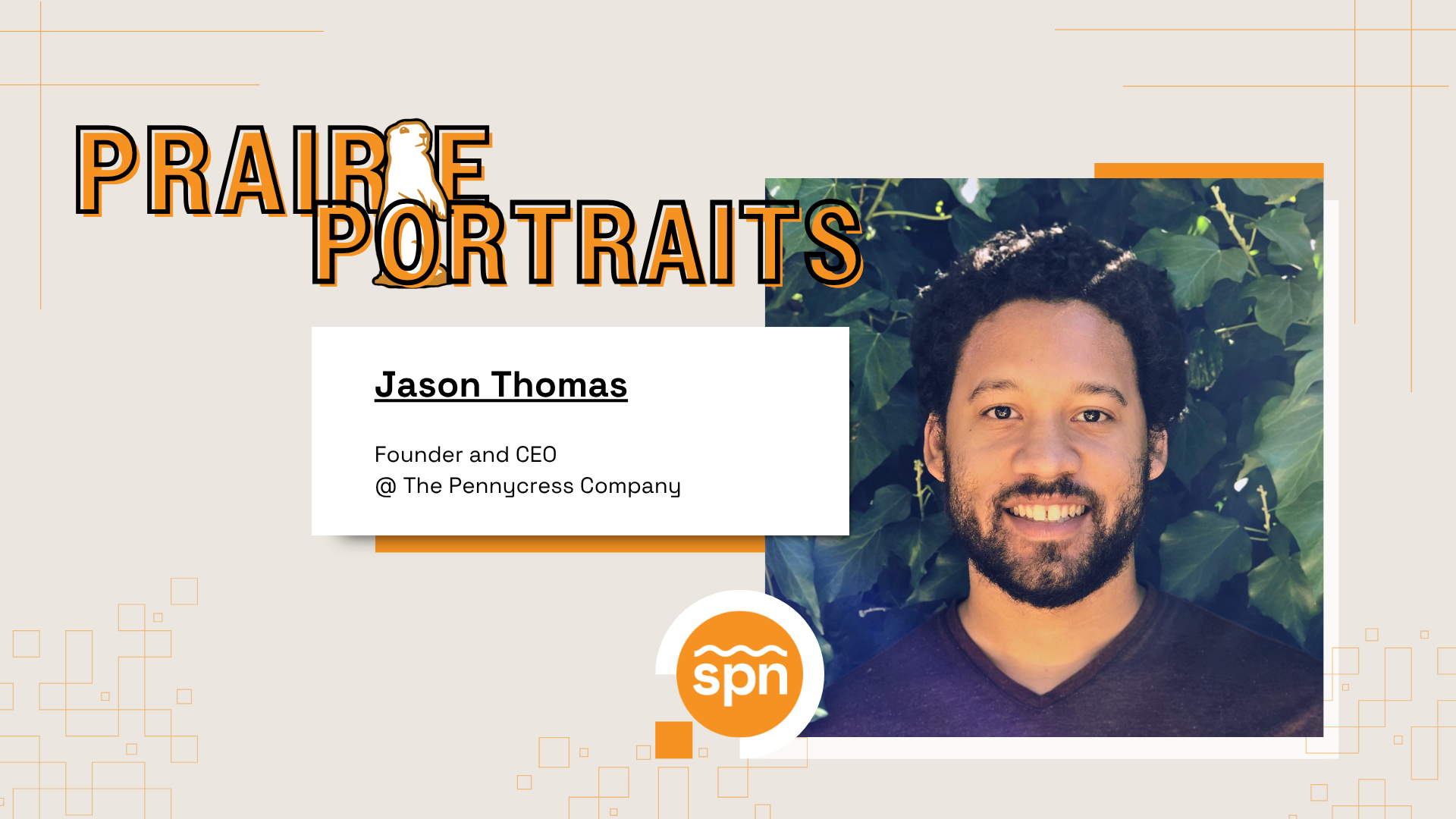
Meet Jason Thomas, Founder and CEO @ The Pennycress Company
The Pennycress Company is a Lincoln-based agricultural bioengineering startup. It uses bioengineered field pennycress to help farmers achieve another income source between cash crop harvests. The startup says the crop can be used to create animal feed and biofuel while improving soil health and the environment.
Thomas earned his doctorate in plant biological sciences at the University of Minnesota. He has taken part in local resources such as NMotion Accelerator Fall 2025 cohort, Nebraska Department of Economic Development and The Combine, as well as other entrepreneurial and startup opportunities across the country and abroad.
Thomas said his company last month harvested 2.5 acres of pennycress out in Mead, Nebraska.
What inspired you to become an entrepreneur or support other entrepreneurs?
I wanted to make an impact on the world. When you’re going into grad school, they ask what you’re doing after that. They always say industry and academia.
Academia certainly makes an impact on students, and it makes an impact on the body of knowledge that people have. But sometimes ideas that are worked on, like say during a Ph.D., just stay in publications around lab shelves. They don’t necessarily go out into the real world.
I really want to make the work that I’ve done, as well as the work that other scientists have done that this is all building upon, go and make a difference, particularly to farmers, the environment and the people who could benefit from using pennycress in whatever end use.
And somewhat embarrassingly, just growing up as a millennial and seeing people like Mark Zuckerberg or Elon Musk starting out, before they were as objectionable. That was maybe part of it, too. Like saying, “Oh, hey, those people made it work. Maybe I could do something similar.”
What advice would you give yourself if you could go back in time to when you were just starting out?
Probably the biggest thing, which you’ll hear in books on entrepreneurship like “The Lean Startup”, is that you don’t want to scale up too fast.
In my Ph.D. and in my post-doc, I had some ambitious projects where I’d be trying to make, say, dozens of varieties of new pennycress plants with different traits at once. Or in my post-doc, I’d be trying to characterize the growth, measure the growth, of hundreds of individual plants at once in an experiment.
But, really, you should start a little bit smaller. Make sure you have everything right and then you can scale up. Fail fast and fail quickly.
Whereas with those experiments that I had previously, they were long experiments. It took a lot of time and effort. If they failed, it would be a setback.
I’d say now the advice is (to) start small. Make sure that with your minimum viable product, or whatever you want to call it, you can build it quickly and test it quickly. Rapidly iterate to make it better.
And you can only do that if you’re working with a small number of plants or whatever.
How do you stay motivated when things feel overwhelming — or stagnant?
To stay motivated, I would say looking at the news, in some cases, really helps. And by that, I mean the issues that we’re facing. With what I’m doing, there’s actually a real chance that it can make some of these things better.
I mean like climate change. Pennycress could contribute a whopping 1% reduction in greenhouse gas emissions — which is really a lot. That’s nearly on the gigaton level.
That being through sequestering carbon in the plant tissues, like the roots and such, but also in terms of displacing the fossil fuels that are generally used for aviation and our diesel engines.
As well as (using pennycress to address) things like the biodiversity collapse and all the other bad things that are related to climate change, like flooding or just severe weather impacts.
The other thing I would say is the farmers, helping them out. Right now with the trade war that we have, the tariffs, that situation, it’s been a rough year for farmers. As we grow pennycress and make it something that can make them additional revenue — like yeah, someone has to do it.
And then the other thing, the end piece, is the aviation fuel aspect. That just being really expensive, (and) fertilizer being really expensive. Pennycress is a low input crop that doesn’t need a lot of fertilizer. With jet fuel, (the goal is) making a cleaner and eventually cheaper form of fuel to lift you, me and hundreds of other people … in the sky and across the country on an airplane.
What is the biggest challenge you’ve overcome and how did you overcome it?
Running the marathon of entrepreneurship. I’ve stuck with it for three years, and I’m seeing progress. I’ve always been patient, and I’ve always been a pretty resilient person. I’ve actually also run like two half marathons, the Lincoln ones. Haven’t done a full one yet, but I guess, the two halves equal a whole.
But yeah, not giving up. Also, support from family, friends, mentors (and) the community is very important.
How can the Nebraska community support you?
Stakeholder support for pennycress throughout the state of Nebraska and just people championing it, cheering it on and making it work in this state would be excellent, especially contacts to the biofuel or the aviation industry that is in Nebraska, or different farm groups.
I’ve found that the entrepreneurial ecosystem here has been great, like with 1 Million Cups, with NMotion, with things like Open Range. Also, the universities have been great to work with: UNO, Nebraska Wesleyan and UNL, of course. As well as just people out in the community.
I just want to say that support means a lot, and I really hope to give back to Nebraska and the community. Connections to people who would want to work on this kind of project full time would be great.