

Marcia Shade intimately knows how pain can degrade someone’s quality of life.
Her grandmother lived in a small Oklahoma town about an hour from the Texas Panhandle. There was a regional hospital, but few, if any, specialists for elder care.
Struggling with pain, Shade’s grandmother was given a variety of medications that drove her to delirium.
“She had a stage three to four pressure ulcer on her (tailbone),” Shade said. “She had a massive urinary tract infection. She was confused … (hospital staff) thought she had dementia.”
More medications were prescribed, and soon after Shade’s grandmother had a stroke. Her independence was gone and she spent the rest of her life in a nursing home.
“Sad part of it is, a week after her 99th birthday, they were transferring her into the shower chair and broke her arm,” Shade said. “And she (was in) pain. And then she passed away.”
That experience drove Shade to get her Ph.D. and study pain during a National Institutes of Health post-doctoral fellowship. And now, while balancing life as a professor at the University of Nebraska Medical Center, Shade is also the founder and CEO of Voice-It, a startup trying to improve how patients communicate their pain to medical professionals.
She is part of a new crop of academic entrepreneurs spinning out of the NU System and trying to bridge academia and commercialization for the public benefit.
“I’m a nurse at heart — I may not be actively practicing anymore, but I still need to make sure what I’m doing is impacting the people,” Shade said, “going beyond publishing in a journal … or presenting at conferences.”
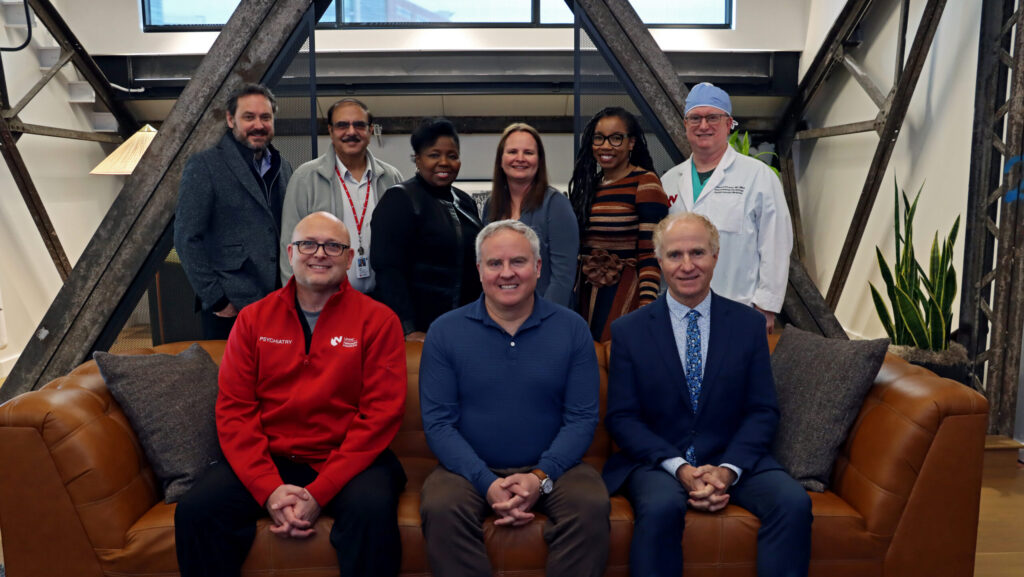
Shade is supported by UNeMed and UNeTech, UNMC’s tech transfer and startup incubator organizations. She also participated in the pilot cohort of the Steel Works Health Accelerator, the new public-private effort to boost the medtech ecosystem in Nebraska.
Ideating a product in academia
Voice-It’s core product is PAINChat, an app that uses AI voice-to-text models to record and summarize patients’ pain for clinicians. What sounds like a straightforward app has been anything but for Shade.
She initially had the idea around 2016. The medical world was experimenting with a variety of apps to track patient pain. Shade wanted to try creating one herself, but was told by her Ph.D. program to focus on graduating instead of side projects.
During her NIH fellowship, she did small studies with adults 65 and older to see how they used pain tracking apps. Features in the app were either too complicated, unintuitive or unhelpful for patients to use.
“What I didn’t realize: I was doing customer discovery,” Shade said. Patients told her that “‘as far as the apps go, this is too much.’ Well, what would make it easier for you? ‘If I could just talk to it.’ I’m like, ‘Oh.’”
Shade took a class about human-computer accessibility and asked her professor about creating a secure transcribing system for pain.
The professor said “it takes a lot of time. You need a lot of data and it’s crazy expensive,” Shade recalled. “And I was like, ‘Oh, great. I don’t have any of that.’”
Starting as a professor at UNMC, she felt like staff didn’t understand her vision, so Shade put the project on the backburner. But she kept trying to make Voice-It a reality.
Eventually, Shade reached out to Deepak Khazanchi, a professor of information science and technology at the University of Nebraska at Omaha. Khazanchi runs The Attic, which trains students in software development to help the university and partner organizations.
With AI tools like ChatGPT emerging, it felt like there was the right technology to make a cost-effective solution for Shade.
“They built me a basic chatbot for cheap,” she said. “And it worked. Was it great? No, it was not great. But it was done and it was functional. And then I got even more excited.”
The road to entrepreneurship
With a rough chatbot, Shade’s vision started to feel real. She applied for a variety of grants and got into a NIH startup accelerator in 2023.
Learning the language of entrepreneurship was exhilarating and intense.
As part of the NIH accelerator, participants role-played a situation where “the board voted us off as CEO, and we had to write our own job description for them to hire someone else,” Shade said.
At the end of the accelerator, Shade won a pitch competition and received a $60,000 NIH award. So far, Voice-It is supported only through non-dilutive funding like grants, including from organizations like the American Society of Pain Management Nursing. Shade is also expecting a federal SBIR grant through the NIH.
But eventually, she will take on venture capital funding and hopes to exit the startup while moving into a supporting role.
First, though, Shade has to successfully prototype and deploy a ready-for-market version of Voice-It. That means fine-tuning AI models to accurately and securely summarize all the context of patients’ pain.
Shade wants to leave the classic 1-10 pain scale in the dust. She recalled trying to explain her pain after an accident to an insurance representative, and the difference between a number (in this case, a seven) and her actual experience.
“Ask me about the fact that I can’t sit at my computer desk and type for more than 15 minutes at a time before it starts bothering me really really badly,” Shade said. “When I want to wash my hair, it really hurts to turn my neck. That’s what people need to understand about pain to understand how to actually treat it.”
But Shade is explicit that Voice-It will not be designed to offer AI suggestions about treatment. She doesn’t want to replace clinicians and medical expertise. She just wants to give them a faster way to understand pain in the short time clinicians have with patients.
Shade knows she still has a long way to go. Commercializing Voice-It also means navigating the complex world of healthcare tech systems and sales cycles.
Connecting the app to the electronic health records (EHR) system at UNMC is a different process, for example, than working with EHRs at rural hospitals.
Shade credits the new Steel Works Health Accelerator for helping her think through those nuances of commercialization. She knows they will be key to her success.
The accelerator “is helpful for anyone that has an idea … and they’re in academia and they have no clue about business,” Shade said. “I’m a nurse. I’m a clinician. I am an academic. And that’s my expertise. I feel like now that I’ve been through Steel Works, I have just enough knowledge to be dangerous.”

Leave a Reply