
As entrepreneurs face uncertainty because of the defunding of state grant programs and worries over global tariffs, Nebraska state leaders and organizations continue to voice strong support for small businesses.
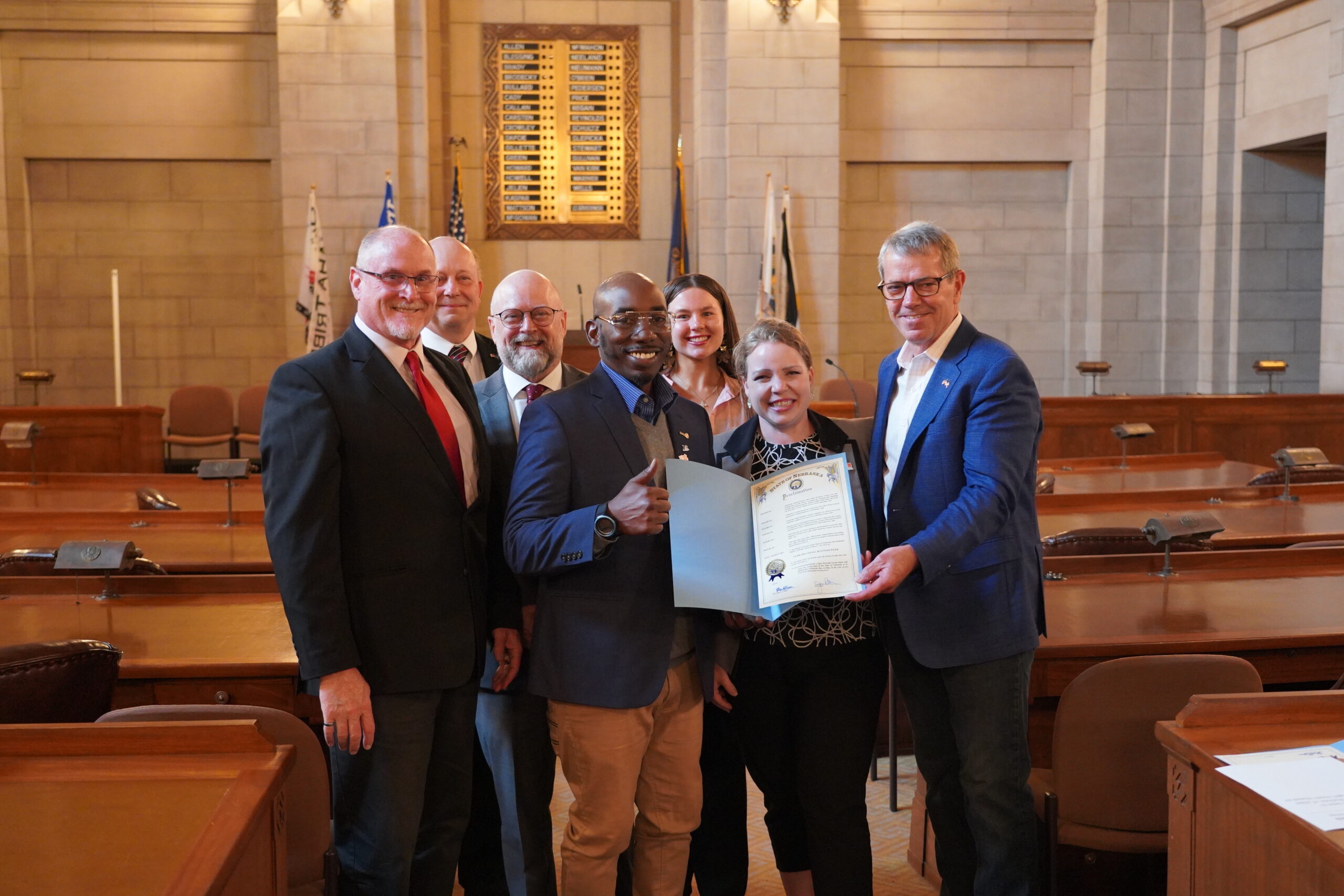
Earlier this month, Nebraska Gov. Jim Pillen issued a proclamation for Nebraska Small Business Week 2025 in conjunction with National Small Business Week. The May 20 event at the Capitol was an opportunity to highlight small businesses’ contributions to their communities and the work of the business development ecosystem in Nebraska.
“Small business, family farms, family businesses are the salt of the earth of what makes Nebraska special,” Pillen said.
Tim Mittan, director of the Nebraska District of the U.S. Small Business Administration said 99% of all businesses in Nebraska are technically small businesses and employ about half of all employees in the state. Mittan said family businesses keep money in communities, provide needed employment to residents and attract and grow otherwise small populations.
“I was in education for many years, and one of the things that I heard from students who lived in small towns was that they wanted to get their education and go back to their small town,” Mittan said. “But there has to be the opportunity for them to do that.”
During the proclamation ceremony, Pillen said customers should think about how local business owners are affected when people shop someplace “10 cents cheaper.” He spoke of the importance of advocating for local ventures, such as the stores on a small town’s Main Street.
“All due respect, we got enough Dollar Generals,” Pillen said. “Our small businesses are who make it happen. But if we don’t support them, they can’t stay in business.”
Balancing state grants with state budget limitations
Scott Asmus, director of SourceLink Nebraska through the Nebraska Business Development Center, said the reason entrepreneurs reach out to SourceLink Nebraska and NBDC is a need for capital. NBDC initiatives offer business planning assistance and direct people to available resources. Asmus said state-funded grants that support small businesses are a unique opportunity for aspiring entrepreneurs in Nebraska.
As lawmakers finalize the Nebraska state budget, Nebraska startup ecosystem members have raised concerns regarding potential cuts to state-funded grant programs. In January, Pillen proposed a $5 million cut to the Business Innovation Act. The act provides funding for programs such as the Prototype Grant and Small Business Innovation Research/Small Business Tech Transfer (SBIR/STTR) Matching Grants.
Another such initiative, the Nebraska Small Business Assistance Act, is currently scheduled to be defunded, according to LB264 of the Nebraska Legislature and GROW Nebraska. The measure awarded grants of up to $25,000 to entrepreneurs who want to start a business and up to $12,500 to qualified small businesses that operated for less than five years. According to GROW Nebraska, the organization has distributed 453 awards of grants and professional services through the act as of May 16.
“We’ve changed a lot of lives with that funding,” said GROW Nebraska Founder and CEO Janell Anderson Ehrke. “We tried to focus on all the same regions as the governor has on his One Nebraska [initiative], and we’ve hit all regions.”
While saddened about having to lose the program, Ehrke said she understood the governor’s mission.
In an announcement discussing the initial passing of the budget package, Pillen said the goals of the fund reallocation were to balance the state’s budget, reduce government spending and lower property taxes. Pillen said he understood the help that the grant programs provided, but he also supported lawmakers’ moves to cut the budget.
“A grant can be helpful, but if that’s what defines success or failure in business, [you] probably shouldn’t go for it,” Pillen said.
According to the Nebraska Department of Economic Development, small businesses can still tap into the Business Innovation Act as well as such resources as the State Trade Expansion Program and funding opportunities through the State Small Business Credit Initiative.
Mitten mentioned additional funding sources in Nebraska, such as the Nebraska Enterprise Fund, the Center for Rural Affairs and Community Development Resources. He said community banks have shown great interest in supporting local entrepreneurs as they likely know each other and have a similar desire to see their communities grow and thrive.
UNeMed President and CEO Michael Dixon, Ph.D., said policymakers need to focus on the development of jobs in high-growth sectors, such as tech and health, in order to attract and retain talent in Nebraska. He said startups are one way to accomplish that, so reducing or eliminating state-funded grant initiatives hurts Nebraska’s competitiveness in building and bringing these companies to the state.
“[Cutting programs] sends a message to entrepreneurs that maybe we’re not as friendly for entrepreneurs and that other states are more able to get them started,” Dixon said. “A lot of things don’t get started without a little bit of support.”
Tariffs and other global considerations
Pillen said he believes the tariffs implemented by President Donald Trump would be “short-lived.”
“The beauty of small business is that we don’t have to worry about all that outside stuff,” the governor said. “We can control our own destiny here.”
Dixon countered that that’s not always the case. He said that while smaller operations, such as restaurants, might be able to focus their operations locally, he said companies wanting to scale or build innovative technology need to look outside the state and seek out national and international markets for success.
“If you’re not looking at those other markets, you’re really missing out on an opportunity to be able to commercialize or develop that product,” Dixon said.
Ehrke, with GROW Nebraska, said entrepreneurs in small towns are able to extend their reach beyond the state’s borders through such online avenues as e-commerce and digital marketing. She said online reviews have brought impactful traffic to small businesses.
Entering his new role, Nebraska Chamber of Commerce and Industry President Todd Bingham said one of his priorities is to bring a sense of certainty to Nebraska businesses that may have “pushed pause” on development projects because they don’t know how global trade policies will impact them.
It’s difficult for businesses to plan when policies are constantly shifting. On Wednesday the U.S. Court of International Trade blocked Trump from imposing tariffs under an emergency powers law. However, as of publication, the Court of Appeals for the Federal Circuit ruled that the president can temporarily continue collecting the tariffs while he appeals the trade court’s decision.
Bingham said Nebraska businesses today are international and connected to global supply chains, citing such examples as the automation equipment needed for the innovation of Nebraska factories coming from China and Europe or the products sold by regional businesses coming from Canada and Mexico.
“While it is a very laudable goal of the president to help reshore manufacturing and jobs here, the short-term impact is that we’ve got a little bit of uncertainty,” Bingham said. “And companies’ capital is very fickle.”
Taking the leap to entrepreneurship
Asmus, with NBDC, said while every entrepreneur’s path is different, Nebraska offers a strong, collaborative ecosystem to assist them.
“If you are a small business and you have questions about anything, or if you think you’re on the right path but you’re not quite sure, do not Google it,” said Mittan, the Nebraska District SBA director. “Ask for help.”
“From my history, there is no bad time to start a small business,” Mittan said. “If you’re prepared and you get the support that you need, you can be a success — as long as you know what you’re getting into.”
Pillen offered his own words of encouragement for prospective entrepreneurs considering starting their own businesses.
“Go for it,” he said. “I’m a veterinarian by education and started a small animal practice from scratch with $10,000 — greatest decision I ever made, and life evolved from one decision to the next.”




One response to “State leaders continue to support small businesses despite budget cuts and tariffs”
Honest question: Where’d Pillen get the $10,000 to start his business?