

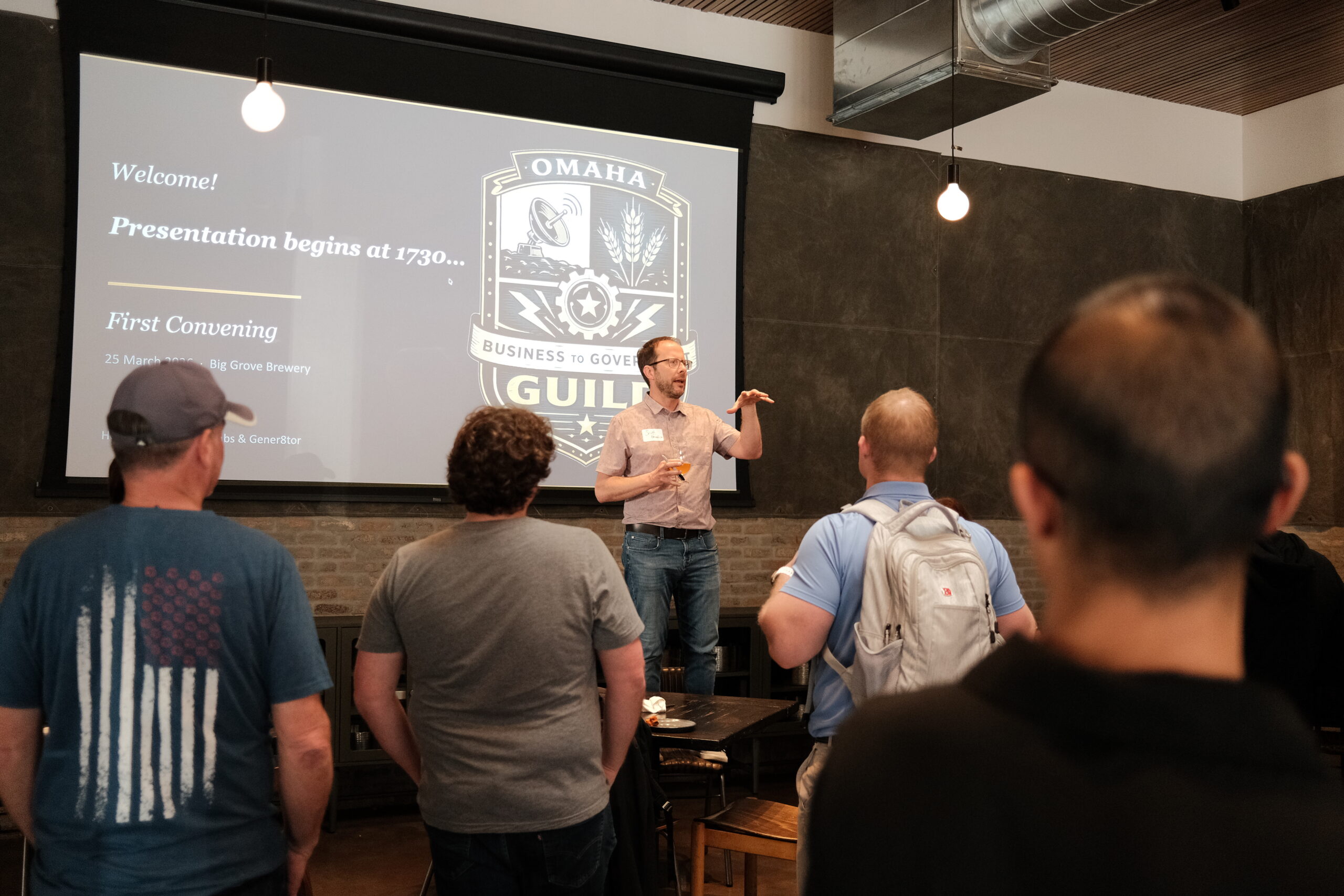
Omaha Inland Port Authority leaders met with business and community representatives in and around its North Omaha borders on Feb. 19 to reintroduce the development agency and hear about business needs.
“Our desire really is to start a regular cadence of engagement with the business community … to make sure that we are retaining existing businesses and finding a way for you all to expand or be supported by our efforts,” said Garry Clark, OIPA executive director.
Clark gave an overview of OIPA’s plans for workforce, innovation and housing development in North Omaha. The boundaries of the agency are about 3,000 acres, with about 984 vacant lots and 377 acres of undeveloped land.
That’s an opportunity for growth and a chance to involve local businesses to develop that land. In the next few months, OIPA plans to solicit proposals for building housing and parts of its innovation district, which will involve a central building with office space for businesses.
“We know you can do the work, and we want to give everyone an opportunity to engage us with proposals,” Clark said. While the location of the innovation district building has not yet been announced, Clark said he anticipates doing so after the OIPA board meeting on March 5.
During the Q&A session, business owners expressed their concerns about workforce development in North Omaha. On one hand, there’s a need to upskill residents for better jobs. On the other hand, upskilling programs take time to apply to and complete — leaving residents struggling with low wages in the meantime.
There is also a mismatch between what upskilling programs offer and what employers actually want. “One of the issues that we have encountered is that a lot of people are going through and getting the training and certification for the expected high-paying jobs. What is happening is that they are not getting these jobs,” said Nancy Williams, a longtime food systems executive and now consultant at Block 27 Consulting.
Employers are not willing to take the risk on someone with credentials but little practical experience, Williams said. So there’s room for OIPA to step in with support programs to bridge that gap.
Supporting the workforce in North Omaha is also essential to wider prosperity in the area. “As many small businesses as we can get going, we have the data that within five years, many of them fail because there aren’t enough customers with enough income to cover basic needs and then support the small businesses,” Williams said.
Clark said his team is working on these issues. He said he hopes to partner with organizations like Ignite Nebraska to expand upskilling programs to serve the area.
Another concern is the lack of access to grocery stores in North Omaha. “My organization over the years spent a lot of money trying to figure out how to get a grocery store in North Omaha” with no success, said Michael Maroney, CEO of the Omaha Economic Development Corporation.
Clark said OIPA and local partners will have to get creative. There are non-traditional grocery stores operating across the country, and that could be a model for North Omaha. “If I had a magic wand,” Clark said, the innovation district building would include some kind of grocery store, though there is no guarantee of that happening.
There are many problems to solve in North Omaha, which has seen decades of proposals for community development that haven’t come to fruition. But Bridget Hadley, the economic development manager for the City of Omaha, sees the potential for OIPA’s efforts to succeed.
“This, to me, is the biggest opportunity, and maybe the only opportunity of this magnitude for things to change for North Omaha,” Hadley told the business crowd. “So I’m excited.”
Lev Gringauz is a Report for America corps member who writes about corporate innovation and workforce development for Silicon Prairie News.


Leave a Reply