The Nebraska Chamber of Commerce & Industry together with the Nebraska Chamber Foundation hosted a tech and workforce-centered event in Omaha on May 20. The “Tech, Talent & Transformation” event featured business leaders, educational institutions and startups, with state legislators and the governor attending.
The event was held as part of the “Go Big Future” series examining Nebraska’s economic challenges and opportunities. Speakers and panelists tackled workforce in the age of artificial intelligence, microcredentialing and the state’s startup ecosystem needs.
Here are the top five takeaways:
Change takes time and commitment
As Nebraska struggles with a brain drain and jobs stagnation crisis, the Nebraska Chamber invited Ted Abernathy, a longtime North Carolina economic developer, to give lessons from that state’s decades-long transformation.
Today, Abernathy is managing partner of Economic Leadership, an economic development consulting firm watching as North Carolina leads with job and population growth. But when he was born in the 1950s, the state was one of the poorest in the country.
Changing that took a variety of efforts and long-term leadership, such as with the Research Triangle, one of the largest research parks in the world, anchored by tech companies.
“For the first 10 years (of the Triangle), there were two or three times where they had to borrow money from private-sector people to pay their staff,” Abernathy said. “The first international firm and biotech firm happened 15 years after the idea of the park … Remember that (Nebraska is) going to have to have leadership to keep this going. Focus on your leadership.”
Build a trustworthy, believable plan
Like many economic developers, when Abernathy worked directly on North Carolina’s growth in the early 2000s he focused on research about industry clusters. That can show what kinds of industries are concentrated in a particular area and that stand out compared to other locations.
The idea is to choose one or a few of those unique industries and invest in them. Instead, North Carolina tried to make smart predictions about the future of workforce and industry needs.
As a result, leaders took a big bet on industries that could be huge in the future, like biotech. In organizing the business, nonprofit and educational community around that goal, Abernathy learned some hard truths that Nebraska will also need to keep in mind.
“People and organizations collaborate when it’s in their interest to do so. Period,” he said. “If you don’t understand what the other person’s getting out of it, they’re not collaborating with you. Give up.”
There needs to be trust for any successful collaboration to take place, and trying to rush ahead without that trust won’t work. The same goes for planning economic development.
“If you create a plan that is ridiculous, unsustainable, can’t be resourced, not achievable, you will not get people to stay on board,” Abernathy said. “Do something that’s believable.”
Business leaders need to do a better job talking about AI
Mike Cassling, chairman of the board at Cassling and CQuence Health, regularly hears workers worry about how artificial intelligence might replace them. He told business leaders to take those concerns seriously to maintain an engaged and productive workforce.

“Don’t dismiss it,” Cassling said. “Reframe what technology can do for employees, and to make a difference and improve their efficiency and their outcomes.”
He gave examples from the healthcare world about how AI is proving to be an asset. The technology is improving imaging for radiology and predictive analytics for diseases. It also can reduce paperwork for doctors so they can focus on patients, Cassling said..
“What we’re able to do with AI and technology is not replace radiologists but improve the time to diagnosis, improve their efficiency,” he said. “Empathy, judgment, relationships — you’re not going to get that from a machine. People still matter, and the most valuable workers are those workers that embrace AI.”
To successfully navigate the AI transition, companies need to have a clearer focus on upskilling and continuous education. AI can be a powerful tool but requires an understanding of its failings for employees to use effectively.
“Organizations that thrive embrace … technology and people,” Cassling said. “That’s critical. It’s not about, ‘My job is going away.’ It’s working with (employees) to understand, how do they embrace technology?”
Nebraska is undergoing a workforce revolution
On a “Manufacturing and Microcredentialing” panel, Katie Thurber, the Nebraska labor commissioner, said there’s a renewed momentum and focus on workforce from the federal level down to the states.
Nebraska institutions are already working to take advantage of that. “You’re seeing the microcredentials come up, you’re seeing the university systems and the state college systems look at how they ‘educate for workforce’ and not just ‘how they educate,’ and those are really important conversations to have,” Thurber said.

Part of the challenge as Thurber sees it is that there are many pathways to a career. Someone can get microcredentials, or an apprenticeship, or get a more traditional degree from universities or community colleges.
For any of those paths to be successful, though, business leaders need to clearly tell educators what their needs are, especially when it comes to AI. How institutions measure success also needs to change.
Nebraska educators should think about “are you placed in employment and the occupation the training was provided for?” Thurber said. “And that’s really a different way of looking at it.”
Startups still looking for capital and workforce support
Nebraska has come a long way with enabling funding for startups, especially for early-stage pre-seed and seed companies.
But there’s still a point at which practically every founder needs to look outside the state for series A and later funding to really scale their business, said Rick Knudtson, the CEO and co-founder of Workshop.
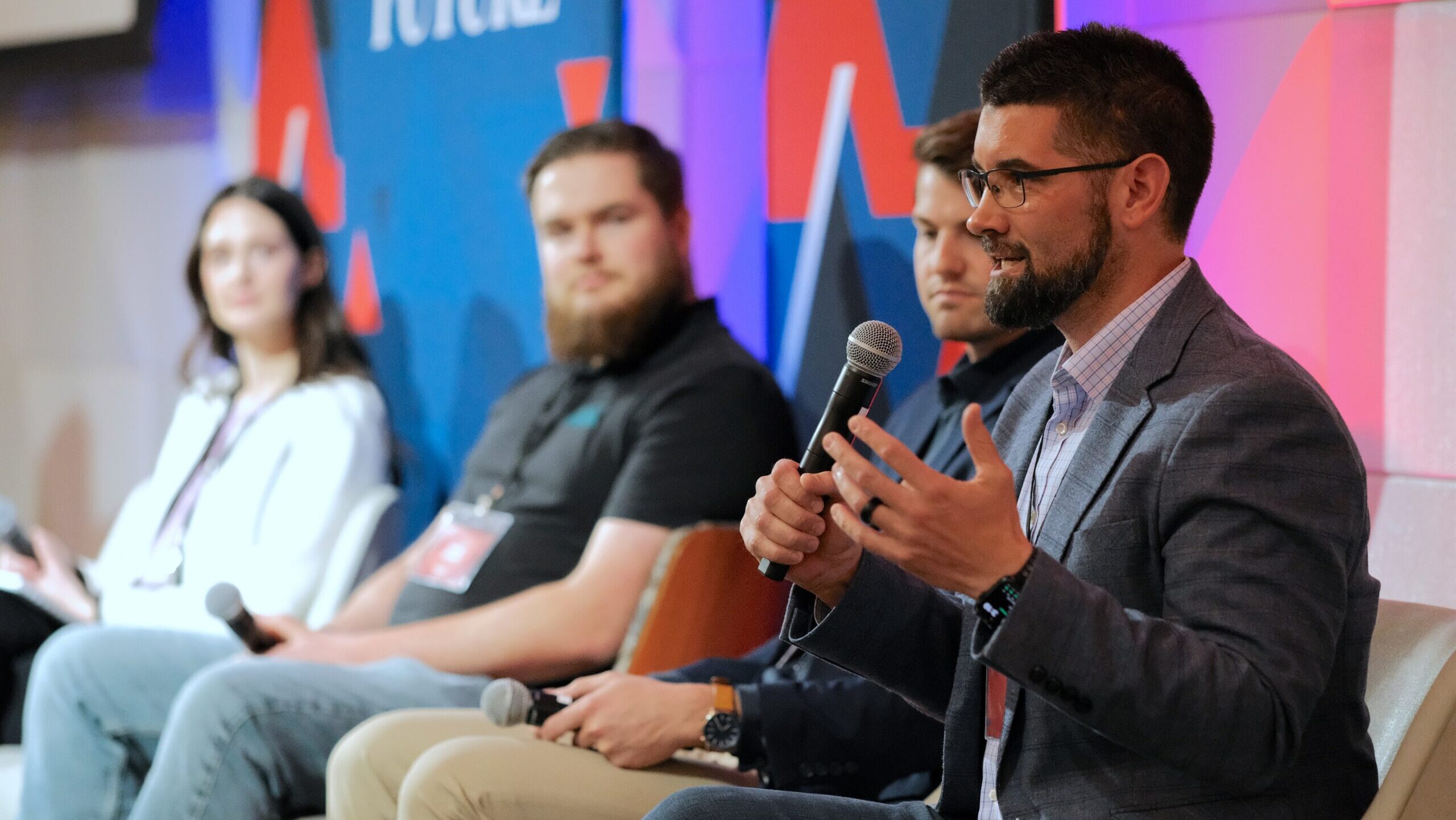
Knudtson spoke on the “Nebraska’s Startup Ecosystem” panel together with Tullen Mabbutt, the CFO of CompanyCam, and Chafik Barbar, the CEO of Marble Technologies. Each said they found great support in Nebraska, often crediting resources such as Invest Nebraska, Nebraska Angels and the Business Innovation Act.
To solve the funding dilemma, Barbar sees an opportunity to bring more family offices and corporate venture capital to the table for startups. But other funding options should also be on the table. “When I think of funding, it could be equity, debt — it can take all kinds of forms,” he said.
But startups don’t just need money. Talent can also be an issue — Nebraska has high- quality tech workers, but often not enough of them or in the specific areas that companies need.
Ben Jackson, the CEO of Guardify, spoke on the “Venture Capital Culture” panel about wanting better support for relocating talent to Nebraska — something he said the state doesn’t provide right now.
“Engineers from Anthropic or OpenAI … there’s like five in the whole state, like that’s crazy. Who are we going to learn from?” Jackson said. “The only thing we’re doing with AI is consuming it and reselling somebody else’s stuff … Why aren’t we bringing them here? Bring everything here so that we can learn from those individuals.”