In 2020, meatpacking plants were hit hard by the COVID-19 pandemic. Workers — many of them refugees and immigrants — were designated as “essential,” keeping them on the processing lines.
There, doing highly manual labor in close quarters, workers contracted the coronavirus. As a result, meatpacking facilities had to run at reduced capacity or shut down, under pressure in an industry that already had a worker shortage before the pandemic. Meat prices skyrocketed as production struggled to keep up with consumer demand.
At the same time, Jordyn Bader and Britany Wondercheck were canvassing the agriculture industry for problems that might be solved with technology. They had previously worked at GrainBridge, an Omaha software startup that worked on financial risk management for farmers.
“It was the relationships that we had in Nebraska that kind of pointed us to, hey, we ought to look at meat processing to see what’s going on there, if technology is at a point that it can automate this industry,” Bader said.
Bader and Wondercheck toured meatpacking plants during the pandemic in an intensive round of customer discovery that would come to define their work.
“Every facility we went into, we just asked the question, ‘If you could automate anything in your plant, what would it be?’” Wondercheck said. “We kept being pushed back to the packaging department.”
Packaging, known as “pack-off,” is the last stage of meatpacking in which vacuum-sealed cuts of meat are sorted, boxed and readied for shipping. With a clear direction, Bader and Wondercheck got in touch with Chafik Barbar, a GrainBridge co-founder, to get the band back together for a new startup.
Six years later, Lincoln-based Marble Technologies has raised $30 million in a Series A round — mostly from Nebraska investors — and is a profitable company selling automated pack-off lines. Used in meatpacking plants in Omaha, central California and Kansas, Marble now sorts 3% of the U.S. beef production every day.
That success has been painstakingly built at the intersection of robotics, artificial intelligence and customer trust.
“One thing we often talk about is being a problems-based company,” said Bader, who today is Marble’s director of industry partnerships. “Sometimes, companies will start and build (themselves) around a solution or a product and then go try and find a market to serve. I think we’ve really taken the opposite approach.”
Relentless customer focus
Given Marble’s inspiration from pandemic-era worker shortages, one way that the startup pitches its technology is to reduce meatpacking labor.
But “labor efficiency (is) just one component,” said Barbar, Marble’s CEO. “Believe it or not, if you walk in with these solutions and it is just purely on a labor reduction conversation, the numbers don’t make sense. This technology is not cheap.”
Each one of Marble’s automated pack-off lines costs around $1 million and includes software license and service fees.
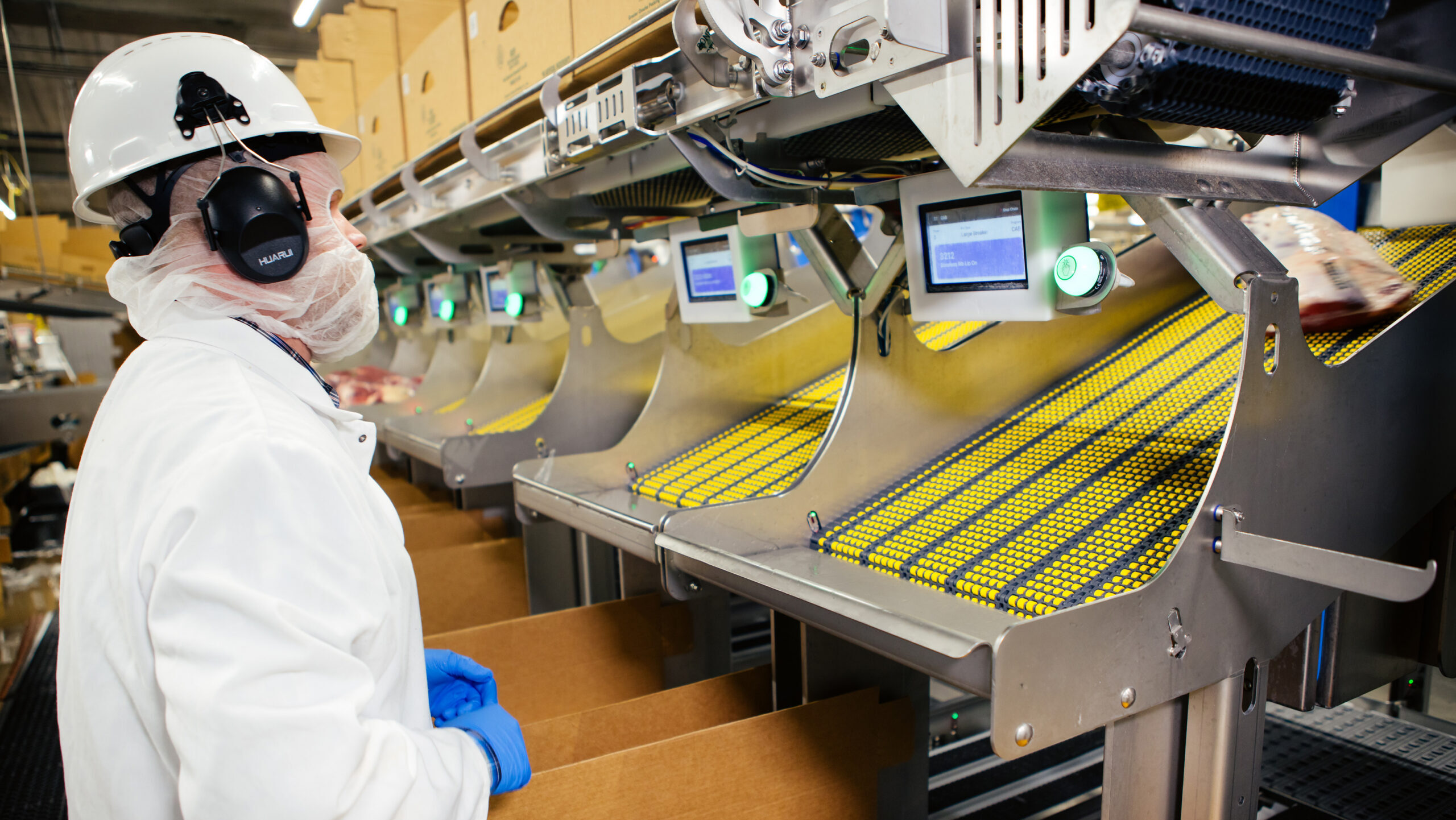
For that price, meatpackers get a system that improves food safety — cameras can check that meat is properly vacuum-sealed, for example. It also quickly and accurately sorts cuts of meat so clients and consumers get what they pay for.
At its heart, these systems have three parts: The physical sorting lines with multiple cameras, on-site computer servers (almost like a small data center) and the custom AI models analyzing and operating the sorting lines from those servers.
Building these systems and convincing meatpackers to use them took a deliberate approach. Marble’s leaders felt they couldn’t shop around a rough prototype. Instead, the startup had to build toward a fully functional commercial product — with customer feedback at every step of the development process.
Without that feedback, “you might wake up a million dollars later and realize that you maybe missed (the mark on product-market fit) … and that is just a massive risk,” Barbar said.
Before building anything, Marble designed 3D renders of their automated pack-off line and relentlessly asked meatpackers about them.
“We would literally go from one facility to the next, and we would walk them through all the details, and we would say, ‘Does this work,’” Barbar said. “We crowdsourced the solution in so many ways.”
Marble also worked to de-risk and prove its technology. The startup convinced some meatpacking facilities to let it install cameras. Photo by photo, Marble built datasets and AI models for identifying cuts of meat at different orientations on the pack-off line, organizing meats by breed, season and region.
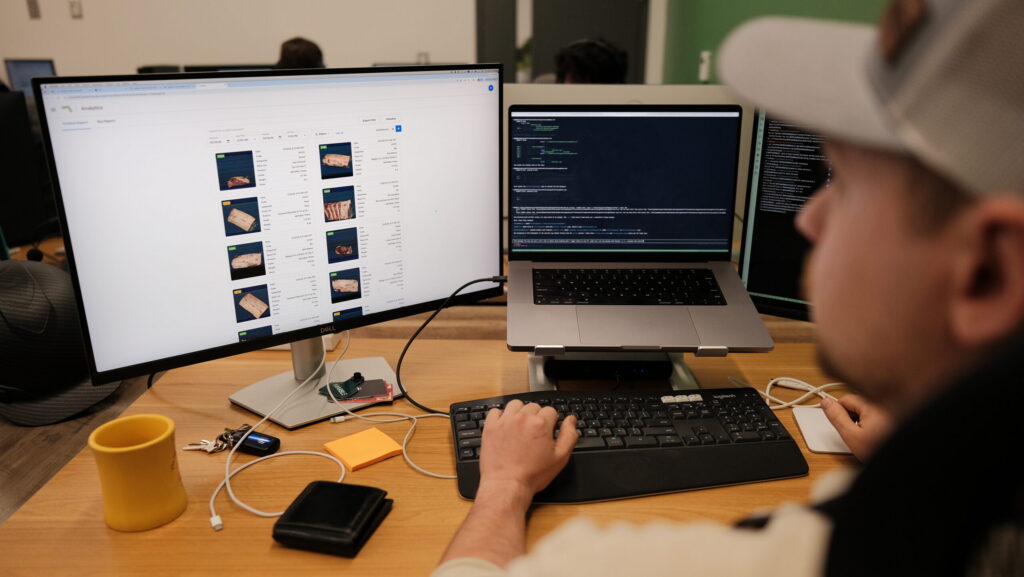
“There’s just not enough data out there to identify a brisket within 99.9% accuracy,” Barbar said. “We had to build these data sets from nothing … I think the current model is trained on 30+ million images that we’ve collected.”
In 2022, Marble built a pilot system in its space on the Nebraska Innovation Campus. Meatpackers could see the system in action, and their comments about it were overwhelmingly positive. The next year, the pilot was installed on a real pack-off line, and another year after that, the pilot was switched out for Marble’s full commercial pack-off line.
That success, leading to a profit-making year in 2025, is “almost unreal,” Barbar said. “The fun part is actually seeing it in your customer’s eyes, like, ‘Oh my God, it works.’”
For Bader, there’s a great sense of pride in having created “something out of nothing,” she said. “Just back to the team, how many long nights, long days it took, and people involved to do it.”
Creating the future of meatpacking in Nebraska
When Marble was founded, Barbar worked out of an office in Massachusetts. But the team quickly realized they had to commit to being in Nebraska, in the heart of the beef industry. The company attributes its success to that decision.
Marble relocated and joined a wave of agtech companies coming out of The Combine, the startup incubator and accelerator. Once here, it was easier to work with and learn from potential customers.
And while some companies feel that finding local tech talent is difficult, Marble has had few of those problems thanks to the University of Nebraska-Lincoln. Most of Marble’s staff are NU System graduates, Barbar said. If Marble didn’t have a job opening for a promising hire, they created one — a uniquely startup-y way of doing business.
“You can’t do that at a corporation,” said Wondercheck, Marble’s director of operations and HR. “No one could come and be like, ‘I found this awesome person (but) we don’t have a job.’ Everyone would shut it down from a budget perspective.”
Much of the 40-odd staff (most of whom are in Lincoln, with some at a satellite office in Massachusetts) are electrical, mechanical and machine learning engineers. Together, they’re shaping the future of meatpacking automation — something for which Marble has ambitious plans.
Right now, Marble’s pack-off lines are designed to fit into meatpacking facilities that were designed for humans. “Sometimes, people will think it’s the AI or machine learning that’s hard,” Bader said. “What’s actually hard is, how do you get industrial advanced automation systems to fit in these legacy facilities? Because space is not something that they have a lot of.”
But Marble is also thinking about what meatpacking could look like if built for automation from the ground up. The startup is working on X-ray and CT scanners to analyze meat on the inside. That kind of granular view can guide robotic tools to de-bone and trim meats, as well as do in-depth food safety checks.
Other problems also need solving, like better automation to bring the cardboard boxes used in pack-off to and from the line. Before they’re filled, the cardboard boxes are very light and, when moved too quickly, are liable to fly off their transport and jam up the line.
If boxes aren’t available, Marble’s pack-off systems can’t work. So they’re prototyping with a line that flings empty boxes using custom-made parts.
A fully automated meatpacking plant is a lofty goal. But Marble is confident that by staying true to its customers and its integrated hardware-software approach, the startup can turn its ideas into reality.
It’s a lesson Marble learned early on. Today, “hardware is the sexy thing,” Barbar said.
“Five years ago, it was not … even investors would say, ‘Just do the computer vision piece and let somebody else do the hardware piece,’” he said. “Fast forward to now, I would say any traction and any success we got out there, it is because we do all of it.”